
The Asia Society Switzerland name and emblem are the property of Asia Society and appear here solely to identify the fellowship under which this project is being developed. Their use does not imply endorsement of this site or of any views expressed on it.
Asia Systems Literacy
Asia already shapes Switzerland. We do not always see how.
Research, learning design and digital prototyping on the connections between Asia and Switzerland: business, technology, healthcare, manufacturing, trade, talent, education, arts and culture.
Thank you to everyone who takes the time to fill this out. Whether you are a high school student, a CEO or a chairperson, your time is worth the same to me here, and I am grateful for it.
The finished project
The digital learning prototype, built and published as my Gen A 2026 graduation project with Asia Society Switzerland.
Open the project ↗ Try the quizzes →How much do you already know?
Seven short quizzes, eight questions each, no trick questions. Every answer comes with a fact and the source it rests on.
One step before your result
Your answers feed the research behind this project: what people in Switzerland already know about Asia, and where the gaps sit. Leaving an email address lets me count your responses properly and, if you want it, send you what the research finds.
{{ scoreLine }}
{{ scoreNote }}
Has Switzerland's understanding of Asia kept pace with Asia's growing importance to the country?
The project does not assume the answer is yes or no. It gathers perspectives from companies, educators, students, experts, foundations and public institutions, including views that challenge its starting point.
Asia is not distant from everyday life in Switzerland. It is already in the products people use, the companies they work for and the technologies shaping their future. Most people are given fragments; few are given a way to see how the fragments connect.
Eight audiences, eight questionnaires
Each group is asked different questions, with a different time commitment, so contributing stays proportionate to what someone can offer. Employers are asked where Asia knowledge actually bites: sourcing, market entry, standards, talent, what graduates misunderstand, which capabilities will matter by 2035. Every questionnaire carries explicit consent, and no named quotation is published without approval of the wording.
Company Companies and employers approx. 5 min Open questionnaire
Educator Teachers, schools and universities approx. 5 min Open questionnaire
Student Students and young professionals approx. 3 min Open questionnaire
Expert Asia experts and researchers approx. 5 min Open questionnaire
Creative industries Design, media, film, music, fashion, art approx. 5 min Open questionnaire
Financial services Banking, asset management, insurance approx. 5 min Open questionnaire
Foundation Foundations and funders approx. 5 min Open questionnaire
Public affairs Public affairs and government approx. 5 min Open questionnaire

"The readiness to listen, the ability to think connected, the willingness to allow anything 'different' in."
Bettina Schaller, President of the World Employment Confederation, SVP Global Public Affairs at The Adecco Group, and Advisory Committee Member of Asia Society Switzerland.
Information is not the same as understanding.
Bettina Schaller cautions against assuming younger generations simply know less about Asia. Many encounter it constantly, through YouTube, Instagram and influencers. The challenge is less about access to information than about understanding that stays fragmented and anecdotal.
Her perspective sharpened the project's central question: not whether people know anything about Asia, but whether they can connect what they already encounter into a structured understanding.
What I am buildingA digital learning prototype +
A digital learning prototype
A short interactive experience, fifteen to twenty minutes, that helps learners see how Asia connects to Switzerland, their work and their future. The first lesson, Why Asia Matters to Switzerland, is designed for Swiss upper-secondary students.
Observe
Start with something the learner already holds: a phone, a medicine, an online order.
Understand
Name the system behind the object: the chain, the platform, the standard, the actors.
Connect
Link the system to Switzerland specifically: firms, rules, jobs and consumers.
Reflect
Confront competing perspectives honestly: opportunity and dependency, openness and risk.
Apply
End with a decision, not a summary. The learner takes a position and defends it.
A preview of the design, not a finished product: the interactive build is the next stage of the fellowship.
Where this beganTaipei, January 2018 · Sri Lanka, 2016 +
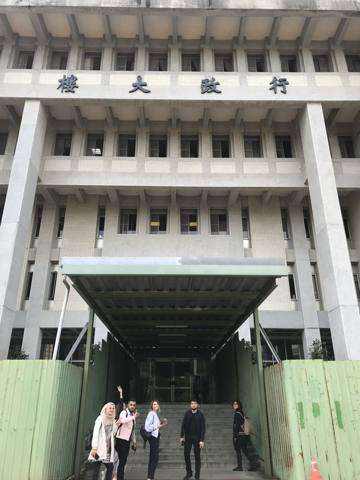
Taipei, January 2018
A student exchange took me to Taipei in January 2018. Between lectures, night markets and the view from Taipei 101, one observation stayed: Asia was not a distant chapter in a textbook, it was everyday life, moving fast. This project continues what that month started.



Sri Lanka, 2016
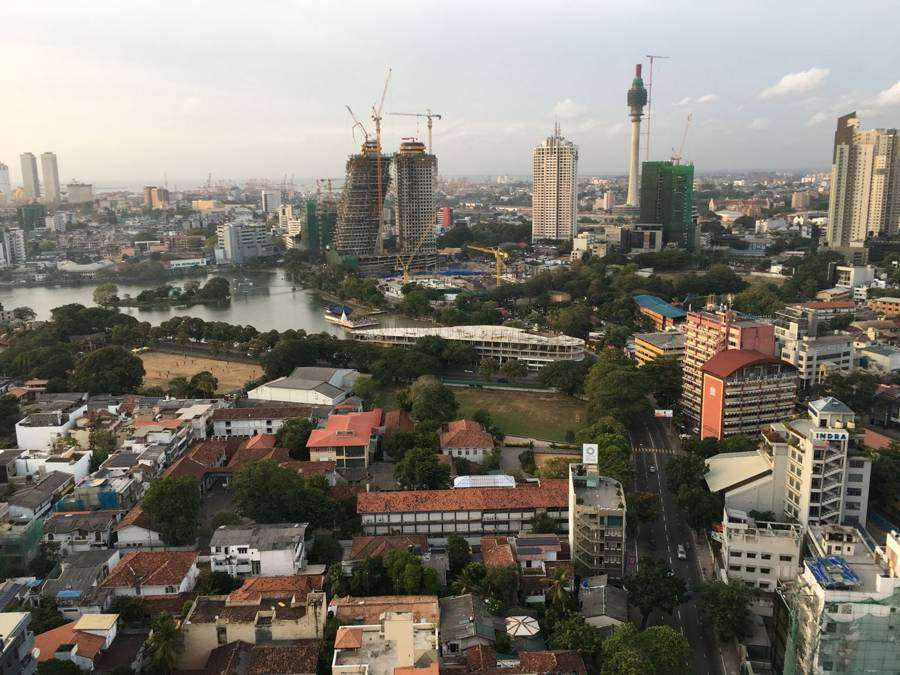
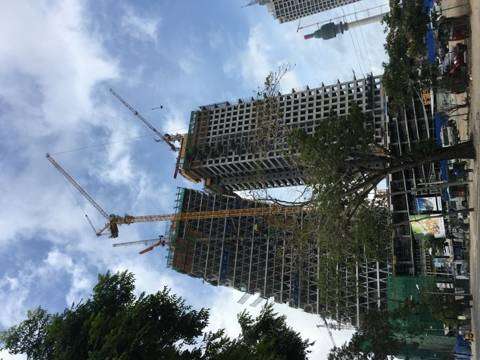
Travels through Sri Lanka showed another side of Asia: cranes over Colombo, a tower rising above the lake, fishing boats a few hours south. Watching the same country boom, stumble and rebuild since then is a lesson in how fast, and how unevenly, the region moves.


What has changed since 2016 Four verifiable markers
Still wrapped in scaffolding in these photographs. At around 350 metres, the tallest structure in South Asia.
Roughly 270 hectares reclaimed from the sea beside the harbour. A special economic zone followed in 2021.
Sri Lanka defaulted on its external debt for the first time in its history. An IMF programme followed in 2023, and inflation fell from around 70 per cent back to single digits.
About two million visitors in 2016, a collapse after 2019, and a recovery to roughly two million again.
Development is not a straight line, which is exactly why understanding it matters.
From the fieldReading the region, and what it means here +
Reading the region, and what it means here
Three recent pieces from Asia Society Switzerland that connect the project to real developments, each read twice: once for the region, once for Switzerland.
China's Falling Birth Rate: A Crisis or a Revolution?
Why are young Chinese choosing not to have children, even now that the state encourages larger families? Drawing on personal conversations, the essay asks whether the falling birth rate is a crisis or a quiet revolution in values.
An aging, shrinking China changes what Swiss companies sell there and to whom: fewer young consumers, growing demand in health and elder care, and shifting supply chains, from Basel's pharma labs to Swiss machine builders.
How Young Chinese See the World
Built on years of conversations with over a million young, urban Chinese listeners, the essay describes how their generation experiences the world: anxiety, a search for agency, and views formed largely through digital channels.
The next generation of Chinese customers, colleagues and business partners thinks differently from the textbook image. Swiss firms that employ, sell to or negotiate with young Chinese benefit from understanding their reality first-hand.
How to Think About Asia in 2026
A set of mental models for understanding Asia's role in the world. The key shift: Asia is moving from being an arena where world politics happens to an actor shaping it.
Rules, standards and initiatives will increasingly be set in Asia rather than merely applied there. Understanding how Asia acts, not just what it is, becomes a practical skill for Swiss business and policy.
Seventy-five years, one free trade agreement and more than thirty running dialogues. The relationship is older and more formalised than most people assume, which is exactly the point: the connections exist whether or not the understanding does.
Switzerland recognised the People's Republic of China on 17 January, among the first Western states to do so. Seventy-five years of relations were marked in 2025.
A trade agreement and a joint economic commission, four decades before the free trade deal, and long before China was anyone's largest market.
Signed in Beijing in 2013, in force on 1 July 2014. Switzerland was among the first continental European countries to conclude one with China.
Technical dialogues run between the two administrations, from intellectual property and finance to human rights, which has had its own channel since 1991.
In June 2025 the Federal Council widened the China strategy into an Asia G20 Strategy 2025 to 2028, adding India, Indonesia, Japan and South Korea.
Sources: Federal Department of Foreign Affairs, bilateral relations Switzerland to China; Fedlex treaty database; the joint declaration on the innovative strategic partnership, 2016.
Also from the field: twelve of my own observations from the Canton Fair promotion event in Zürich.
The research pipelineFrom evidence to prototype +
From evidence to prototype
The objective is to move past diagnosis. Quantitative and qualitative research with learners, educators, institutions and employers feeds the development and testing of something usable.
Map
What is currently taught about Asia in Switzerland, and by whom.
Listen
What students, teachers and employers say they actually need.
Measure
What learners already know, value and want to learn.
Prototype
What an improved Asia-learning experience could look like.
Test
What works with real learners, and what does not.
Translate
How validated concepts could move into existing digital learning environments.
Bringing research closer to practiceResearch that knows what it costs to build +
Research that knows what it costs to build
Alongside the fellowship, I am Executive Advisor to the Founder of evulpo, a Swiss digital learning platform. That separate role gives me a working view of the Swiss EdTech ecosystem and of how an educational idea becomes something a learner will actually finish.
I am exploring how findings from the research could inform practical learning concepts, while keeping the research and the prototype independent and evidence-led.
Executive Advisor to the Founder, evulpo
A distinct advisory engagement on partnerships, positioning and growth in Swiss digital learning.
See the full record →Inside the fellowshipThe room where the questions get harder +
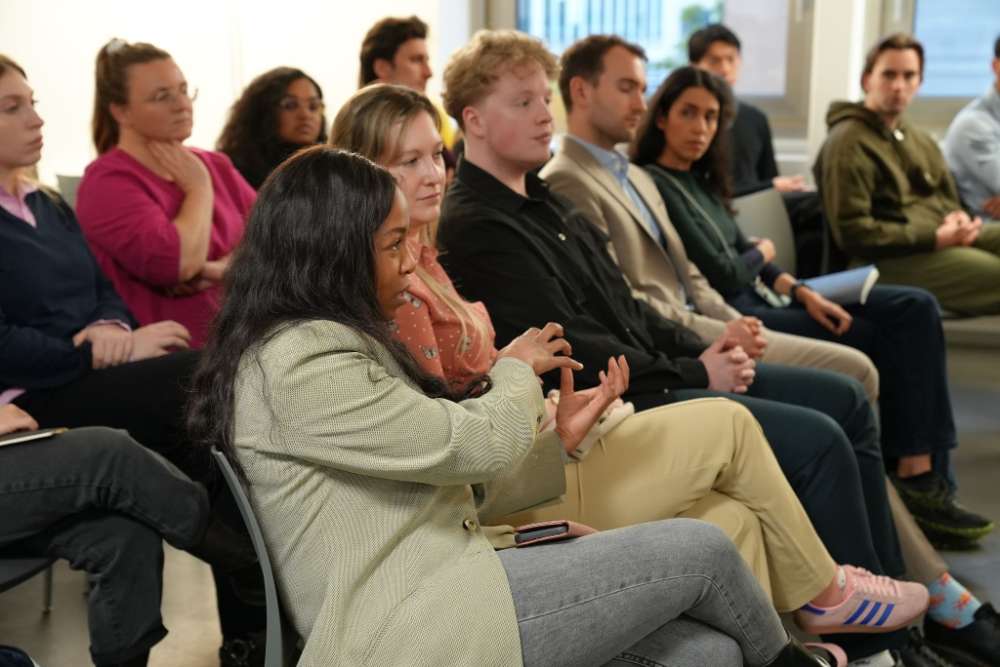
The room where the questions get harder
The fellowship runs on roundtables. One of them brought in Yasmin Naderi Afschar, Swiss-Iranian curator and Co-Director of the Migros Museum für Gegenwartskunst, on how decisions shift across cultural and political contexts, what it means to take a stance while protecting artistic voices, and how institutions hold the line between visibility, interpretation and restraint. Moderated by Martina M. Froehlich.
What stayed with me was how fragile those spaces are, and how much active work it takes to keep them open. I wrote about it afterwards.
Looking From Two Sides ↗Learning prototype
A fifteen to twenty minute digital experience, from hook to decision in nine steps.
Research instruments
Eight audience-specific questionnaires, each proportionate to what that group can give.
Expert contributions
Practitioners from business and public affairs, including views that challenge the premise.
Field notes
Observations connecting current developments in Asia to what they could mean for Switzerland.
Knowledge quizzes
Seven short sets on Asia, China, Japan, India, South Korea, culture and finance, each answer paired with a fact worth keeping.
What this project showsSix kinds of work that recur across the practice. +
Six kinds of work that recur across the practice.
Pick one to see where it actually shows up in this project.
{{ capDesc }}
{{ capExample }}
Still in development, deliberately.
The fellowship has set the research direction, the learning philosophy and the prototype. The next stage is testing and refining the experience with learners and institutional partners.
Project context: the Gen A Fellowship project and my advisory role with evulpo are distinct engagements. References to potential future applications describe areas being explored, and do not imply an existing commercial, institutional or implementation agreement unless stated.