Tiffany-Annabelle and the Courage to Bloom · TheSwissPanAfrican
THESWISSPANAFRICAN
One-on-One · Lagos / London

Tiffany-Annabelle and the Courage to Bloom

On artistic becoming, Nigeria’s new cultural infrastructure, and why the world needs artists who can move between places without surrendering where they come from.

An essay by Tallulah Patricia Bär · Zürich, September 2026
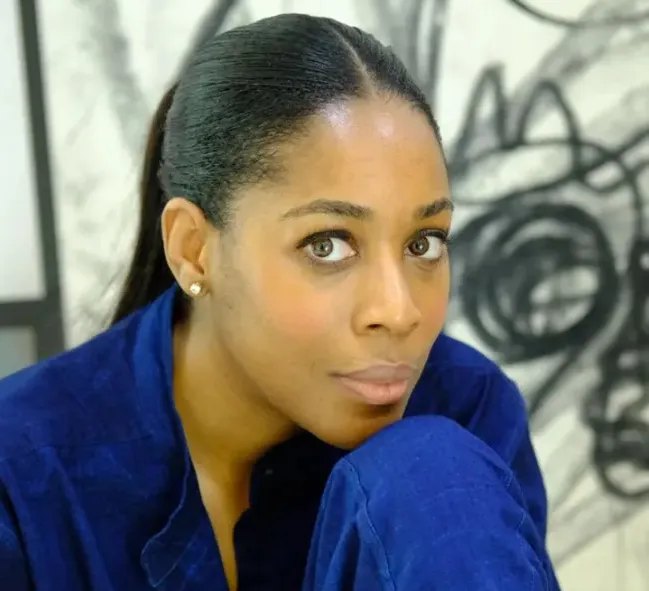
Tiffany-Annabelle in a cobalt-blue shirt, in front of a large charcoal drawing
Tiffany-Annabelle
BornLondon, 1989
HeritageBritish-Nigerian, Itsekiri
BasedLagos and London
MediumScreen print, acrylic, charcoal and pastel on brown postal paper and envelopes; now sculpture and installation
GalleryEd Cross Fine Art, London

There are artists whose importance is immediately legible because institutions have already agreed upon it. Their names arrive surrounded by museums, auction records, retrospectives and critical consensus.

And then there are artists whose significance lies in something more exciting: we are watching the formation happen in real time.

Tiffany-Annabelle belongs to the latter category.

Her story is not compelling because it follows the traditional blueprint of an artist’s career. It is compelling precisely because it does not.

Born in London and deeply connected to Nigeria, Tiffany-Annabelle studied law at the University of Surrey and later worked in publishing before becoming a full-time artist. She had been drawing since childhood, but her professional practice began in Lagos during the disruption of the Covid-19 pandemic. Within a few years, she moved from that act of personal commitment into solo exhibitions in Lagos, Accra and Abuja, gallery representation in London, London Art Fair, an invitation into El Anatsui’s studio residency, and an expanding practice that now encompasses not only works on paper but sculpture and installation.

That trajectory is inspiring because there is something profoundly human inside it. It is the story of someone choosing the thing that was hers.

Tiffany-Annabelle has spoken about art as something different from the paths that had previously been laid before her: unlike law or other professional expectations, art was something she pursued from an internal conviction. In a 2026 conversation published by Ed Cross Fine Art, she described the relationship between making, belief and becoming: the importance of creating from lived experience rather than from what an artist imagines the market wants to hear.

That matters. Because in a creative economy increasingly preoccupied with visibility, personal branding and rapid recognition, Tiffany-Annabelle’s story is ultimately about something quieter and more enduring:

permission.

  1. The permission to begin.
  2. The permission to begin later than somebody else.
  3. The permission to change disciplines.
  4. The permission to make work that contains joy when seriousness is so often equated with suffering.
  5. And eventually, the permission to outgrow the version of your practice for which people first recognised you.
The essay in ten chapters
01 Radical optimism as an artistic positionWhy joy, beauty and ambition belong in the archive. +

Tiffany-Annabelle describes the territory of her practice as “radical optimism.” It would be easy to misunderstand the phrase.

Optimism in her work is not the absence of complexity. It is not a refusal to acknowledge the histories that surround Blackness, womanhood, migration or African identity.

It is a refusal to accept that pain must be the principal language through which those lives become culturally significant.

Her Women in Bloom works place women amid an abundant botanical world informed by plants connected to her ancestral Niger Delta region and her Itsekiri heritage. Hibiscus, African orchids and frangipani become intertwined with images of female flourishing. The women do not appear as sociological case studies. They are not waiting to be rescued, decoded or validated. They inhabit beauty, intimacy, desire and possibility on their own terms.

Hibiscus African orchid Frangipani

There is something quietly radical about that. For generations, images of Africa and Black life have travelled internationally through frames disproportionately constructed elsewhere: crisis, conflict, poverty, ethnography, political struggle.

Those stories are real and must be told. But they are not the whole human record.

Joy is part of the archive. Beauty is part of the archive. Ambition is part of the archive. Domesticity, flirtation, femininity, confidence, sensuality, aspiration and tenderness belong there too.

And when artists insist upon those dimensions of life, they are not producing something less politically meaningful. They are widening the record of what a human life is permitted to contain.

That is why Tiffany-Annabelle’s optimism deserves to be taken seriously.

It is not decoration. It is authorship.
02 The love letterBrown postal paper, envelopes, and work made to travel. +

Her choice of material makes that authorship particularly intimate.

Tiffany-Annabelle has worked with charcoal, acrylic, oil pastel and screen-printing on unbleached brown postal paper and envelopes. Ed Cross describes the postal material as carrying ideas of exchange and communication; Tiffany-Annabelle herself has described the works as a form of love letter.

It is an extraordinarily fitting material for an artist whose life and practice move between geographies.

Postmarked Lagos · Accra · LondonBrown postal paper

An envelope exists because something needs to travel.

Something begins in one place and is intended to arrive somewhere else.

It carries a message without becoming the message.

It bears evidence of movement.

That metaphor sits beautifully beside Tiffany-Annabelle’s own trajectory between Lagos, Accra and London. Her work is rooted, but it is not stationary.

And perhaps that is one of the most important ideas for understanding a new generation of African and diasporic artists. They do not need to choose between specificity and internationalism.

  • An artist can be profoundly connected to an Itsekiri inheritance and exhibit in London.
  • An artist can build a career in Lagos and enter a Swiss collection.
  • An artist can undertake a residency in Ghana, work with a British gallery and speak to an American audience without becoming culturally less Nigerian in the process.
Movement does not necessarily dilute identity. Sometimes movement reveals how strong the roots actually are.
03 From Lagos outwardEight milestones in five years, and what a market actually requires. +

Tiffany-Annabelle’s professional development has happened extraordinarily quickly.

2021MissAlignedNo Parking Lagos, LagosSolo
2022Behind The CoatMILIKI, LagosSolo
2023How She Brought The Good NewsNubuke Foundation and FrontBack, AccraSolo
2024Women in BloomTranscorp Hilton, AbujaSolo
2025Ebiren Oliuwa Prosi ProsiAMG Projects, LagosSolo
2025El Anatsui StudioGhana, the studio’s inaugural residencyResidency
2026Platform, London Art FairWith Ed Cross Fine Art, LondonFair
2026100 Ways She BloomsEd Cross Fine Art, LondonSolo

Her own website records her first solo exhibition and an early group exhibition as sold out.

But the journey has not simply been a neat upward line from one exhibition to the next. It has also taught her what being an artist actually requires.

In Ghana, she experienced something that many artists eventually discover: appreciation does not automatically equal a functioning market.

  • People can love art without being able to purchase it.
  • An exhibition can attract attention without producing sustainable income.
  • And a single introduction can completely change an artist’s commercial experience.

Her Ghana exhibition ultimately led to significant acquisitions, including by Rebecca Akufo-Addo, then First Lady of Ghana. But Tiffany-Annabelle has also been frank about the limited number of buyers at the price levels necessary to sustain a professional practice.

Tiffany-Annabelle standing with Rebecca Akufo-Addo and another guest in a living room hung with paintings
Tiffany-Annabelle (right) with Rebecca Akufo-Addo (centre), then First Lady of Ghana

That lesson is important because it takes us beyond the romantic mythology of the artist.

Artists require

Studios · Materials · Shipping · Insurance · Documentation · Fabricators · Residencies · Curators · Critics · Galleries · Collectors · Time

And money to pay rent while the work develops.

The question facing African art therefore cannot simply be:

Where are the talented artists?

They are already there. The more consequential question is:

What architecture are we building around them so that talent can become a lifetime practice?

04 Nigeria is increasingly building that architectureART X Lagos, residencies and development understood properly. +

Tiffany-Annabelle’s journey is individual, but it sits inside a much larger transformation. Nigeria is not simply producing artists. It is increasingly building an artist-development ecosystem around them.

ART X Lagos, founded in 2016, has developed into a major international platform for contemporary African and diasporic culture, bringing together galleries and artists while also investing in programmes specifically designed to develop future careers. Its programming now includes the ART X Prize for emerging artists, a Development Forum connecting younger practitioners with the professional industry, and RESONANCE, developed with the Cité internationale des arts and French cultural partners to give Nigeria-based artists, designers and curators fully funded residency time in Paris, mentorship and international networks.

The Access ART X Prize itself offers something instructive: funding alone is not considered sufficient. Artists receive production support alongside mentorship, exhibition opportunities, residencies and professional networks. The explicit aim is to help early-career African and diasporic artists build practices capable of succeeding internationally.

This is artist development understood properly.

Discovery as spectacle. Development.
Time to experiment Permission to fail Mentorship Professionalisation Critical dialogue Mobility Access to collectors Exposure to institutions And relationships that can survive beyond a single exhibition

A 2023 British Council mapping of visual arts across nine sub-Saharan African countries likewise identified a strongly collaborative arts ecosystem, often supported by independent spaces and practitioners themselves. But it also noted that in many markets, significant commercial representation remains concentrated in only one or two key galleries.

That is exactly why development infrastructure matters.

There can be extraordinary talent without sufficient routes through which that talent can travel.
05 And there is a lineageEl Anatsui’s studio and the transfer of knowledge. +

The most beautiful part of Tiffany-Annabelle’s current chapter may be that it connects contemporary artist development to a much longer West African tradition of artists developing other artists.

In 2025, after encountering her work, El Anatsui invited Tiffany-Annabelle to undertake a three-month residency at his studio in Ghana. Her gallery identifies it as the inaugural residency at the studio.

The significance of that invitation deserves context. El Anatsui is not simply an internationally successful artist who happens to come from Africa. He spent more than four decades teaching at the University of Nigeria, Nsukka, and his influence on generations of artists in West Africa has been explicitly recognised internationally. When the Venice Biennale awarded him its Golden Lion for Lifetime Achievement in 2015, the citation highlighted not only his artistic achievement but his decades of work as an artist, teacher and mentor and his influence on successive generations of West African artists.

That makes Tiffany-Annabelle’s residency part of something larger than celebrity proximity. It belongs to a lineage of knowledge transfer.

  1. iAn older artist creates room for another artist.
  2. iiExperience is transmitted not by imitation, but through proximity.
  3. iiiAnd an emerging practice is given enough confidence and space to risk becoming something else.

That last point is particularly important. Because Tiffany-Annabelle did not simply leave the encounter with another line on her biography.

Her practice is moving into sculpture and installation. That is where the story becomes especially exciting.

06 The courage to leave what already worksFrom paper to wood: becoming a beginner again. +

There is one form of courage involved in becoming an artist. There is another in becoming successful enough at one thing, and then allowing yourself to become a beginner again.

Tiffany-Annabelle had established a recognisable language on paper. Collectors could understand it. A market could understand it. A gallery could show it.

Then came wood.

Weight. Volume. Objects. Benches. Pestle-like vertical forms. Colour embedded into material surfaces. Things that stand rather than hang. Things that occupy the same space as the viewer.

Her sculptural works introduce an entirely different relationship between artwork and body.

Papercan be looked at.
Sculpturemust be negotiated.

You encounter its front, its back, its height, its material history and its relationship to the architecture surrounding it.

And this is precisely why this moment in Tiffany-Annabelle’s practice feels so alive. She is not simply producing more examples of a successful formula. She is asking:

What else can my language become?

Artists who sustain important practices over decades usually have to ask this question repeatedly. Recognition can become a trap if an artist begins producing only what recognition has rewarded.

Development requires risk. Tiffany-Annabelle is taking it.

07 Why the world needs artists like herCirculation, not extraction. +

This is where Tiffany-Annabelle’s story extends beyond Tiffany-Annabelle.

The question is not merely why European or American institutions should “give African artists opportunities.” That framing is already too small. African artists do not require European or American permission to possess cultural significance.

The more interesting proposition runs in the opposite direction:

Europe, the United States and the wider international art world need these artists.

Because no genuinely global cultural ecosystem can be built while the majority of the world’s narratives circulate through a small number of geographic and institutional centres.

76% of global art sales by value in 2025 were made in the United States, the United Kingdom and China, according to the 2026 Art Basel and UBS Global Art Market Report.

That concentration of transactions does not mean those countries possess 76% of the world’s imagination. It means infrastructure and capital are unevenly distributed.

The role of international mobility should therefore not be to extract the most successful artists from Lagos, Accra, Dakar, Nairobi or Johannesburg and relocate cultural legitimacy to London, Paris or New York.

It should be to build circulation.

Lagos → Accra Accra → Abidjan Lagos → London Paris → Nigeria Basel → Johannesburg Zürich → Lagos

And New York into dialogue with the continent rather than simply collecting from it.

  • Artists should be able to move while ecosystems at home become stronger.
  • Collectors should encounter African artists before auction prices tell them they are allowed to care.
  • Institutions should build relationships before retrospective consensus makes those relationships risk-free.
  • And African artists should be able to access international capital without surrendering the geographic, historical and intellectual contexts from which their practices emerged.

That is an ecosystem.

08 The collector is changing tooRelationship before transaction. +

There is another reason Tiffany-Annabelle’s moment is particularly timely. The next generation of collectors is behaving differently.

The 2025 Art Basel and UBS Survey of Global Collecting, based on 3,100 high-net-worth collectors across ten markets including Switzerland, the US and UK, found significant engagement among younger collectors and women. It found growing direct engagement with artists, strong interest in unfamiliar artists and increasing attention to identity, community and meaning alongside conventional ideas of value.

That does not guarantee an artist commercial success. Nothing does. But it changes the conditions under which artists can be introduced.

  • A dinner can matter.
  • A studio visit can matter.
  • A conversation can matter.
  • Encountering a sculpture in somebody’s home can matter.
  • Hearing an artist explain why she made something before seeing its price can matter.

In other words, the future of collecting may depend increasingly upon

relationship before transaction.

And that opens possibilities for artists like Tiffany-Annabelle whose work carries a story that cannot be reduced to dimensions, medium and price.

09 Patronage as participationWhat the first collectors make possible. +

It also asks something of collectors. Buying art is not merely acquiring an object. At certain moments in an artist’s development, it can become participation in the construction of a cultural record.

  1. The first collectors of an emerging sculptural practice matter.
  2. The first curator willing to contextualise a new body of work matters.
  3. The first institution willing to exhibit it matters.
  4. The first serious essay matters.
  5. The first collector who places the work in a home where another collector encounters it matters.

The first person who says, I don’t yet know what this will become, but I believe it deserves the opportunity to become, matters.

That is patronage at its most meaningful.

Not speculation. Not charity. Participation.
10 Tiffany-Annabelle is not a finished storyA succession of courageous decisions. +

And perhaps that is what makes her so inspiring. She is not interesting because every question about her career has already been answered. She is interesting because she keeps answering one question by becoming capable of asking another.

  1. A child who drew.
  2. A young woman who studied law.
  3. A professional working in publishing.
  4. An artist who decided during a global pandemic that the quieter calling mattered.
  5. An artist building a practice in Lagos.
  6. An artist exhibiting in Ghana.
  7. A woman selling work into significant collections.
  8. An artist invited into the studio ecosystem of El Anatsui.
  9. A painter entering sculpture.
  10. A Nigerian artist entering London without abandoning Lagos.
  11. A woman making work about flourishing while she herself is still in the act of becoming.

There is something profoundly hopeful in that progression. Because Tiffany-Annabelle’s story does not tell us that success arrives when someone finally discovers you. It tells us that a creative life can be constructed through a succession of courageous decisions.

01Begin. 02Show the work. 03Learn. 04Travel. 05Listen. 06Sell. 07Make something different. 08Enter another room. 09Allow mentorship. 10Return to the studio. 11Begin again.

And around her, another story is unfolding.

Nigeria is building institutions, fairs, residencies, galleries, prizes and artist-development structures capable of carrying more of its extraordinary creative intelligence into the world. Those structures need to deepen. They need capital. They need collectors. They need intra-African networks as much as European and American ones. They need critics, curators, insurers, shippers, archivists and patrons. And they need international partners willing to engage African artists not only when the market has already crowned them, but while consequential practices are still developing.

Because the ultimate goal cannot simply be to create a few globally famous African artists.

It must be to create the conditions in which thousands of serious artists can build serious lives in art.

Tiffany-Annabelle’s journey allows us to see what that possibility looks like at the level of one person. And perhaps that is the most important thing about her work at this moment.

El Anatsui Studio · Ghana · 2025

Works from the residency

Three sculptural series built from objects of West African everyday life. The texts are the artist’s own.

Two stacks of wooden tomato crates lined with strips of patterned Ghana Must Go bags, against a white wall
Series 01

What Carries Us

Wood and plastic “Ghana Must Go” bags
The artist’s text+

This sculpture series is built from stackable wooden tomato boxes, symbols of trade, hustle and the weight of daily survival, lined with strips of Ghana Must Go bags. For many Nigerians and Ghanaians, these bags are more than storage: they are reminders of 1983, when over a million Ghanaians were expelled from Nigeria. In haste, with dignity packed in plastic, entire lives were carried in multicoloured bags.

The term “Ghana Must Go” was born from that political rupture, but the bags outlived the insult. Reclaimed across markets, borders and generations, they became symbols of migration, adaptation and resilience, not just for Ghanaians but for all who have ever had to move with everything they own in something not built to last.

By lining tomato crates with the bag’s patterned skin, the work binds two everyday objects of West African survival. The sculpture becomes a layered container of memory, movement and market life. It honours the makeshift, the reused, the carried. It asks: what do we throw away, and what carries us through?

More views · 1+
Close view of two crates, the gaps between their slats lined with bright strips of the bags’ checked pattern
Two tall bench planks studded with recycled glass beads, their lower ends dipped in neon yellow and pink
Series 02

The Guards That Let The Colour Through

Pestles and discarded wooden benches, acrylic paint, recycled glass beads
The artist’s text+

The objects used and discarded carry the memory of countless local “chop bar” kitchens from Ghana. The pestles used in preparing foods along with the stools and benches supporting the hours of pounding, sweat and preparation. The rhythm of the pounding or creaking benches once echoing across courtyards. Now, dipped in a single block of colour, it is reborn a quiet monument where tradition is reconstructed.

The recycled glass beads glimmer like beads of sweat. In many African households, to cook a meal is to sweat; the labour, fire, and African heat leave their trace on the body, making nourishment inseparable from effort.

Together, they whisper of cycles unbroken: tools that once fed bodies now feed memory, heritage finding new breath in form and colour.

More views · 2+
A group of wooden pestles set with glass beads, each base dipped in a single block of orange, yellow, pink, blue or purple A row of bench seats on a terrazzo floor, bead-studded, their ends dipped in pink, orange, green and blue
Three clay bricks painted in bands of colour, each topped with a sealed sachet of drinking water
Series 03

Burden of Thirst

Clay brick, acrylic paint, resin
The artist’s text+

This sculpture captures a quiet yet heavy truth. A single sachet of pure water rests atop a handmade clay brick, humble objects found on countless West African streets. The brick symbolizes the labor, resilience, and foundation of survival. The water, though small and sealed, is a precious weight: representing the constant human need for relief and nourishment.

Together, they reflect how access to even the most basic necessities such as water and shelter is still a burden many carry. The piece visualises the tension of survival: how access to water and other forms of relief is often not just distant but restricted, conditional, and controlled.

More views · 1+
A single painted clay brick on a wooden stool, a sachet of water resting on top

She makes flourishing visible.

Then, through the life she is constructing around the work, she demonstrates that flourishing itself is not a passive state.

It is built. It is protected. It is shared. It is carried from one place to another.

And sometimes, like a letter placed carefully inside an envelope, it simply needs someone on the other side willing to receive it.

Follow the artist Instagram ↗ Ed Cross Fine Art ↗
Sources and credits+
  • Ed Cross Fine Art: artist biography, exhibition history and a 2026 conversation with the artist.
  • ART X Lagos: the ART X Prize, the Development Forum and RESONANCE.
  • British Council: mapping of the visual arts in nine sub-Saharan African countries, 2023.
  • La Biennale di Venezia: Golden Lion for Lifetime Achievement to El Anatsui, 2015.
  • Art Basel and UBS: The Art Basel and UBS Global Art Market Report, 2026; Survey of Global Collecting, 2025.
  • Works and texts from the residency: courtesy of the artist.

More long-form exchanges with individual practitioners

All portraits Get in touch