TheSwissPanAfrican An independent advisory and editorial practice
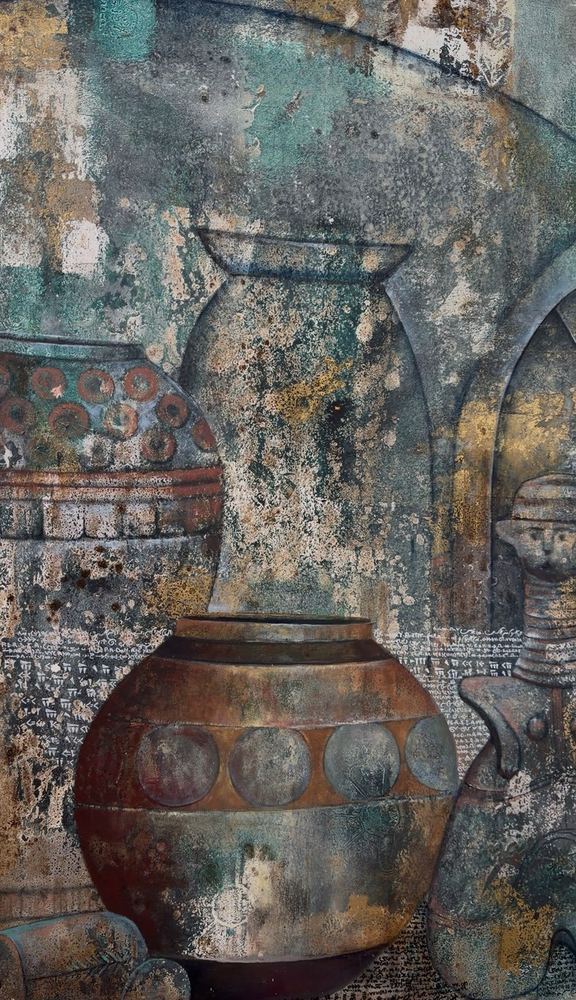
A painting by Pantea Mahrou shown at UNTRANSLATED, vessels and cuneiform inscriptions
Image: Pantea Mahrou ● from the stand at VOLTA Basel

An Artistic Conversation ● VOLTA Basel 2026

UNTRANSLATED

Four women artists, two galleries, one booth in Basel. The exhibition was called UNTRANSLATED, and the title is the argument: what a work carries does not have to pass through Europe to be understood.

An Artistic Conversation
Recorded and written by Tallulah Patricia Bär
Basel ↔ Zürich
In person at VOLTA Basel ● June 2026
Ceramics ● Memory ● Migration
Ancestry ● Ecology ● Material culture

The booth was shared, which is the first thing worth saying about it. At VOLTA Basel in June, The Southern Art Hub and Janet Rady Fine Art presented together, one stand holding two rosters and, as it turned out, one argument. Around the corner from where we spoke, the Brazilian artist Luma Nascimento was assembling a sculpture on site. On the walls, four women artists working between Brazil, Iran, Spain and Equatorial Guinea.

1974Rady's first journey to Iran, a decade before she lived there
2007Janet Rady Fine Art founded, now between London and the UAE
2021The Southern Art Hub founded, on the foundation of The African Art Hub
4Women artists in UNTRANSLATED, across four countries and a diaspora
The exhibition

UNTRANSLATED

The presentation had a name, and the name was arguing before anyone spoke. UNTRANSLATED brought together four women artists whose practices ask how memory is held, passed on and altered between generations: Bisila Noha, Luma Nascimento, Pantea Mahrou and Sabrina Da Silva Medeiros. The map runs across Brazil, Iran, Spain, Equatorial Guinea and the wider diaspora, and the connections traced are between spirituality, ecology, migration, ancestry and material culture.

AshSoilClayTextileGlassPigmentFound objectsPhotographsCeramic form
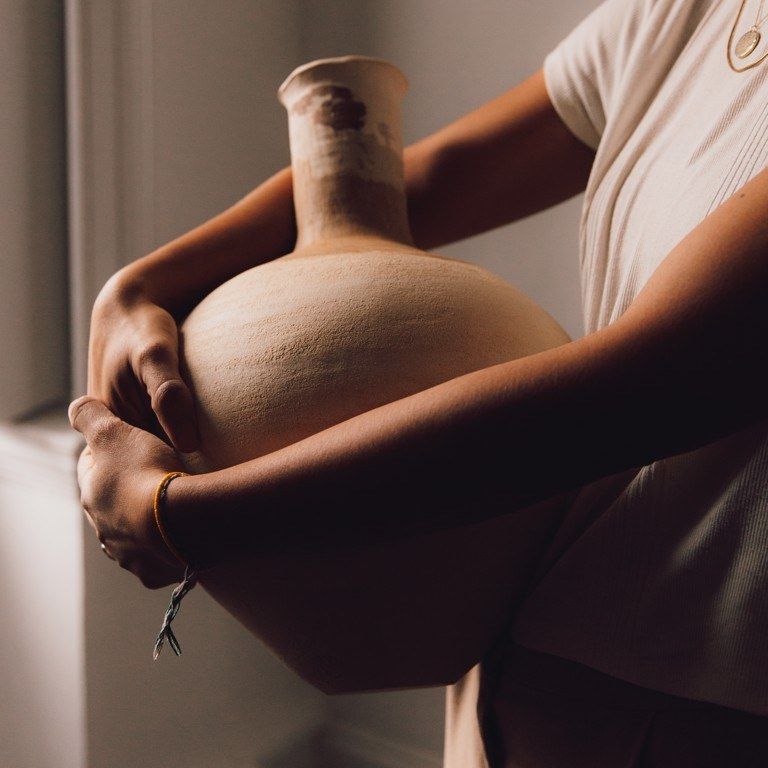
A large unglazed vessel held against the body
Bisila NohaWheel-thrown and sculptural ceramics, from a practice that argues with the line between art and craft.Image courtesy the artist, The Southern Art Hub and Janet Rady Fine Art
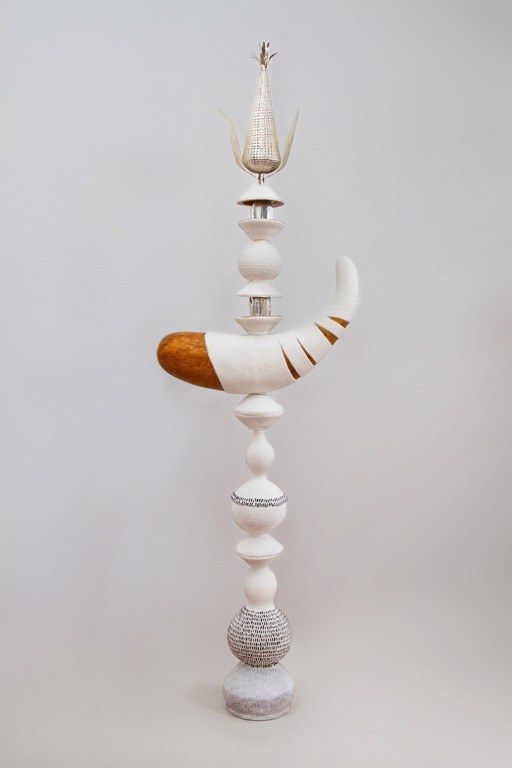
A tall stacked sculpture in white ceramic with gilding and beadwork
Luma NascimentoStacked ceramic, gourd, brass and glass beads, in the vocabulary of the penca de balangandã.Image courtesy the artist, The Southern Art Hub and Janet Rady Fine Art
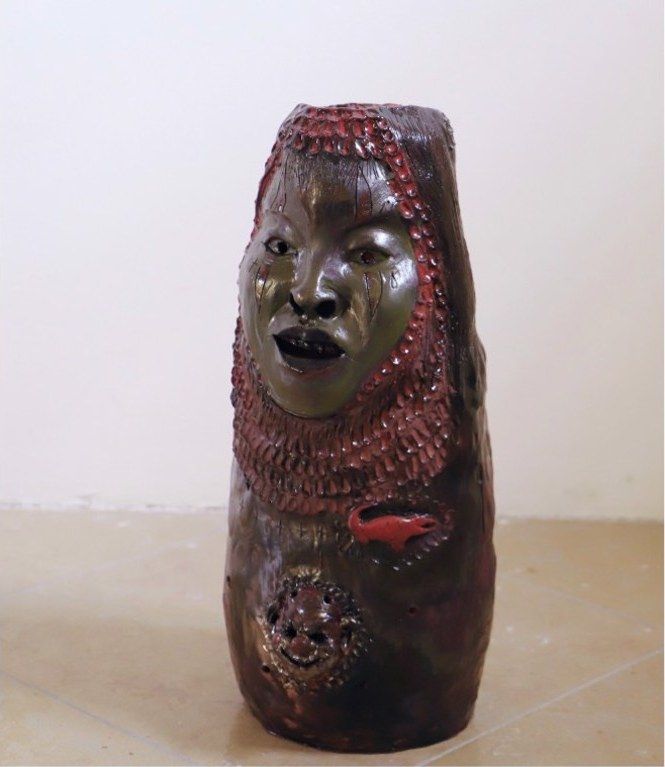
A ceramic vessel with a modelled face and red beaded surface
Sabrina Da Silva MedeirosCeramic worked by fragmentation and reassembly, with the figure emerging from the vessel.Image courtesy the artist, The Southern Art Hub and Janet Rady Fine Art
A painting of ancient vessels among cuneiform inscriptions
Pantea MahrouPainting in which vessels, arches and cuneiform hold a pre-Islamic Iran in the present tense.Image courtesy the artist, The Southern Art Hub and Janet Rady Fine Art
UNTRANSLATED ● VOLTA Basel
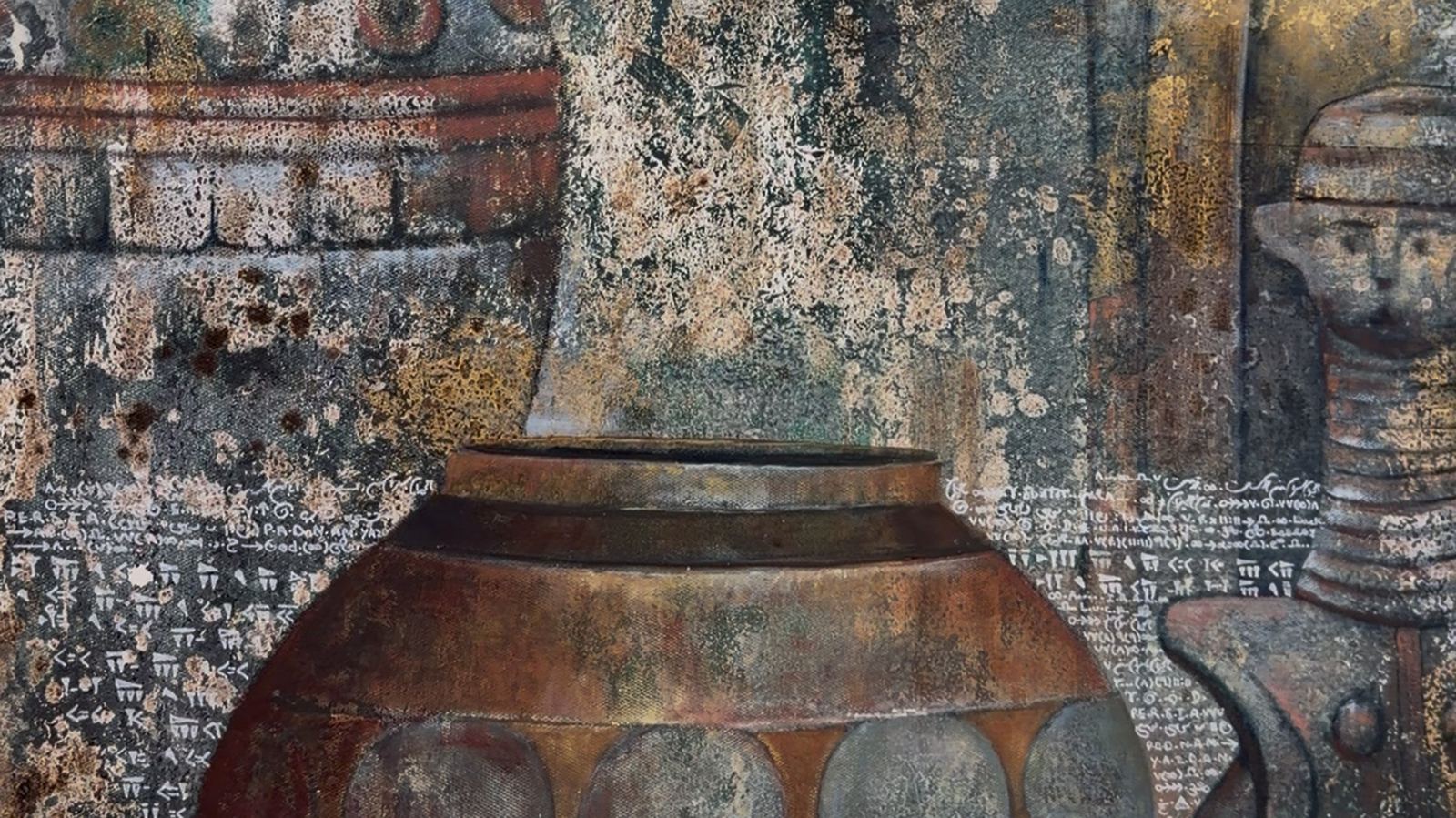
Two paintings by Pantea Mahrou on the stand, the domed city and the vessels among cuneiform. Filmed at the booth, VOLTA Basel, June 2026, by Tallulah Patricia Bär.

The conversation

Six chapters. Open what interests you.

Chapter 01Bond Street, and how a fair actually begins

Ask a gallerist why they are at a particular fair and the answer is often strategy. Rady’s answer was memory. She is exhibiting at VOLTA for the first time, and one reason, she says, is that she has known Lee Cavaliere, the artistic director of VOLTA Art Fairs, since around 2008, because they used to work with galleries that sat right next door to each other on Bond Street.

The record supports the coincidence. Before Ramsay Fairs appointed him to lead VOLTA in July 2023, Cavaliere worked on the Tate’s collection displays, then delivered exhibitions at Max Wigram Gallery and at the Fine Art Society on Bond Street. Fairs present themselves as open calls with selection committees, and they are, but the first door is usually a person who already knows what you are good for. When a gallery representing artists outside the Euro-American canon lacks that person, the absence is invisible in the accounts and decisive in the outcome.

I am really delighted to be exhibiting at VOLTA for the first time this year.
Janet Rady, founder, Janet Rady Fine Art
Chapter 02Four decades in one region

Rady was born in Malta. She first went to Iran in 1974, lived there in 1983 and 1984, and has been returning ever since. She holds a degree from the School of Oriental and African Studies in London and a master’s in Islamic art history from the University of Melbourne, which is to say she came to the market through the scholarship rather than the other way round.

Forty years spent in one region does something specific to a dealer’s ear. It makes generalisation audible. When a collector says they are interested in Middle Eastern art, Rady is hearing perhaps fifteen art histories at once, and she knows which of them the sentence is quietly flattening. That is the same faculty Abia was describing from the other side of the booth, in different vocabulary.

A route, not a career plan

1974

First visit to Iran, the beginning of a lifelong regional focus.

1983

Lives in Iran for a year, and later in France and Australia.

2006

The first contemporary Middle Eastern sale in Dubai and the British Museum’s Word Into Art open the market within months of each other.

2007

Founds Janet Rady Fine Art, working with contemporary Arab and Iranian artists.

2013

Begins building the secondary market for art from the region at auction.

2020 to 2023

Runs the modern and contemporary Middle Eastern and African art department at Chiswick Auctions.

2022

Curates the first Kyrgyz Republic pavilion at the fifty-ninth Venice Biennale.

Now

Specialist at Olympia Auctions, with two African and Middle Eastern sales a year, and a first booth at VOLTA Basel.

Chapter 03The hub that changed its name

Abia is managing director of The Southern Art Hub, and chief executive of a group whose interests run across legal services, consulting, accounting and tax, energy, healthcare, financial services and the arts. What he chose was a gallery that has now publicly changed what it calls itself, which in this industry is a substantive act rather than a cosmetic one.

His reasoning was not that Africa had become too small a frame. It was that the frame had been doing work nobody asked it to do. The region, he said, is enormously complex, with extraordinary cultural and sociopolitical diversity. Yet seen from a Eurocentric vantage point, the same habits recur: oversimplification, generalisation, and at times denigration. Renaming the gallery for the Global South refuses the single-story reading while widening the field to places whose histories are entangled with each other, and not only with Europe.

Chapter 04Art should not need translation

This was the sentence the whole conversation turned on, and Abia said it early, as a premise rather than a conclusion. Art should not need translation. Visibility in the art market is insufficient on its own, because visibility does not necessarily mean understanding. It is important to take works for what they are, and important to look deeper.

There is a version of inclusion that consists of being shown, counted, photographed and moved on from, in which the number of artists from a given region rises every year while the quality of attention paid to any one of them stays where it was. Presence becomes the metric because presence is easy to audit. Comprehension is not. The uncomfortable implication is for the buyer, not the artist: if visibility has been achieved and understanding has not, the deficit sits with the viewer’s reading.

Art should not need translation. Visibility does not necessarily mean understanding.
Abraham Abia, managing director, The Southern Art Hub
Chapter 05The justification tax

Abia’s second claim was sharper. Artists should not always have to justify themselves from an art-historical perspective. It should not be necessary, particularly in contemporary art, to tie a work to a period of the Renaissance, or to a canonical figure whose name a collector already trusts, in order to be taken seriously. They should be able to create freely, and to do so from a less Eurocentric position.

Call it a justification tax. It is levied in wall texts and press releases, and paid disproportionately by artists whose reference points sit outside the European canon. The mechanism is subtle, because the comparison is usually offered as a compliment. A painter is introduced as a Lagos Basquiat, a sculpture is described as having a Brancusi-like reduction, and both make the unfamiliar purchasable by routing it through the familiar. What Abia proposes instead is slower: look at the object, ask what it is made of, ask what the symbols are doing rather than what they resemble.

They should be able to just create freely.
Abraham Abia, on artists and the art-historical footnote
Chapter 06What a booth is for

A fair is a compressed argument about attention: several hundred booths, a finite number of hours, and a visitor economy that rewards whatever can be understood at walking pace. Basel in June is the most concentrated version of that pressure anywhere in the calendar.

Which is exactly why the shared stand was interesting. Two dealers with long regional expertise pooled their space and, instead of using the extra room for volume, used it for concentration: four artists, one of them assembling a work in front of the public, and two people willing to say out loud that being seen is not the same as being understood. Rady’s route to the booth ran through a street in London eighteen years ago. Abia’s ran through a decision to change a name that was working perfectly well commercially. Both are forms of patience.

It is important to take works for what they are, and it is important to look deeper.
Abraham Abia, at the booth, VOLTA Basel

The work on the walls

Four artists, four ways of holding memory

Spain and Equatorial Guinea, born 1988Bisila Noha

Born in Zaragoza and based in London, Noha is a Spanish and Equatoguinean artist, researcher and writer whose practice runs from wheel-thrown vessels to sculptural ceramics and mixed-media work. Her subject is the vessel and the histories it carries, and through it she questions the Western separation of art from craft, along with the ideas of productivity, value and authorship that capitalism attaches to making. She describes herself as a storyteller, and the political content is specific: recovering the contribution of women of colour to the histories of art and craft.

Her work has appeared in the Financial Times and The New York Times. Exhibitions include Maker’s Eye with the Crafts Council in 2021, Body Vessel Clay at Two Temple Place and York Art Gallery in 2022, a solo show at Galerie REVEL in Bordeaux, a solo presentation at Unit London in 2023, Body Vessel Clay at the Ford Foundation Gallery in New York in 2025, and Collect in London in 2025 and 2026. Her work is held by the Victoria and Albert Museum, the Crafts Council, the National Museum of Scotland, The Box, Middlesbrough Institute of Modern Art, the Ulster Museum and the High Museum of Art.

Brazil, born 1991Luma Nascimento

Nascimento was working at the stand while we talked, assembling a sculpture on site. She describes herself as a researcher and visual artist, working across sculpture, installation, audiovisual performance and computational processes in a field she calls Afrovisualities, and her continuing series Corpo Documento treats the body as a spatial document.

In UNTRANSLATED her concern is where ancestral knowledge sits inside ecological systems, and her materials say it plainly: one work combines gourd, ceramic, brass, glass beads and clay gathered in Durban and in the Santa Rita quilombo area of Maranhão. The penca de balangandã, the charm jewellery in which Black women in Bahia held wealth no bank would take, is the object her thinking keeps returning to.

Iran, born 1990Pantea Mahrou

Born in Tehran, Mahrou came to art through building: a first degree in architecture at Azad University, then a master’s in environmental design engineering at the University of Tehran. Painting and sculpture were the childhood practice she returned to, and the training shows in how she treats a picture as a constructed space rather than a surface.

Her series looking back to ancient Iran reinterprets deities, myths and symbols alongside traditional architecture, and her vocabulary is specific: sacred numbers, ancient scripts including Avesta and cuneiform, and signs for power, fertility and fortune. This is the artist Abia used to explain the whole curation: not a painter of landscapes, but an artist demonstrating that a landscape can hold identity without needing a European footnote to license it.

BrazilSabrina Da Silva Medeiros

Da Silva Medeiros works on memory through fragmentation and reconstruction, asking how personal and collective histories are assembled, preserved and reimagined rather than simply recalled. In UNTRANSLATED she showed both painting and ceramic, including Tronqueira, a ceramic work of 47 by 96 centimetres.

Her presence completes the exhibition’s logic. If Noha holds memory in the vessel and Nascimento in the landscape, Da Silva Medeiros holds it in the break: the point at which something has come apart and been put back together differently, which is what actually happens to an inherited story as it travels.

The wider rosterWho else The Southern Art Hub works with

Beyond this exhibition the roster runs across continents rather than within one: Gbemileke Adekunle, Kingsley Ayogu, Ibrahim Bamidele, Sebastien Enangnon Boko, Colomba Fontaine, Kay Gasei, Miguel Angel Polick and Candelaria Traverso, alongside the artists shown at Basel.

Abraham Abia

A businessman, a collector, and a name he decided to change

The day jobBusiness first, and the arts as the serious part

Abia is chief executive of a multinational group spanning legal services, consulting, accounting and tax, energy, healthcare and financial services, with the arts as one of its arms rather than a decoration on the side. When someone whose other holdings are in energy and finance says visibility is insufficient, he is not making a romantic case against commerce. He is saying the commercial mechanism currently produces a poor result, and could be built better.

The collectionA private collection that began in 2015

Abia has collected since 2015, and the gallery is explicit that the collection is separate from the programme. The names nonetheless indicate the taste behind it: Abderrahmane Rahoule, Julien Sinzogan, Ibrahim Bamidele, Kay Gasei, Kelani Fatai, Tiffany Annabelle and Bisila Noha, among others. Sinzogan, born in Porto Novo in Benin in 1957 and long based in Paris, works with the legacy of the Atlantic slave trade in ink and colour. Neither practice can be read off a regional label, which is rather the point.

The renameFrom The African Art Hub to The Southern Art Hub

The African Art Hub described itself as a UK-based platform and agency promoting contemporary African art, working through gallery collaborations and fairs. The Southern Art Hub keeps the mission and widens the map, on the reasoning that these histories are entangled rather than parallel. Traces of the earlier name are still in the plumbing, in social handles and legal pages, which is what a real transition looks like from the inside.

The teamWho else is in the room

Antonia Mejía Arango, gallery lead and curator, holds an MA in curation and collections from Chelsea College of Arts at the University of the Arts London and a degree from the Istituto Europeo di Design in Madrid, and leads the shift towards a Global South programme. Kezia Ouomoye Owusu-Ankomah, consultant, has been a guest curator at Kwame Nkrumah University of Science and Technology in Kumasi. Sina Laura Oehler, based in Barcelona, represents the gallery at fairs.

The names we use

Five categories, and what each one quietly does

African art

Useful for a shipping manifest, blunt for a body of work. It groups fifty-four countries and thousands of languages under one adjective, and in reception it foregrounds origin over practice. The gallery that used it for years is the same gallery that decided the term had begun to describe its audience’s assumptions more accurately than its artists’ work.

Middle Eastern art

A market category that barely existed commercially before 2006, when the first contemporary Middle Eastern sale in Dubai and the British Museum’s Word Into Art arrived within months of each other. Rady built a practice in the space that opened. The term still flattens Iranian, Iraqi, Lebanese, Palestinian, Syrian and Egyptian histories into a single collecting habit.

Global South

Broader and more honest about entanglement, since it names a shared position in relation to power rather than a shared aesthetic. Its risk is the mirror image of the term it replaces: a category so capacious that it can absorb anything, and so comfortable that it can be used without any specific knowledge of any specific place.

Emerging

The most commercially loaded word in the sector. Applied to an artist it can mean early in a career. Applied to a region it usually means priced below where the buyer expects it to end up, which is a forecast disguised as a description. Fairs positioned around discovery live on this word, and the better ones are candid about it.

Contemporary

The only one of the five that Abia’s argument leaves intact, because it makes a claim about time rather than about origin. It is also the term under which his request is most reasonable: if a work is contemporary, the case for reading it through a fifteenth-century European lineage is weak on its own terms.

The checklist

Works shown in UNTRANSLATED

Two galleries, one standWho presented the exhibition
London and the UAE

Janet Rady Fine Art

A gallery and advisory working with contemporary Arab and Iranian artists, and with international artists whose work references the region. The programme runs on online exhibitions, curated pop-up shows and fairs.

Founded
2007
Director
Janet Rady
Also
Specialist, Olympia Auctions
Nomadic

The Southern Art Hub

A nomadic contemporary gallery and cultural platform for practices from the Global South, built on the foundation of The African Art Hub and working across Africa, Latin America, South and Southeast Asia, Oceania and their diasporas.

Founded
2021
Managing director
Abraham Abia
Gallery lead
Antonia Mejía Arango
The checklistSee all seventeen works
Bisila Noha
£1’400
Inquire
Bisila Noha
£1’800
Inquire
Bisila Noha
£2’950
Inquire
Luma Nascimento
£3’000
Inquire
Luma Nascimento
£3’000
Inquire
Luma Nascimento
£3’000
Inquire
Luma Nascimento
Body of Conversion (Corpo de Conversão), 2026Gourd, ceramic, brass, glass beads and clay, from Durban and the Santa Rita quilombo area, Maranhão. 150 x 30 cm
£4’600
Inquire
Luma Nascimento
£3’150
Inquire
Pantea Mahrou
£6’300
Inquire
Pantea Mahrou
£5’000
Inquire
Pantea Mahrou
£5’000
Inquire
Pantea Mahrou
£3’900
Inquire
Pantea Mahrou
£4’200
Inquire
Pantea Mahrou
£7’500
Inquire
Sabrina Da Silva Medeiros
£1’120
Inquire
Sabrina Da Silva Medeiros
£3’870
Inquire
Sabrina Da Silva Medeiros
Tronqueira, 2025Ceramic, 47 x 96 cm
£2’980
Inquire

Titles, media and prices as published by Janet Rady Fine Art at the time of writing, in pounds sterling. Inquiries go to the presenting gallery.

In a nutshellThe two people, in brief

Janet Rady founded Janet Rady Fine Art in 2007 and works between London and the United Arab Emirates, with contemporary Arab and Iranian artists. She first travelled to Iran in 1974 and lived there in 1983 and 1984, holds a BA from the School of Oriental and African Studies and a master’s in Islamic art history from the University of Melbourne, ran the modern and contemporary Middle Eastern and African art department at Chiswick Auctions from 2020 to 2023, and is now a specialist at Olympia Auctions. In 2022 she curated the first Kyrgyz Republic pavilion at the fifty-ninth Venice Biennale. VOLTA Basel 2026 was her first edition of the fair.

Abraham Abia is managing director of The Southern Art Hub, founded in 2021 and built on the foundation of The African Art Hub, a nomadic gallery working with practices from across the Global South and their diasporas. He is also chief executive of a group spanning legal services, consulting, accounting and tax, energy, healthcare, financial services and the arts, and has collected since 2015. At VOLTA Basel the hub shared a stand with Janet Rady Fine Art, presenting UNTRANSLATED with Bisila Noha, Luma Nascimento, Pantea Mahrou and Sabrina Da Silva Medeiros.

The exhibitionMaterials, and how each artist arrives at memory

What holds it together is not a region but a set of substances. Ash, soil, clay, textile, glass, pigment, found objects, photographs and ceramic form recur from wall to wall as carriers of experience, each holding traces of labour, ritual, displacement, survival and belonging. The proposition is that history sits inside landscapes, bodies and craft traditions, and that it can be read there without passing through an archive first.

Each artist arrives at the question in her own language. Noha works identity, migration and inheritance through ceramics informed by her Equatoguinean heritage and diasporic life. Nascimento looks at how ecological systems hold ancestral knowledge. Mahrou engages philosophical and spiritual traditions through symbolic material form. Da Silva Medeiros works by fragmentation and reconstruction, asking how histories are assembled, kept and reimagined. Together they make a case for knowledge that persists outside institutions, which is a precise thing to hang on a wall at an art fair.
The conversation was recorded at VOLTA Basel in June 2026 and took place in two parts, with Janet Rady and then with Abraham Abia. Spoken quotations have been lightly edited for readability, with hesitations removed and no change to meaning. Biographical and market details have been checked against the galleries’ own published material and public records. This article is published in English, German, Spanish and Portuguese.