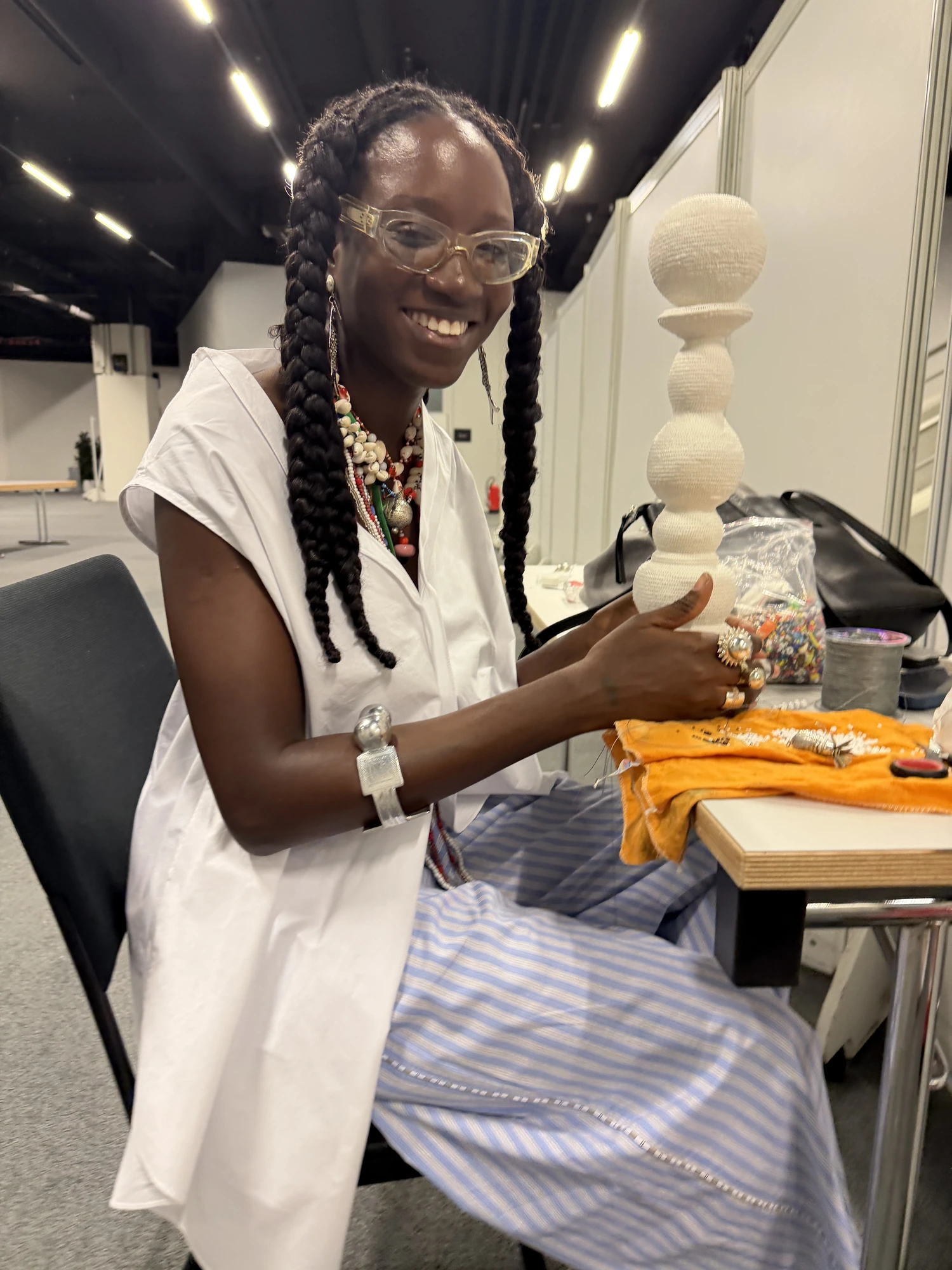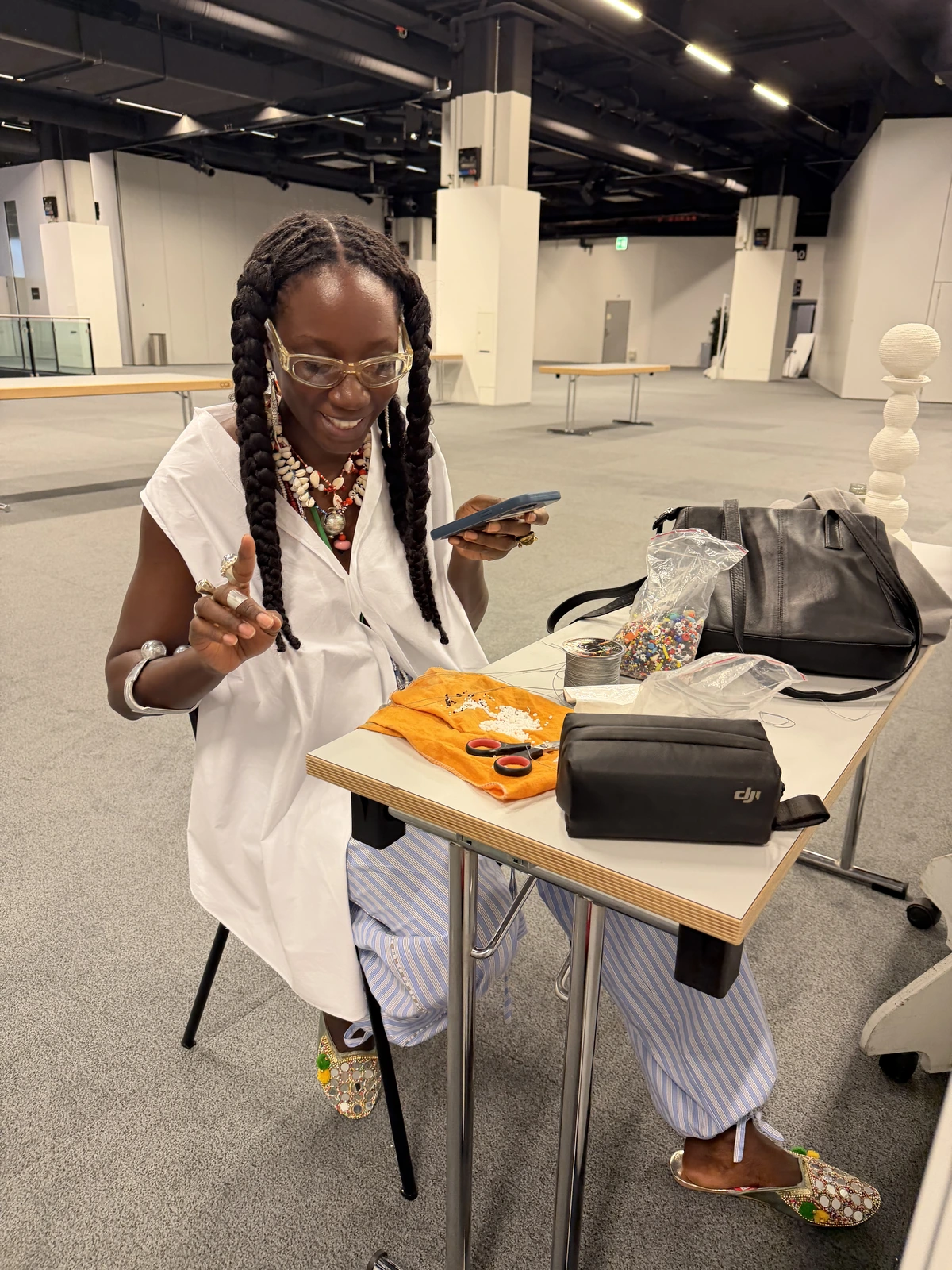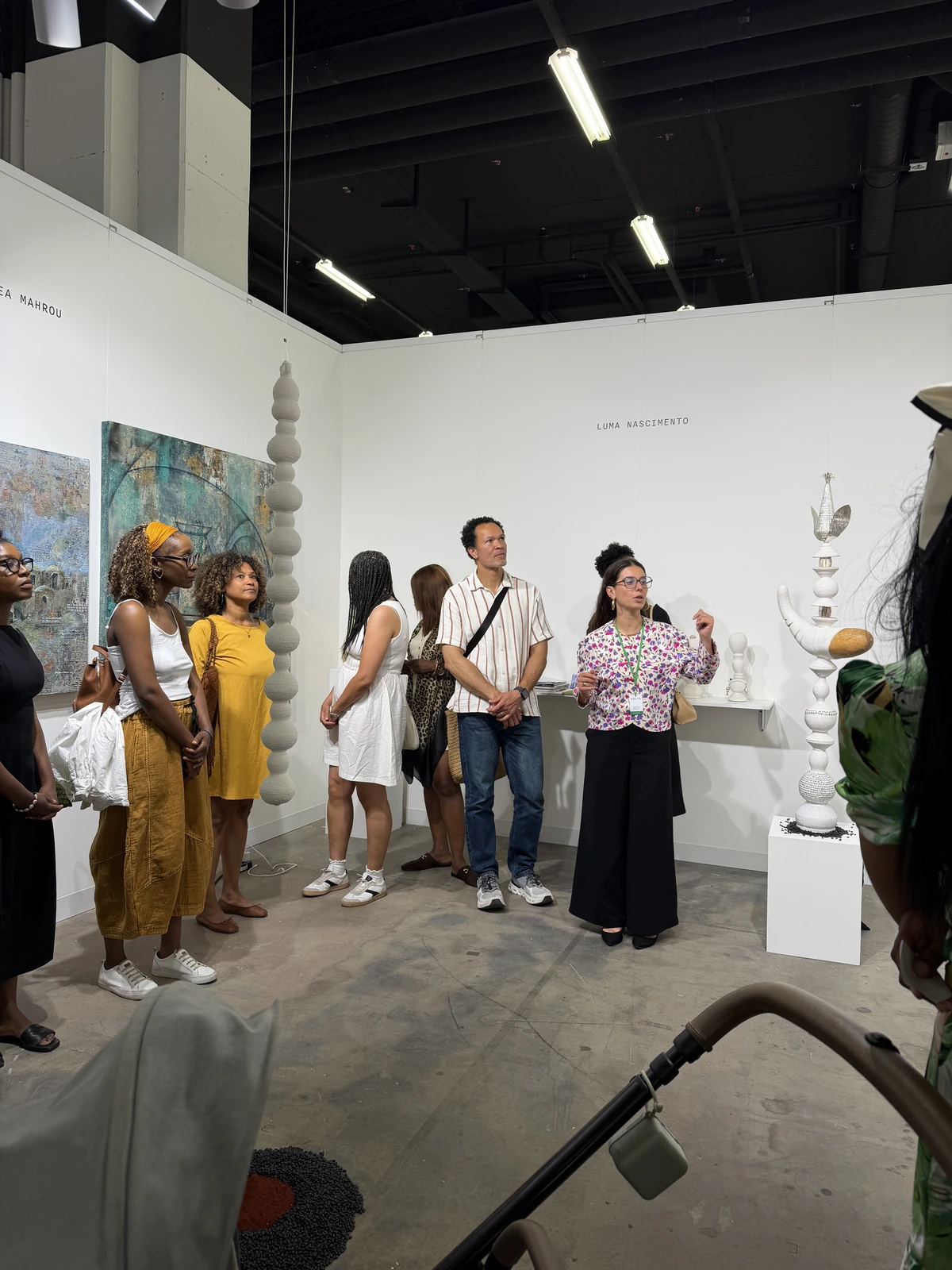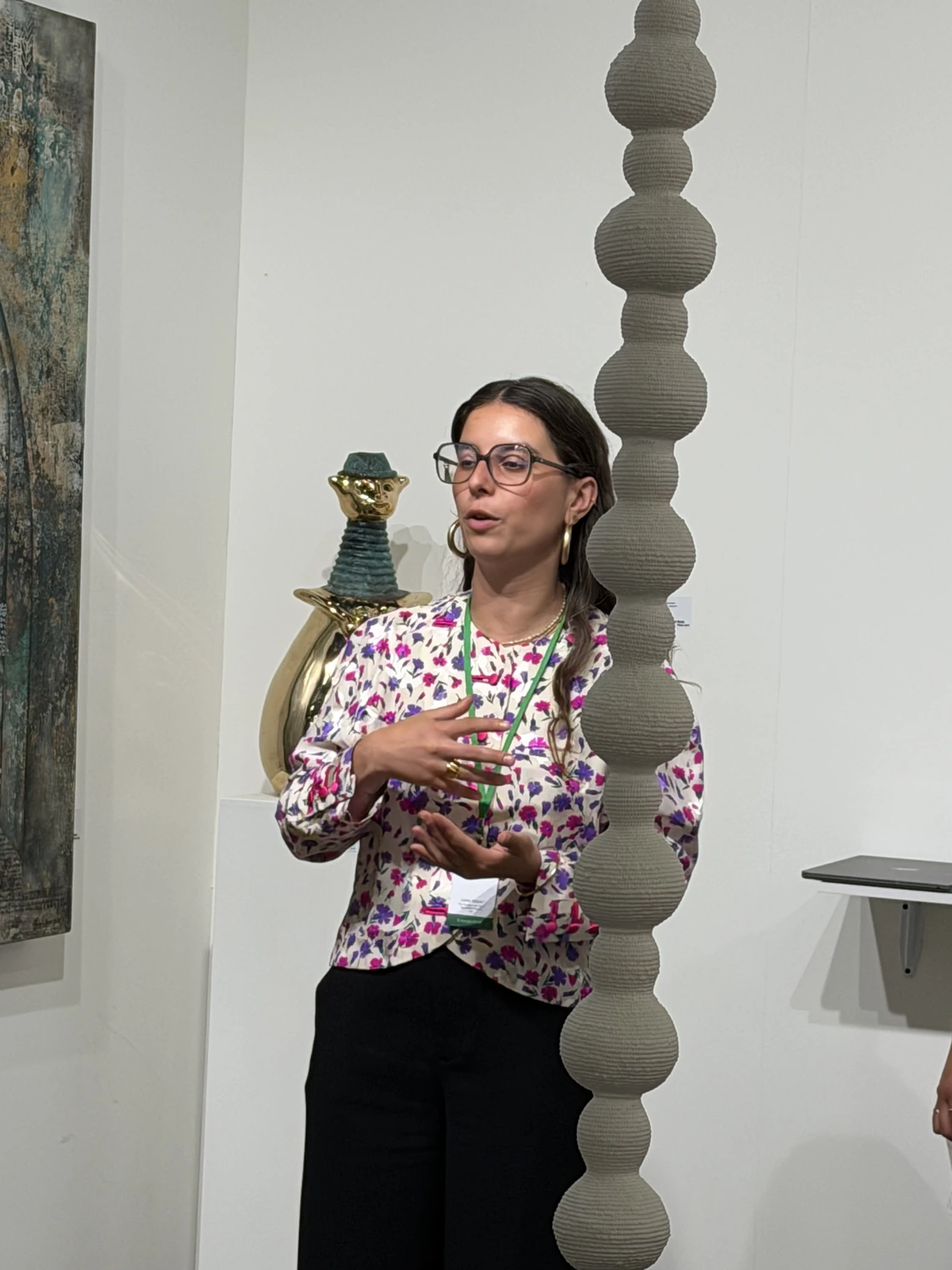
Luma Nascimento remakes a balangandã in Basel: the charm jewellery that held the savings of Black women in Bahia, and was pledged to buy letters of freedom.Luma Nascimento refaz um balangandã em Basileia: a joia de pingentes que guardava as economias de mulheres negras na Bahia e era penhorada por cartas de alforria.
VOLTA, Basel · June 2026VOLTA, Basileia · junho de 2026
An artistic conversationUma conversa artística
Written and moderated by Tallulah Patricia BärEscrito e moderado por Tallulah Patricia Bär
Brazil ↔ BaselBrasil ↔ Basileia
VOLTA Basel · June 2026VOLTA Basel · junho de 2026
Sculpture · Material memory · DiasporaEscultura · Memória material · Diáspora
Adornment · Value · FreedomAdorno · Valor · Liberdade
The conversation began badly, in the useful sense. She was working, I was in the way, and neither of us had the language for what she was making.A conversa começou mal, no sentido útil. Ela estava trabalhando, eu estava no caminho, e nenhuma de nós tinha a língua para aquilo que ela fazia.
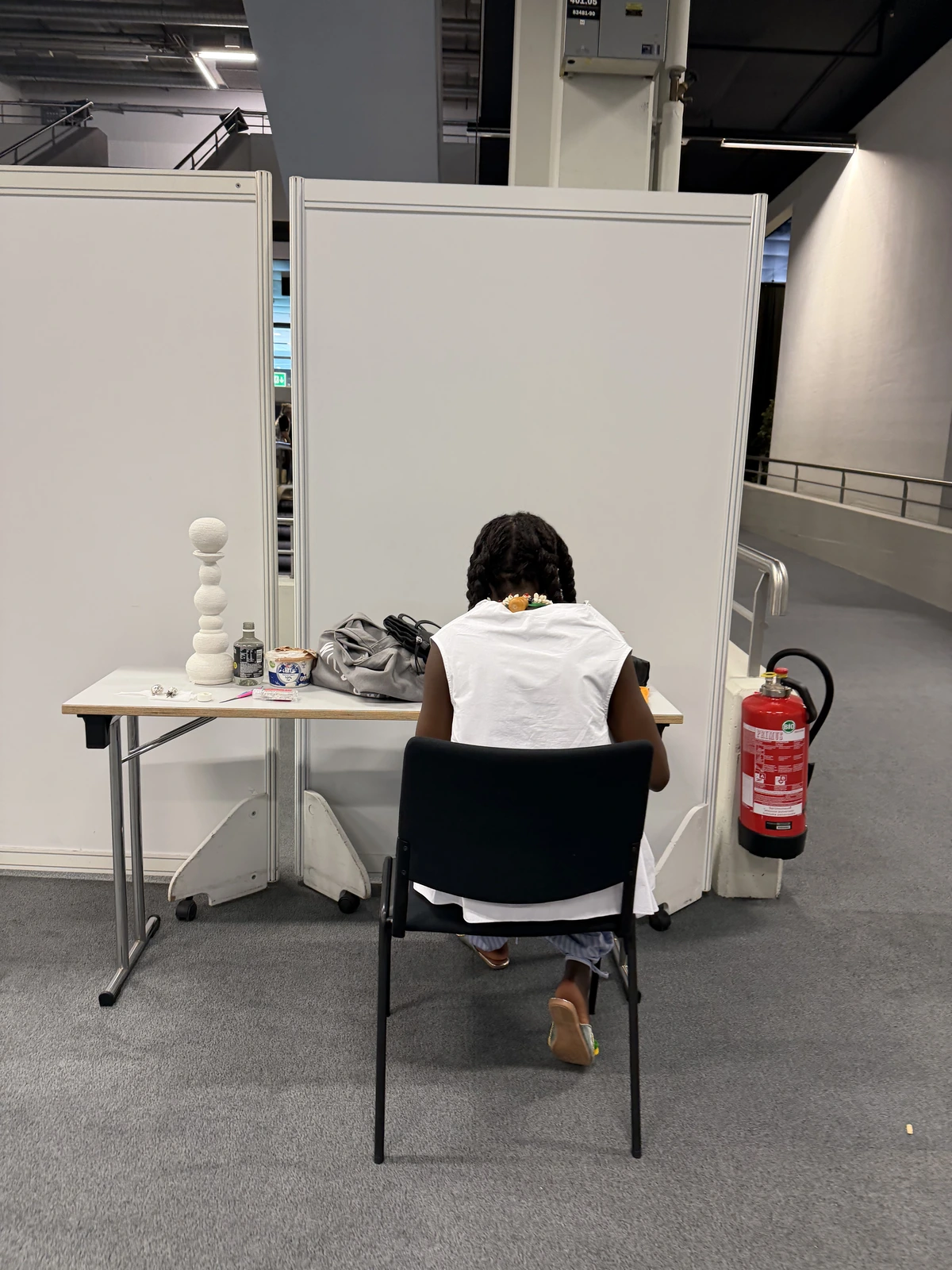
It was the second day of VOLTA in Basel. Luma Nascimento was seated at a folding table behind the booth walls, finishing a piece, and I asked her the two questions you ask a stranger at an art fair: what is your name, and where are you from. Brazil, she said. She apologised for her English, which she did not need to do, and we managed for a while in a mixture of English and the four words of Portuguese I possess.Era o segundo dia da VOLTA em Basileia. Luma Nascimento estava sentada a uma mesa dobrável atrás das paredes do estande, terminando uma peça, e eu lhe fiz as duas perguntas que se fazem a uma desconhecida numa feira de arte: qual é o seu nome e de onde você é. Do Brasil, ela disse. Pediu desculpas pelo seu inglês, o que não era necessário, e nos entendemos por um tempo numa mistura de inglês e das quatro palavras de português que eu tenho.
Then I asked whether she would rather speak Portuguese, and she said yes, and for the next ninety seconds I understood almost nothing.Então perguntei se ela preferia falar português, ela disse que sim, e pelos noventa segundos seguintes eu não entendi quase nada.
It was one of the more interesting ninety seconds of the fair.Foram alguns dos noventa segundos mais interessantes da feira.
The ObjectO Objeto
What she was assembling was, in her own description, a jewel made for a sculpture rather than for a body. It would hang the way such objects once hung in Brazil, at the waists of women, some time ago.O que ela montava era, na sua própria descrição, uma joia feita para uma escultura, e não para um corpo. Ficaria pendurada como esses objetos ficavam no Brasil, na cintura das mulheres, em alguns tempos atrás.
It has a name, and she repeated it twice so that I would hear it properly. Balangandã.O objeto tem um nome, e ela o repetiu duas vezes para que eu o ouvisse direito. Balangandã.
Pencaa bouquet of charms on a clasp, worn at the waist or the wrist.um buquê de pingentes num fecho, usado na cintura ou no pulso.
Gold and silverOuro e pratawith bone, coral, wood and stone among the charms.com osso, coral, madeira e pedra entre os pingentes.
17th to 19th c.Séc. XVII ao XIXmost actively worn in the eighteenth and nineteenth centuries, in Bahia.usados sobretudo nos séculos XVIII e XIX, na Bahia.
27 pencasat the Museu Carlos Costa Pinto in Salvador. Twenty six in silver, one in gold.no Museu Carlos Costa Pinto, em Salvador. Vinte e seis em prata, uma em ouro.
The word does two jobs at once. Penca means bouquet, because the charms cluster tightly together. Balangandã is onomatopoeic: it is the sound the metal makes when a woman walks.O nome faz duas coisas ao mesmo tempo. Penca quer dizer buquê, porque os pingentes se agrupam bem juntos. Balangandã é onomatopeico: é o som que o metal faz quando uma mulher caminha.
They were made in Bahia, in the northeast of Brazil, from the seventeenth century onward and most actively through the eighteenth and nineteenth. A clasp of gold or silver carried a curated group of pendants, worn at the waist or the wrist. The charms were syncretic by design, holding Catholic symbols and Afro Brazilian orixás in the same object, and each owner assembled her own set for the protection she specifically wanted. Alongside the metal there were pieces of bone, coral, wood and stone.Eram feitos na Bahia, no nordeste do Brasil, a partir do século XVII e sobretudo ao longo dos séculos XVIII e XIX. Um fecho de ouro ou prata sustentava um conjunto escolhido de pingentes, usado na cintura ou no pulso. Os pingentes eram sincréticos por concepção, reunindo símbolos católicos e orixás afro-brasileiros no mesmo objeto, e cada proprietária montava o seu conjunto conforme a proteção que desejava. Ao lado do metal havia peças de osso, coral, madeira e pedra.
Museums now hold them as documents. The largest collection sits at the Museu Carlos Costa Pinto in Salvador, twenty seven pencas, twenty six of them silver and one gold, acquired in the early twentieth century when Bahian families were selling off what an economic slump had made expensive to keep.Hoje os museus os guardam como documentos. A maior coleção está no Museu Carlos Costa Pinto, em Salvador: vinte e sete pencas, vinte e seis delas em prata e uma em ouro, adquiridas no início do século XX, quando famílias baianas vendiam aquilo que uma estagnação econômica tornara caro de manter.
None of that is what Luma told me, and none of it is what mattered in the moment. She told me what the object was for.Nada disso foi o que Luma me contou, e nada disso era o que importava naquele momento. Ela me contou para que servia o objeto.
In colonial Brazil, Black women could not put money in a bank. Not as a matter of preference or custom, but as a matter of exclusion. So the money went where it could be kept, which was on the body.No Brasil colonial, mulheres negras não podiam guardar dinheiro em banco. Não por preferência nem por costume, mas por exclusão. Então o dinheiro foi para onde podia ser guardado, que era o corpo.
Português
As mulheres confeccionavam balangandãs, que tava muito representando o poder aquisitivo dessas mulheres, mas também era uma forma delas guardarem o dinheiro.
English
The women made balangandãs, which strongly represented these women's purchasing power, but were also a way for them to keep their money.
Luma Nascimento, Basel, June 2026
The historical record supports her precisely. In Brazil's urban centres, enslaved people working under the ganho system, hired out for wages, surrendered most of what they earned and were permitted to retain a portion. Enslaved and freed Afro Brazilians spent that remainder with local goldsmiths and silversmiths. The pieces were valuable enough to be named individually in wills and fought over by executors.O registro histórico a confirma com precisão. Nos centros urbanos do Brasil, pessoas escravizadas que trabalhavam no sistema de ganho, alugadas por salário, entregavam a maior parte do que recebiam e podiam reter uma parcela. Pessoas escravizadas e libertas gastavam essa parcela com ourives e prateiros locais. As peças tinham valor suficiente para serem nomeadas individualmente em testamentos e disputadas em inventários.
So the balangandã is usually described as adornment, and it is. It is also a savings account, a portfolio and a proof of solvency, worn where everybody could see it, by women the formal economy had refused to serve.O balangandã costuma ser descrito como adorno, e ele é. Também é uma conta de poupança, uma carteira de bens e uma prova de solvência, usada onde todos podiam ver, por mulheres a quem a economia formal se recusara a atender.
Excluded from the institution, they built a smaller one and wore it.Excluídas da instituição, elas construíram uma menor e a vestiram.
Then she said the thing I did not understand until much later, and which is the reason this piece exists.Foi então que ela disse a coisa que eu só entendi muito depois, e que é a razão pela qual este texto existe.
Português
Esse mesmo balangandã de ouro e de prata eram usados para penhorar alforrias, então elas libertavam pessoas.
English
These same balangandãs of gold and silver were used as pledges towards letters of freedom, so they freed people.
Luma Nascimento, Basel, June 2026
An alforria was a carta de alforria, a letter of liberty, drawn up before a notary and naming the person being freed. Payment was recorded in it, which is why historians can now track what freedom cost in a given decade. Enslaved people in Brazil bought these letters far more often than the sentimental version of the story allows, sometimes in instalments under an arrangement called coartação, and the notarial archives in Salvador hold the paperwork.Uma alforria era a carta de alforria, lavrada em cartório e nomeando a pessoa libertada. O pagamento era registrado nela, e é por isso que historiadores conseguem hoje acompanhar quanto custava a liberdade em cada década. Pessoas escravizadas no Brasil compraram essas cartas com muito mais frequência do que admite a versão sentimental da história, por vezes em prestações, sob um arranjo chamado coartação, e os arquivos notariais de Salvador guardam a documentação.
What Luma added is where some of that money had been kept. Not in an account. On a hip. A woman pawned the metal she wore, a letter was signed, a person walked out of ownership, and afterwards, she said, the objects were bought back.O que Luma acrescentou é onde parte desse dinheiro estava guardada. Não numa conta. Na cintura. Uma mulher penhorava o metal que usava, uma carta era assinada, uma pessoa saía da condição de propriedade e, depois, ela disse, os objetos eram comprados de volta.
Two wordsDuas palavras
Elas libertavam.
They freed people. The same gold a woman wore at her waist could be pledged for a letter of liberty, and afterwards redeemed. The adornment was working capital, and the return on it was somebody's life.Elas libertavam pessoas. O mesmo ouro que uma mulher usava na cintura podia ser penhorado por uma carta de liberdade e, depois, resgatado. O adorno era capital de giro, e o retorno sobre ele era a vida de alguém.
It is worth resisting the word craft here, because it flattens what is going on. A balangandã performs at least four functions at once: it stores value, it signals creditworthiness, it carries spiritual protection, and it can be liquidated at short notice for a specific and enormous purchase. That is a financial instrument with a religious layer, engineered by people excluded from every formal version of the same thing.Vale resistir aqui à palavra artesanato, porque ela achata o que está em jogo. Um balangandã cumpre pelo menos quatro funções ao mesmo tempo: armazena valor, sinaliza capacidade de crédito, carrega proteção espiritual e pode ser liquidado em pouco tempo para uma compra específica e enorme. Isso é um instrumento financeiro com uma camada religiosa, criado por pessoas excluídas de todas as versões formais da mesma coisa.
What happened to the object afterwards is its own story. From the 1930s the balangandã was absorbed into a state sponsored idea of Bahia, and from the 1950s into an image of baianidade sold to visitors, until the thing most people recognise is a decorative bunch of charms rather than a mechanism for buying human freedom.O que aconteceu depois com o objeto é outra história. A partir dos anos 1930, o balangandã foi absorvido por uma ideia de Bahia patrocinada pelo Estado e, a partir dos anos 1950, por uma imagem de baianidade vendida a visitantes, até que o que a maioria reconhece é um conjunto decorativo de pingentes, e não um mecanismo para comprar a liberdade de pessoas.
Luma is not restoring the object. She is doing something more useful with it.Luma não está restaurando o objeto. Ela está fazendo algo mais útil com ele.
Nascimento was born in 1991 and works across sculpture, installation, audiovisual performance and computational processes, under a heading she describes as Afrovisualities. Her continuing series is called Corpo Documento, the body as document. She builds by accumulation, stacking glass beads, ceramic forms and collected earth, and her installations have used soil from quilombola territories, treating ground not as a surface but as a means of inscription and circulation.Nascimento nasceu em 1991 e trabalha com escultura, instalação, performance audiovisual e processos computacionais, num campo que ela descreve como Afrovisualidades. Sua série em curso se chama Corpo Documento. Ela constrói por acumulação, empilhando miçangas de vidro, formas cerâmicas e terra coletada, e suas instalações já usaram solo de territórios quilombolas, tratando o chão não como superfície, mas como meio de inscrição e circulação.
Which makes the balangandã an unusually exact object for her to be holding. It is already a body used as a document, and already a technology of circulation.O que faz do balangandã um objeto de exatidão incomum nas mãos dela. Ele já é um corpo usado como documento, e já é uma tecnologia de circulação.
Português
Eu uso isso especificamente porque pra mim é um tipo de memória, criar um espaço de condição pra gente revisitar essas possibilidades de transformar as energias e criar outras condições possíveis.
English
I use this specifically because for me it is a kind of memory, creating a space, a condition, for us to revisit these possibilities of transforming energies and creating other possible conditions.
Luma Nascimento, Basel, June 2026
Read that beside the history and it stops sounding abstract. The balangandã is evidence that a condition thought to be total was not total. Money moved anyway. Freedom was bought anyway. Institutions were improvised on the body when the official ones were closed. Making the object again, in Basel, at a fair, is a way of putting that evidence back into circulation.Leia isso ao lado da história e deixa de soar abstrato. O balangandã é prova de que uma condição tida como total não era total. O dinheiro circulou de todo modo. A liberdade foi comprada de todo modo. Instituições foram improvisadas no corpo quando as oficiais estavam fechadas. Refazer o objeto, em Basileia, numa feira, é uma forma de recolocar essa prova em circulação.
Attention came first. Understanding caught up later.A atenção veio primeiro. A compreensão chegou depois.
I want to be honest about my own position in this. For most of that conversation I was an audience for a language I do not speak, watching a woman explain something that clearly mattered to her, and following it through her hands, the pace of her voice and the care she was giving to a small object.Quero ser honesta sobre a minha própria posição nisso. Durante a maior parte daquela conversa eu fui plateia de uma língua que não falo, observando uma mulher explicar algo que claramente lhe importava, e acompanhando pelas mãos dela, pelo ritmo da voz e pelo cuidado que dedicava a um objeto pequeno.
I understood that something significant was being shared long before I understood what it was. The transcript and the translation came afterwards, and they told me the history. They did not tell me to pay attention. The sculpture had already done that.Entendi que algo importante estava sendo compartilhado muito antes de entender o que era. A transcrição e a tradução vieram depois, e me contaram a história. Não me disseram para prestar atenção. A escultura já havia feito isso.
This is worth naming because the art world often has the order backwards. It assumes that comprehension precedes interest, that the wall text does the work, that a viewer needs context before they can care. Frequently it runs the other way. Something holds you, and then you go and find out why.Vale nomear isso porque o mundo da arte muitas vezes inverte a ordem. Ele supõe que a compreensão precede o interesse, que o texto de parede faz o trabalho, que quem olha precisa de contexto antes de poder se importar. Com frequência acontece o contrário. Algo te segura, e depois você vai descobrir por quê.
It also matters for who gets heard. A person speaking their second language haltingly is easy to underestimate, and a person speaking their first language fluently in front of someone who does not share it is easy to dismiss. Both were available to me in the space of five minutes, and in both cases the object kept the conversation open.Isso também importa para quem é ouvido. Uma pessoa que fala sua segunda língua com hesitação é fácil de subestimar, e uma pessoa que fala sua primeira língua com fluência diante de quem não a compartilha é fácil de descartar. As duas coisas estiveram à minha disposição em cinco minutos, e nos dois casos foi o objeto que manteve a conversa aberta.
Art creates a connection before translation arrives. It invites curiosity before understanding.A arte cria uma conexão antes que a tradução chegue. Ela convida à curiosidade antes da compreensão.
Luma finished the piece. It hung in the fair. Most people who walked past it will have seen a beautiful arrangement of metal, which is a reasonable thing to see.Luma terminou a peça. Ela ficou pendurada na feira. A maioria de quem passou ao lado verá um belo arranjo de metal, o que é uma coisa razoável de se ver.
Some of them will have stayed a little longer.Algumas dessas pessoas terão ficado um pouco mais.
The terms, in more detailOs termos, em mais detalhe
Charm jewellery from the northeastern state of Bahia. Penca means bouquet, describing how tightly the charms cluster; balangandã is onomatopoeic for the sound they make against one another. A clasp of gold or silver carried a set of pendants worn at the waist or the wrist, curated by the wearer for the protection she wanted, and mixing Catholic symbolism with Afro Brazilian orixás in a single object. They are associated with Black lay brotherhoods and sisterhoods and were worn at religious celebrations, among them the festival of Senhor do Bonfim in Salvador.Joia de pingentes feita no estado da Bahia, no nordeste. Penca quer dizer buquê, pela forma como os pingentes se agrupam; balangandã é onomatopeia do som que fazem uns contra os outros. Um fecho de ouro ou prata sustentava um conjunto de pingentes usado na cintura ou no pulso, escolhido por quem o usava conforme a proteção desejada, misturando simbologia católica e orixás afro-brasileiros num só objeto. Estão associados a irmandades negras e eram usados em festas religiosas, entre elas a festa do Senhor do Bonfim, em Salvador.
Under the ganho system, enslaved people in Brazilian cities were hired out for wages, surrendered the bulk of their earnings and were permitted to retain a portion. That retained portion is what bought the jewellery. The Smithsonian's National Museum of African American History and Culture describes enslaved and freed Afro Brazilians buying pieces from local artisans as cultural expression, spiritual protection and a store of wealth at once, and notes that the objects were valuable enough to be written into wills as assets to be adjudicated.No sistema de ganho, pessoas escravizadas nas cidades brasileiras eram alugadas por salário, entregavam a maior parte do que recebiam e podiam reter uma parcela. Essa parcela retida é o que comprava as joias. O National Museum of African American History and Culture, do Smithsonian, descreve pessoas escravizadas e libertas comprando peças de artesãos locais como expressão cultural, proteção espiritual e reserva de valor ao mesmo tempo, e observa que os objetos tinham valor suficiente para constar em testamentos como bens a partilhar.
A letter of liberty, drawn up before a notary, identifying the owner and the person being freed, often with age, colour and birthplace, and recording any payment made. Because the sums were written down, historians have been able to reconstruct the price of freedom decade by decade. Manumission took several forms: unconditional, purchased outright, or conditional on a term of service or the owner's death. Self purchase became more common over time, as enslaved people pursued freedom rather than waiting for it to be granted.Uma carta de liberdade, lavrada em cartório, identificando o proprietário e a pessoa libertada, muitas vezes com idade, cor e naturalidade, e registrando qualquer pagamento feito. Porque as somas eram anotadas, historiadores conseguiram reconstruir o preço da liberdade década a década. A alforria assumia várias formas: incondicional, comprada à vista ou condicionada a um período de serviço ou à morte do proprietário. A compra da própria liberdade tornou-se mais comum ao longo do tempo, com pessoas escravizadas buscando a liberdade em vez de esperar que fosse concedida.
An arrangement in which a price for freedom was fixed and paid over time, leaving the person in an intermediate status until the balance was cleared. It was most widespread in the mining regions, where cash circulated and where more people were freed during the height of gold extraction than during its decline. Scholars differ on how much agency it gave: some read it as owners protecting an investment, others as enslaved people using the available legal machinery. Both readings can be true at once.Um arranjo em que se fixava um preço pela liberdade, pago ao longo do tempo, deixando a pessoa numa condição intermediária até que o saldo fosse quitado. Era mais difundido nas regiões mineradoras, onde circulava dinheiro e onde mais pessoas foram libertadas no auge da extração de ouro do que em seu declínio. Historiadores divergem sobre quanta agência isso conferia: alguns leem como proprietários protegendo um investimento, outros como pessoas escravizadas usando a maquinaria jurídica disponível. As duas leituras podem ser verdadeiras ao mesmo tempo.
The museum holds the largest museum collection of balangandãs anywhere, twenty seven pencas, twenty six in silver and one in gold, within a wider holding of joias de crioulas. The pieces were bought in Salvador in the early twentieth century, during a period of economic stagnation in Bahia that pushed families connected to the old rural aristocracy to sell. The National Historical Museum in Rio de Janeiro holds further examples. The route from private object to museum document runs through a slump.O museu guarda a maior coleção museológica de balangandãs do mundo, vinte e sete pencas, vinte e seis em prata e uma em ouro, dentro de um acervo mais amplo de joias de crioulas. As peças foram compradas em Salvador no início do século XX, num período de estagnação econômica na Bahia que levou famílias ligadas à antiga aristocracia rural a vender. O Museu Histórico Nacional, no Rio de Janeiro, guarda outros exemplares. O caminho do objeto privado ao documento de museu passa por uma crise.
Nascimento's continuing series treats the body as a spatial document. She works by accumulation and stacking, using glass beads, ceramic forms and collected earth, and has incorporated soil from quilombola territories into installations, proposing the ground as a technology of inscription and circulation rather than a passive surface. She describes the field of her work as Afrovisualities, and structures memory as a spatial condition rather than a subject. The balangandã sits inside that logic exactly: an object in which a body was used to hold, carry and move value.A série em curso de Nascimento trata o corpo como documento espacial. Ela trabalha por acumulação e empilhamento, com miçangas de vidro, formas cerâmicas e terra coletada, e incorporou solo de territórios quilombolas em instalações, propondo o chão como tecnologia de inscrição e circulação, e não como superfície passiva. Ela descreve o campo de seu trabalho como Afrovisualidades e estrutura a memória como condição espacial, e não como tema. O balangandã se encaixa exatamente nessa lógica: um objeto em que um corpo foi usado para guardar, carregar e mover valor.
Luma Nascimento was born in Brazil in 1991 and describes herself as a researcher and visual artist. She works across sculpture, installation, audiovisual performance and computational processes, with a focus she calls Afrovisualities, and her continuing series Corpo Documento treats the body as a spatial document. She showed at VOLTA in Basel in June 2026 with The Southern Art Hub and Janet Rady Fine Art, and assembled a balangandã for a sculpture on site.Luma Nascimento nasceu no Brasil em 1991 e se descreve como pesquisadora e artista visual. Trabalha com escultura, instalação, performance audiovisual e processos computacionais, num campo que chama de Afrovisualidades, e sua série em curso Corpo Documento trata o corpo como documento espacial. Participou da VOLTA em Basileia em junho de 2026 com The Southern Art Hub e Janet Rady Fine Art, e montou no local um balangandã para uma escultura.
This feature is based on a conversation between Tallulah Patricia Bär and Luma Nascimento at VOLTA in Basel, recorded on site and transcribed afterwards. The conversation began in English and moved into Portuguese at Luma's suggestion.Esta matéria baseia-se numa conversa entre Tallulah Patricia Bär e Luma Nascimento na VOLTA, em Basileia, gravada no local e transcrita depois. A conversa começou em inglês e passou ao português por sugestão de Luma.
Only her Portuguese is quoted here. During the recording she asked that her English not be published, and that request is respected: the halting English passages have been left out entirely, and where her words appear they are given in Portuguese with an English rendering beside them. The English renderings, and the Portuguese version of this article, are the author's and should be read as translations rather than authorised text. Historical context is drawn from the references above and is the author's responsibility, not hers.Aqui se cita apenas o português dela. Durante a gravação, ela pediu que seu inglês não fosse publicado, e esse pedido é respeitado: as passagens hesitantes em inglês foram inteiramente omitidas, e onde suas palavras aparecem elas são dadas em português com uma versão em inglês ao lado. As versões em inglês, e a versão em português deste artigo, são da autora e devem ser lidas como traduções, e não como texto autorizado. O contexto histórico vem das referências acima e é responsabilidade da autora, não dela.