Where Love Becomes an Archive
Ikechukwu Nnadi on painting, fatherhood, family and the quiet power of tenderness
An essay by Tallulah Patricia Bär · Zürich, October 2026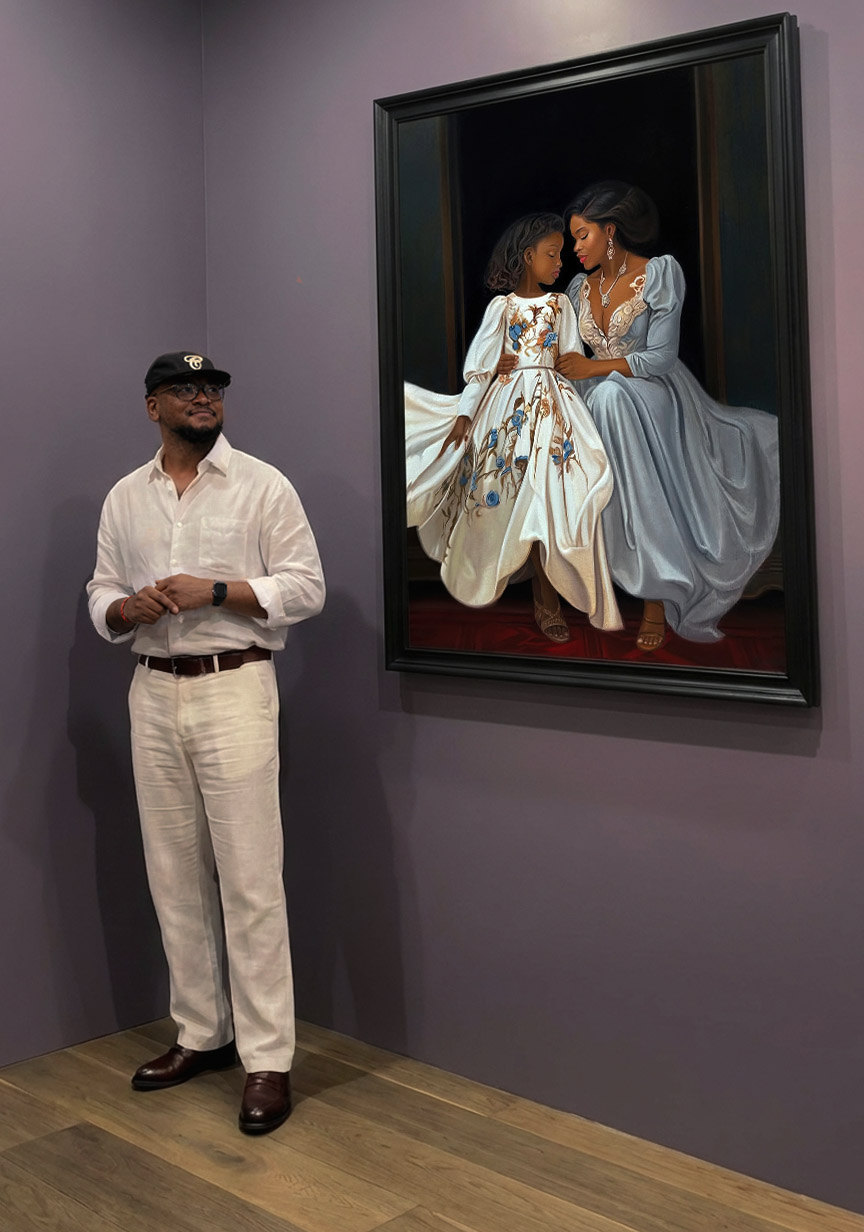
There is something strikingly quiet about Ikechukwu Nnadi’s work.
Mothers hold daughters. Women rest against one another. Fabric folds around bodies. Hands touch shoulders. Faces turn inward. The images are composed, intimate and warm. There is no obvious spectacle. No catastrophe. No demand that the people inside the paintings perform suffering, resistance or exceptional strength for the viewer.
Instead, Nnadi invites us to look at something beautifully ordinary, so familiar that it is easy to overlook, yet worth treasuring and remembering:
love.
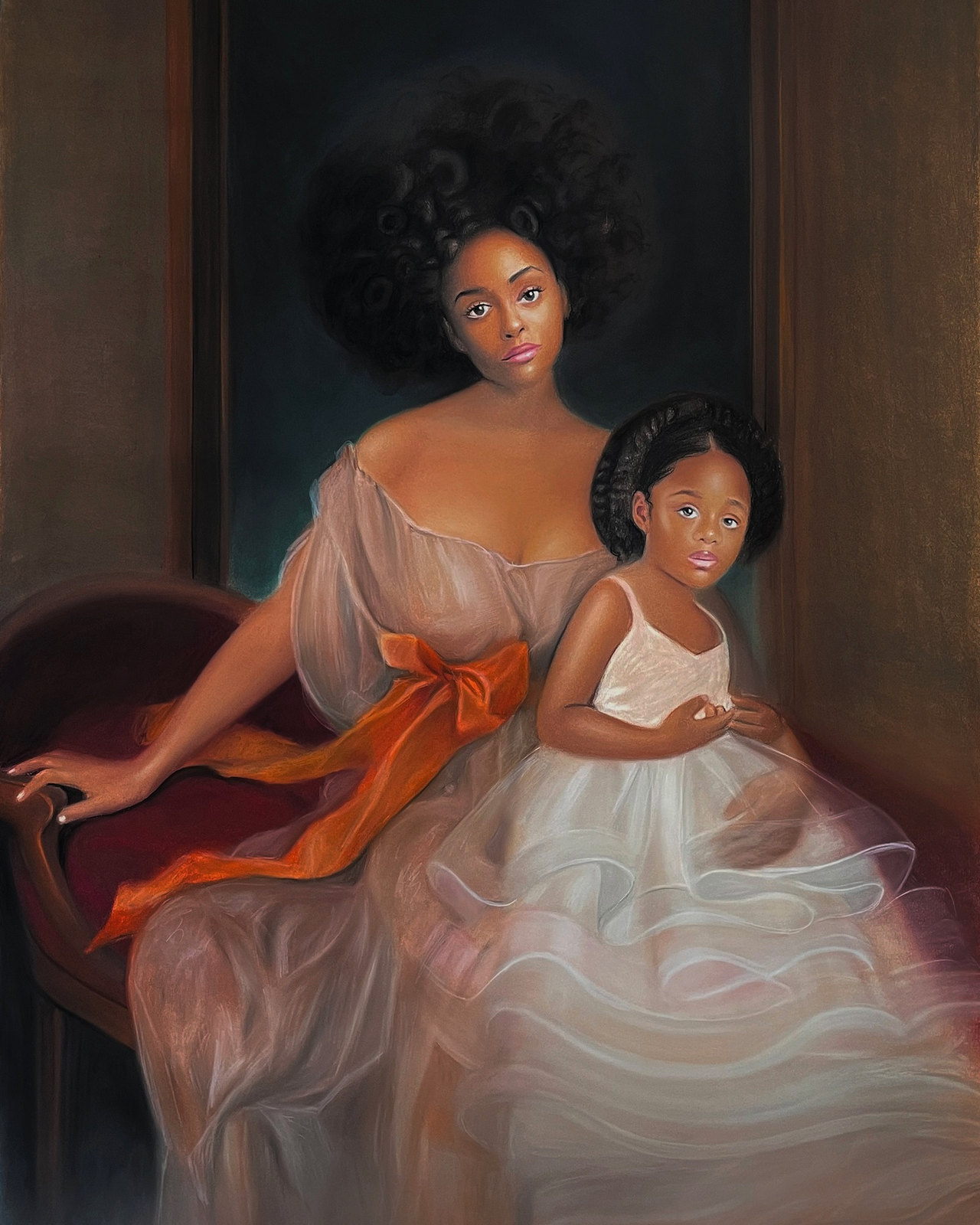
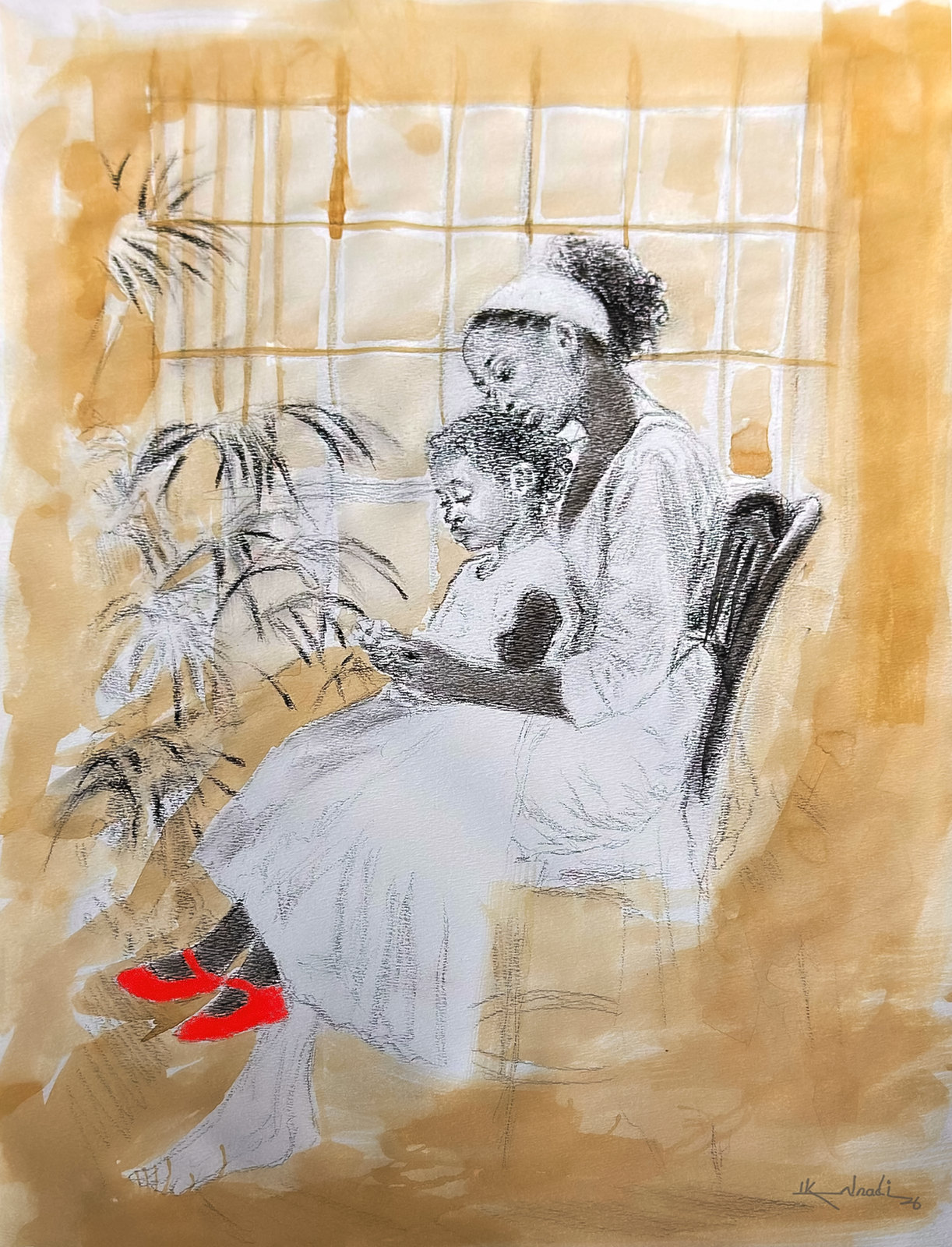
For the Nigerian artist, this interest is not theoretical. It emerged from his own home. Over the past several years, his wife and young daughter have increasingly become the emotional centre of his practice. He photographs them as they move through everyday life and later returns to those moments through painting. What begins as an ordinary domestic gesture can become a canvas.
- A child sleeping.
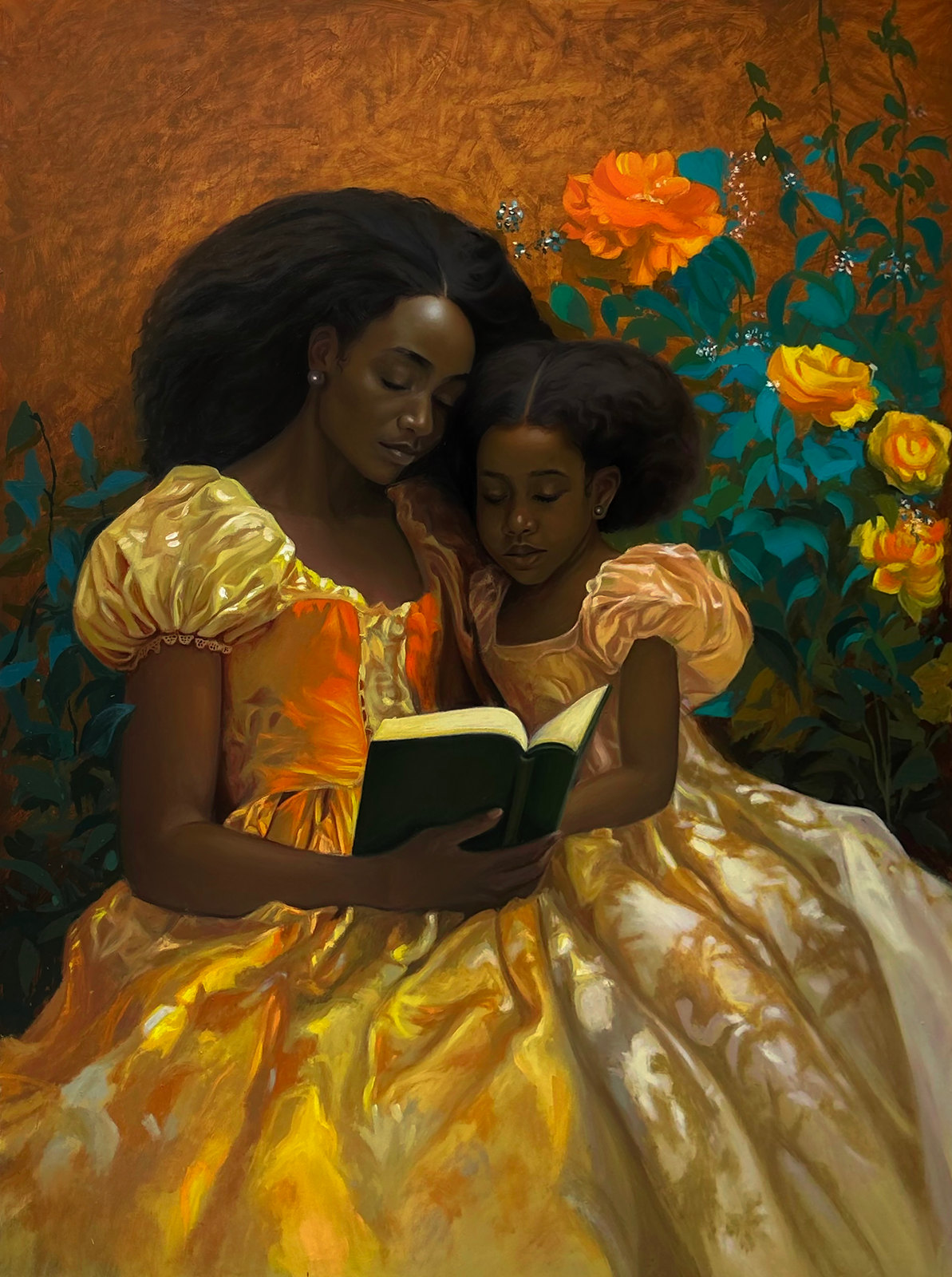
- A mother holding her daughter.
- A particular posture.
- The relationship between two bodies.
- A fleeting expression that might otherwise disappear.
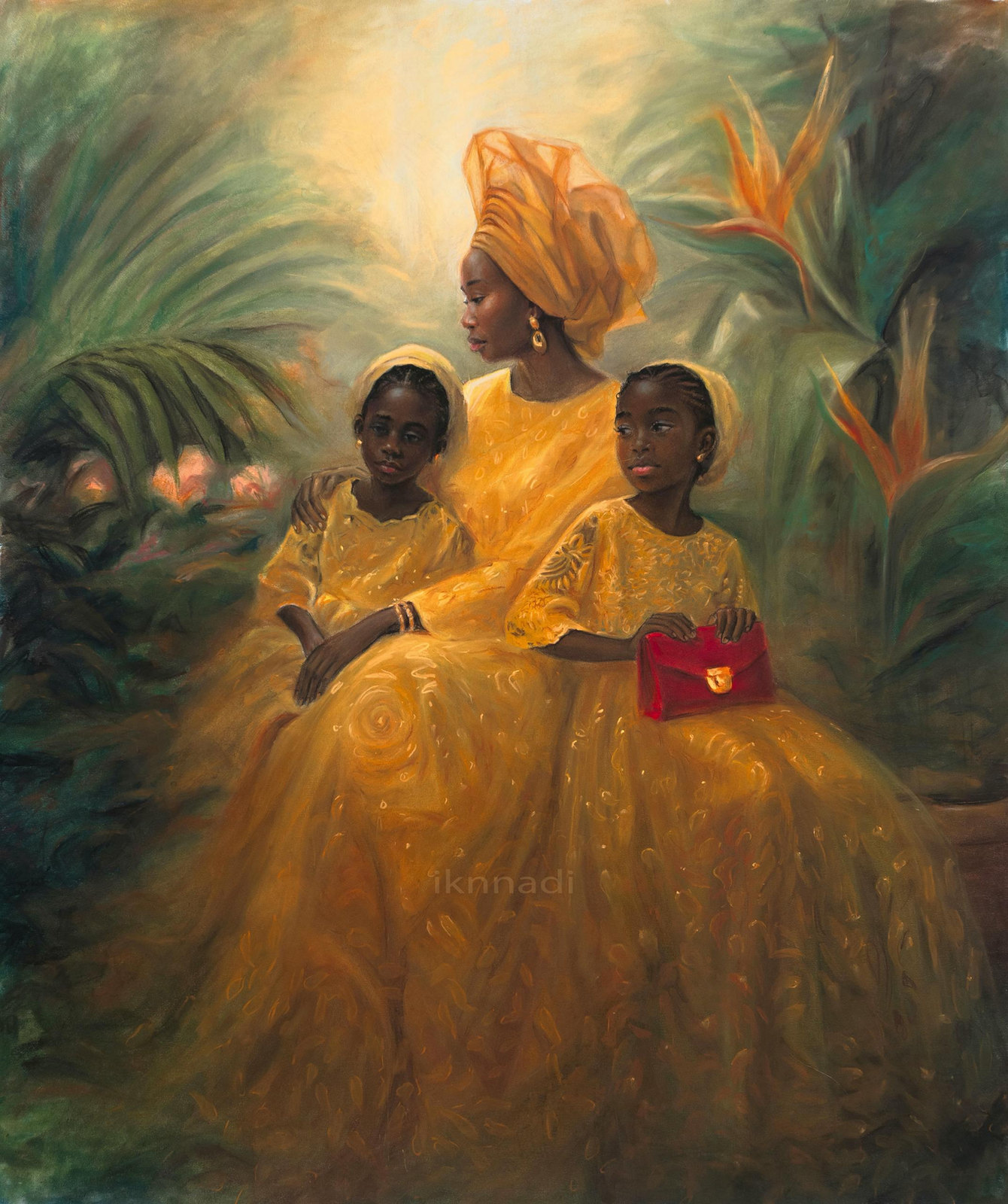
“I’m always with my camera,” he explains. “I’m always taking pictures of them.” The paintings that follow are therefore neither invented characters nor generic representations of motherhood. They originate inside relationships he knows intimately. Those relationships reach beyond his own home. Nnadi has also painted several women from his community with their daughters, and he and his wife are godparents to one of those girls. Even when the family in the painting is not his own, it is never a family of strangers.
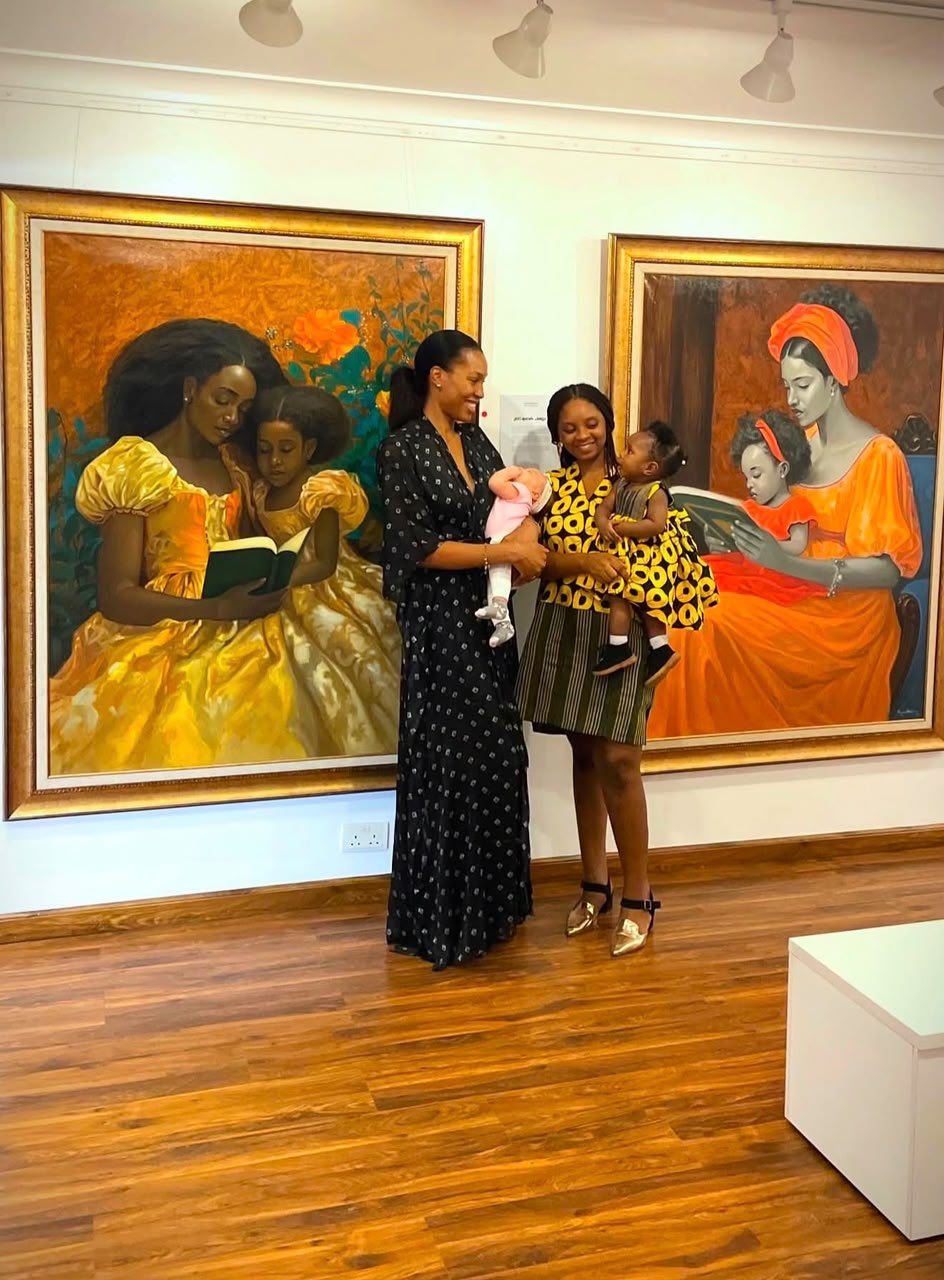
For Nnadi, this proximity matters. There must be truth somewhere underneath the image.
I always wanted to tell a story of what I feel is truth.
That conviction sits at the centre of his current practice.
From the south-east to the city of possibility
- Distance
- About 460 km from Enugu to Lagos as the crow flies: twice the distance from Zürich to Geneva, and across a language border too, from the Igbo-speaking south-east to the Yoruba-speaking south-west.
- Scale
- Nigeria is about 22 times the size of Switzerland. On the map, Switzerland is drawn to the same scale.
- People
- Lagos alone is home to more people than the whole of Switzerland.
01 Before the paintings came the drawingsThe medium changed. The instinct survived. +
Nnadi has been making things for as long as he can remember. Before he understood art as a profession, he drew. He was interested in crafts, images and making things with his hands. He eventually studied Fine and Applied Arts and began taking his professional practice seriously after completing his education.
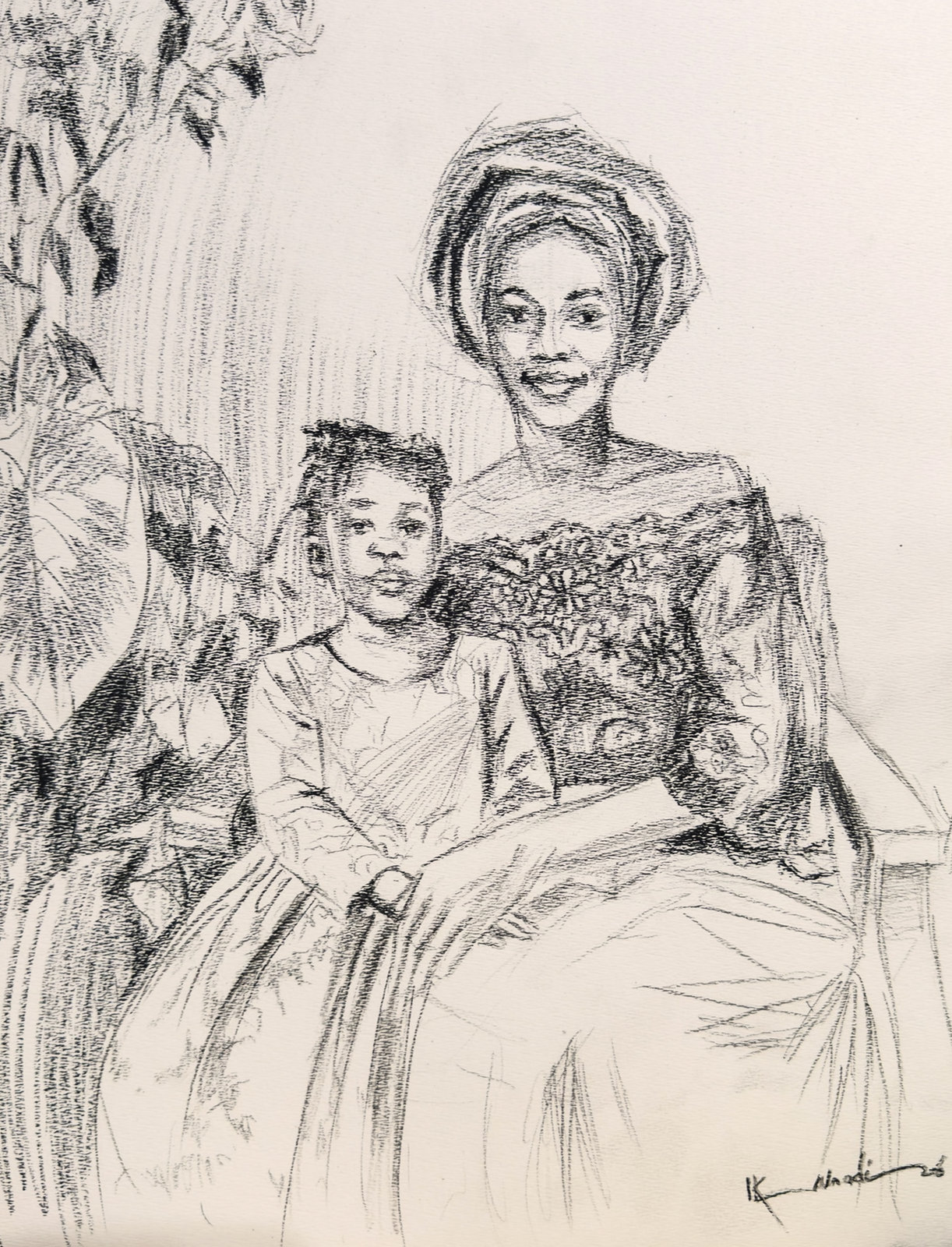
But becoming an artist required more than technical development. It required permission. Not institutional permission. Personal permission. Nnadi grew up in an environment in which art was not necessarily understood as a reliable life. The tension was particularly complicated because creativity already existed inside his family. His father had been a photographer. A very good one, as Nnadi remembers him.
But photography did not ultimately become his father’s long-term professional path. He moved into other forms of business, including real estate. That history shaped the way he responded to his son’s artistic ambitions. Rather than seeing artistic talent as sufficient justification for pursuing art, his father appears to have understood first-hand how uncertain a creative life could become.
Nnadi remembers bringing his artistic achievements home and hoping they might change that perception. At one point, his work appeared prominently in a newspaper. He showed the publication to his father. The response devastated him. His father dismissed its significance. Anyone could appear in such a newspaper, he suggested.
Perhaps he was afraid of what creativity could cost.
Nnadi still remembers the moment. But years later, he tells the story without turning his father into a villain. He interprets the reaction differently now. Perhaps his father was not rejecting creativity. Perhaps he was afraid of what creativity could cost. A man who had himself once been a photographer may have believed he was protecting his son from repeating a difficult path.
That does not make the experience painless. But it makes the inheritance more complex. The father who could not fully encourage his son’s artistic career was also one of the earliest image-makers in his life. Years later, the son would find himself walking through his own home with a camera, photographing his wife and daughter.
02 LeavingMoving to Lagos meant arriving in a city where he knew almost nobody. +
Sometimes artistic development begins with learning something new. Sometimes it begins with leaving something behind. For Nnadi, physical distance became important. After completing university, he remained around family for a period before eventually moving to Lagos in 2018. Part of the decision was practical. Part was psychological. He needed space. Space from expectations. Space from the recurring suggestion that eventually he might abandon art and return to something considered more secure.
Space from what he describes as a limiting belief system surrounding what an artistic life could become. Moving to Lagos meant arriving in a city where he knew almost nobody. But it also gave him something that familiarity had not. Freedom. He could decide what seriousness about art looked like for himself. The city became an important part of his development. His first exhibition followed in Lagos in 2018. Further opportunities came afterwards, including exhibitions outside Nigeria.
The international recognition mattered not simply because the work travelled. It changed something internally. It suggested that the path he had chosen could become a life. “I think it gave me clarity,” he says. “This is serious, and I need to be serious with this.” The transition is important.
At some point the question stopped being whether art would work. The question became how far he could take it.
03 Lagos“A land of opportunity,” he calls it. +
Nnadi speaks about Lagos with affection. It is difficult. It is intense. But to him, it is also a city of possibility. “A land of opportunity,” he calls it. The phrase might surprise anyone accustomed to hearing African cities described primarily through infrastructure failure, political dysfunction or economic crisis.
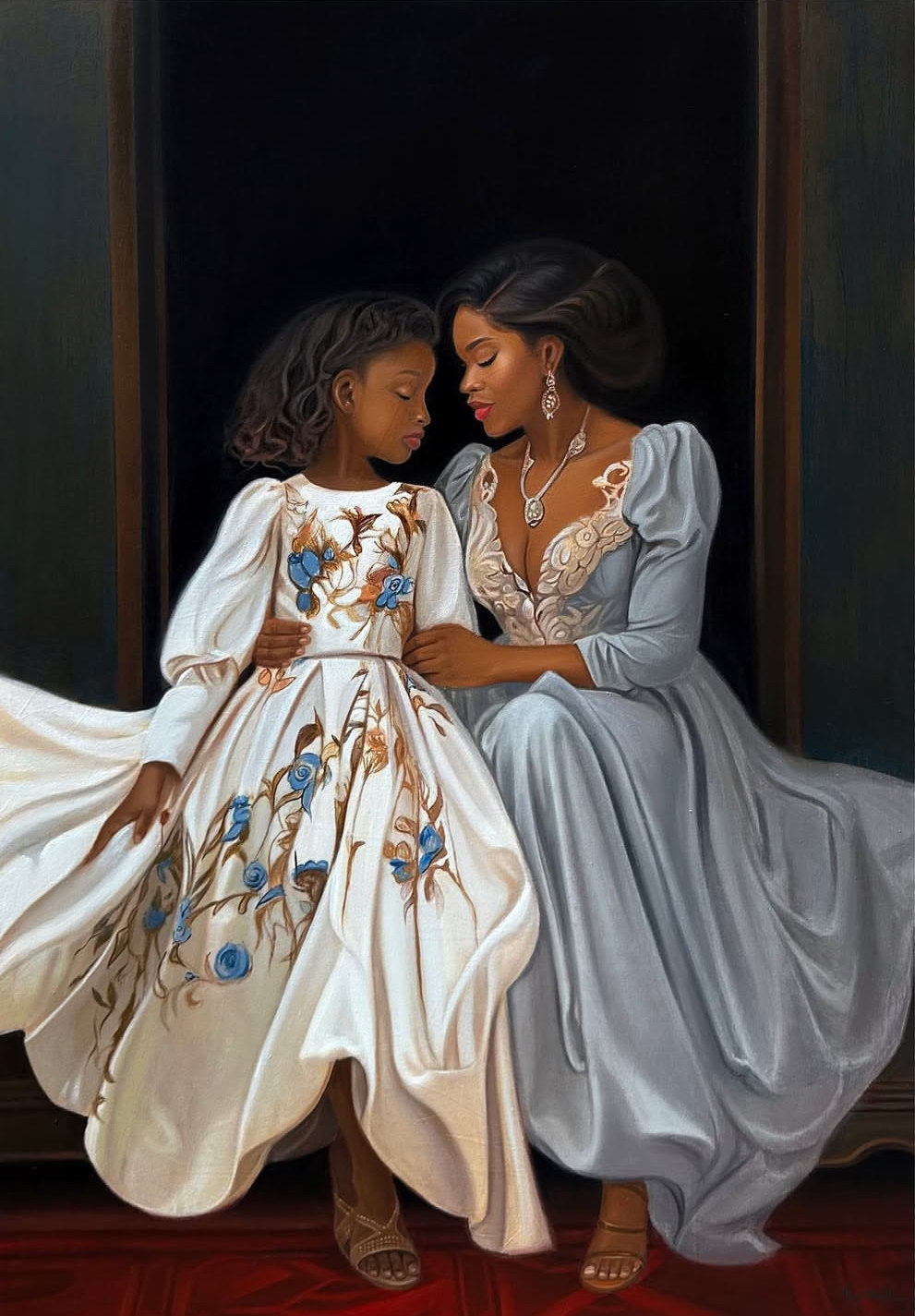
Nnadi sees something else.
- Energy. Ambition. Talent. Possibility.
He believes Nigerians carry an unusual drive to succeed, visible both inside the country and across its diaspora. Yet he is equally clear about one of the contradictions within that ecosystem. Artists largely build careers without the kind of sustained public infrastructure that could make creative work easier to maintain. He hopes that changes. Nigeria does not lack artists. It lacks enough systems around them.
Nigeria does not lack artists. It lacks enough systems around them.
For Nnadi, the question is therefore not whether talent exists. It is whether institutions will recognise what is already there.
04 Then came fatherhoodThe archive therefore grows alongside the family. +
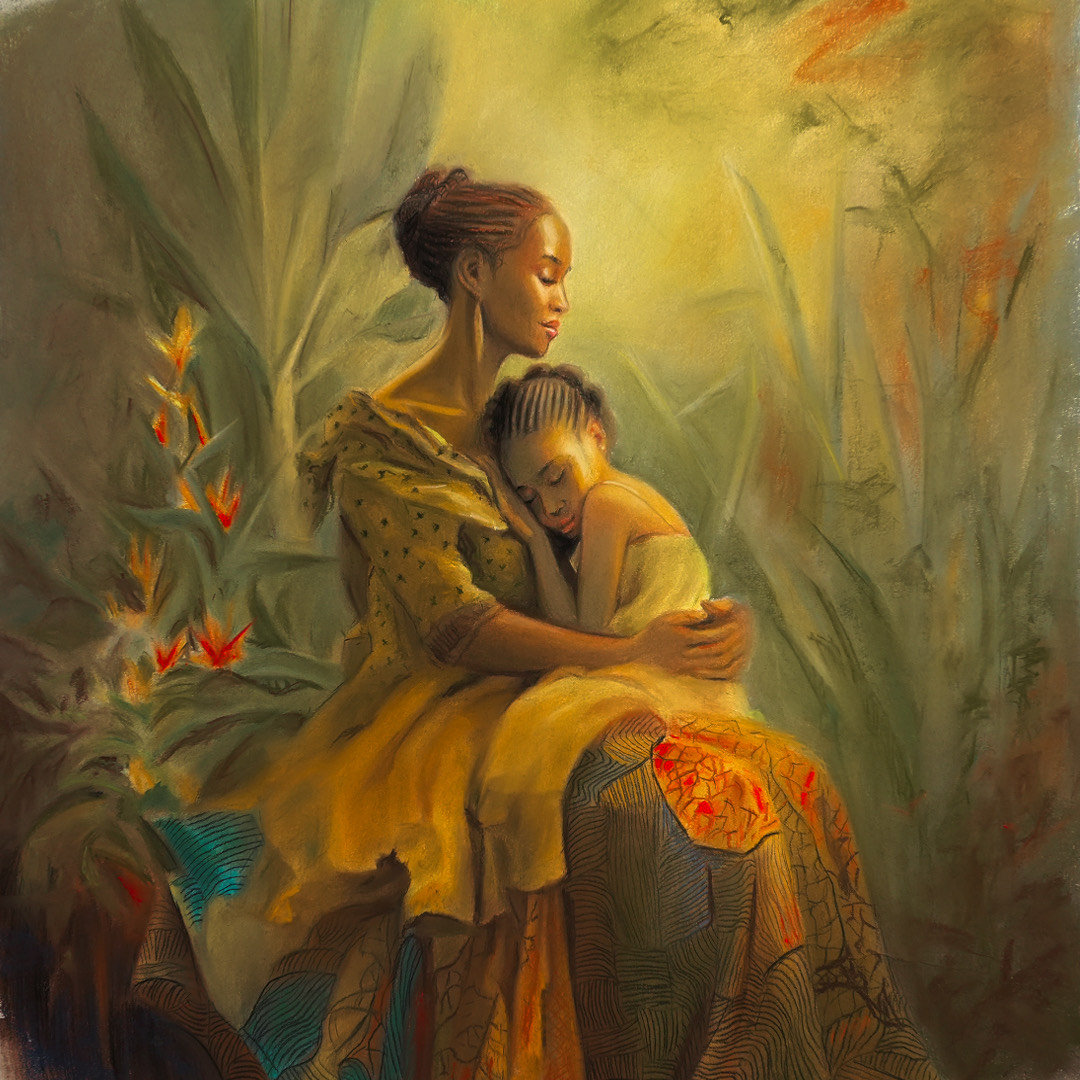
The most significant shift in Nnadi’s recent work did not occur inside a gallery. It happened inside his family. He married. His daughter was born. And gradually the focus of his painting changed. He became fascinated by the relationship between mother and child. Not motherhood as an abstract subject. His wife. His daughter. The world taking shape between them. Watching them together altered his artistic attention. Small gestures became significant. A particular way of holding. A moment of rest. Clothing. Closeness.
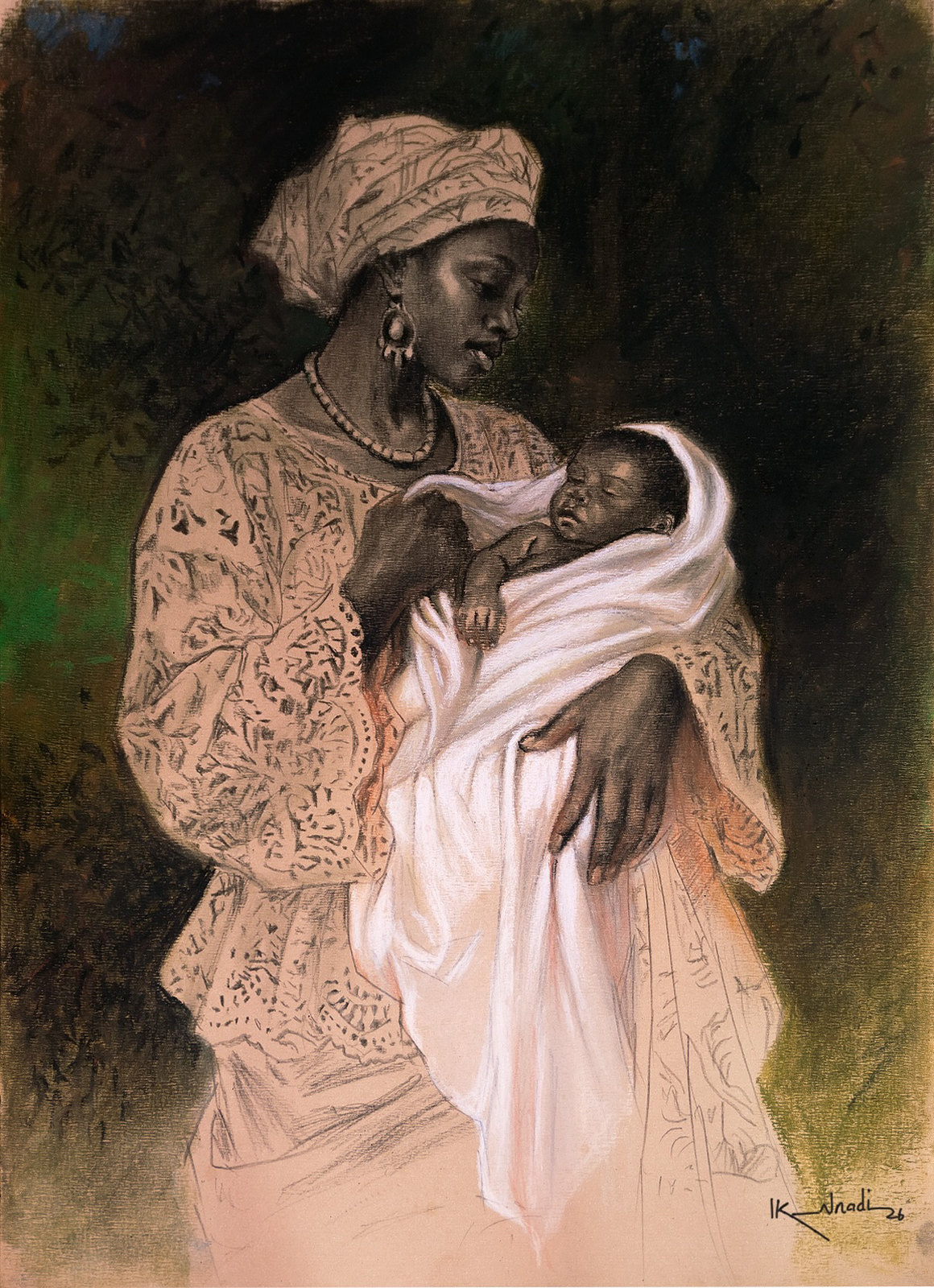
The emotional choreography of ordinary family life. It became what he describes as a mother-and-daughter series, an ongoing body of work that continues to develop. By the time of the conversation, he estimated that he had already made approximately twenty works around the theme.
I’m still telling the story.
But the series is not complete. “I’m still telling the story,” he says. Perhaps that is because the story itself keeps changing. His daughter changes. His wife changes. He changes. The relationship he is observing is alive.
05 A man painting womenSometimes they simply exist. Sometimes they are held. Sometimes they rest. +
Nnadi repeatedly returns to the question of how African women are seen. He speaks about wanting to portray them as soft.
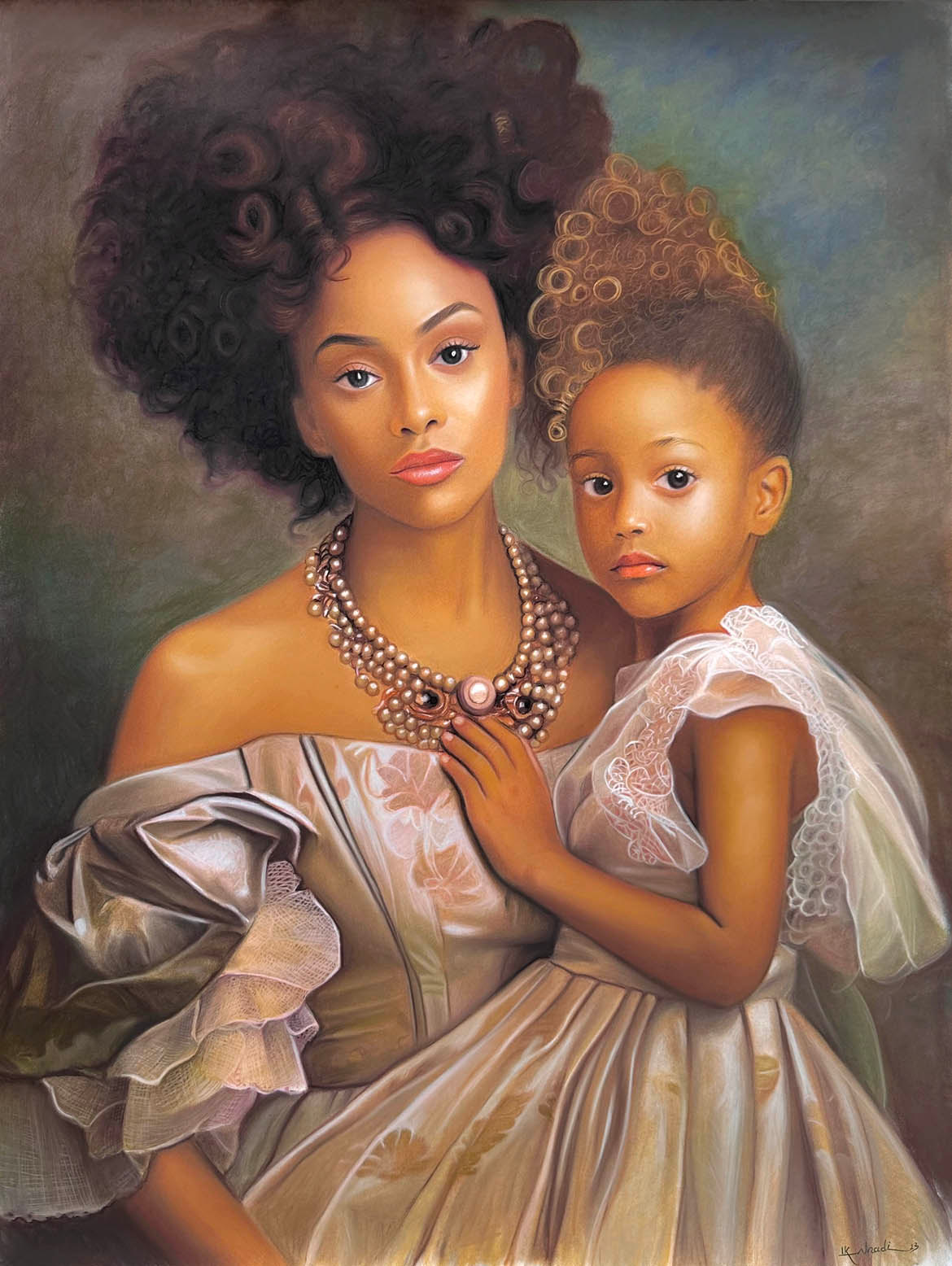
- Graceful. Beautiful. Loved.
His paintings attempt to offer an image of African womanhood grounded in dignity and emotional warmth. There is significance in this intention. For centuries, Black and African women have been subjected to visual regimes largely created by people outside their communities. Colonial photography catalogued bodies. Ethnographic imagery transformed human beings into “types.” Later humanitarian imagery repeatedly positioned African women beside crisis, hunger, disease and conflict. Contemporary culture has often responded with another image: the endlessly resilient Black woman. Strong. Unbreakable. Able to endure anything.
Yes, this is how I look. This is how I feel.
That image can appear empowering. It can also become another burden. Nnadi’s paintings occupy another territory. His subjects do not need to demonstrate exceptional resilience in order to deserve the painter’s attention.
- Sometimes they simply exist.
- Sometimes they are held.
- Sometimes they rest.
06 Softness as a serious subjectTo paint someone carefully is to insist that looking at them is worth our time. +
There is a tendency to confuse softness with superficiality. But softness can contain an entire politics of representation.
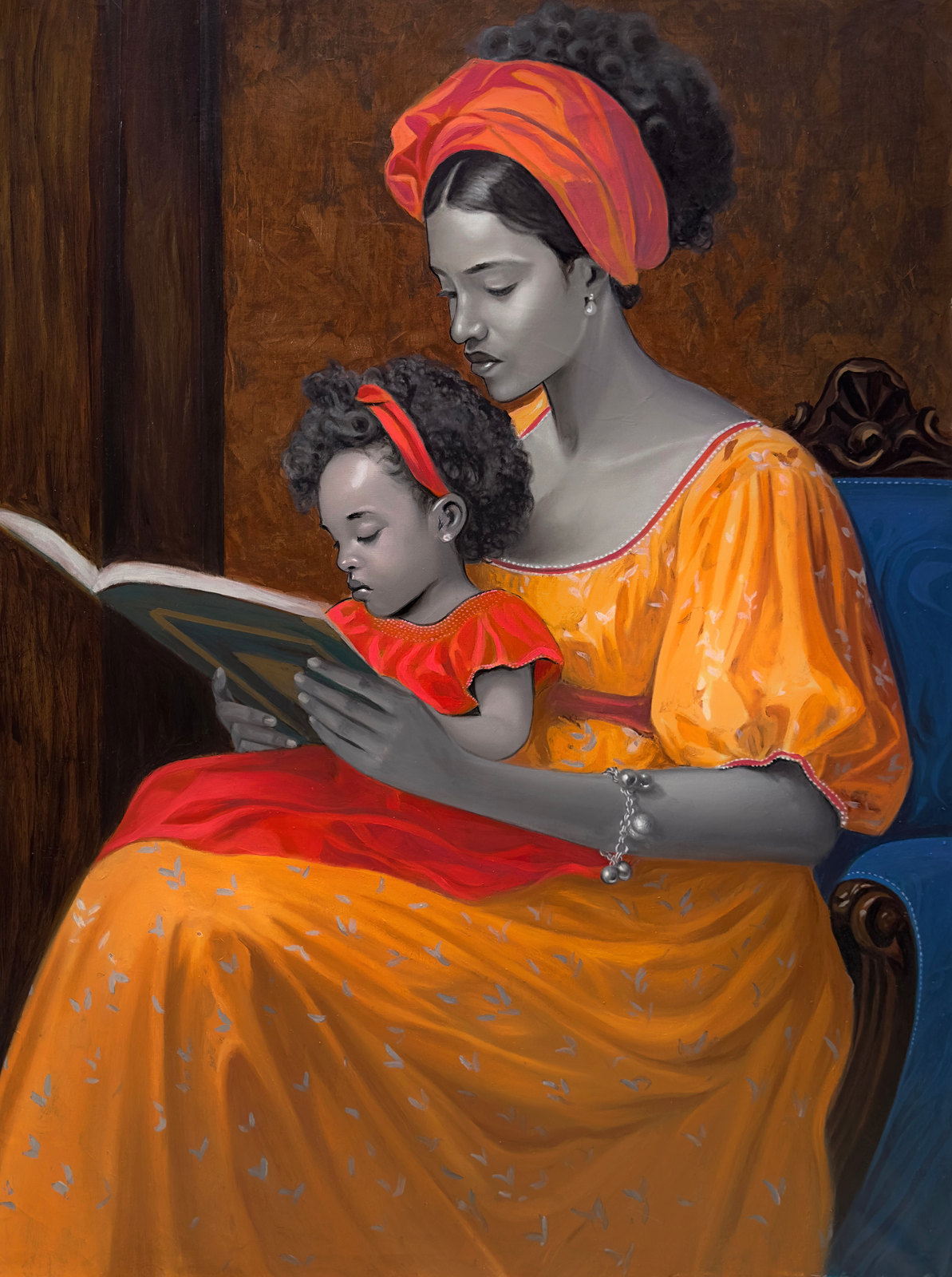
- Who is allowed to rest?
- Who is allowed to be vulnerable?
- Who is allowed to appear beautiful without becoming an object?
- Whose domestic life is considered culturally significant?
- Whose intimacy is worthy of preservation?
The history of portrait painting is filled with answers to those questions. For centuries, wealthy families commissioned paintings precisely because they believed their lives deserved permanence.
- Their marriages mattered.
- Their children mattered.
- Their clothes mattered.
- Their homes mattered.
- Their faces should survive them.
Portraiture was therefore never simply about likeness. It was also about importance. To paint someone carefully is to insist that looking at them is worth our time. Nnadi's paintings extend that dignity towards the domestic lives he knows. The ordinary becomes monumental. A moment that might have lasted seconds can take weeks to paint. Time is transferred from the artist into the image.
That act itself changes the value of the moment.
07 The complexity of idealisationIt means allowing beauty to coexist with contradiction. +
The beauty of Nnadi’s paintings also raises an important question. If African women have historically been represented too often through suffering, what happens when the counter-image becomes almost entirely graceful? Representation does not become free simply by moving from a negative stereotype to a positive one. Women should not be required to suffer.
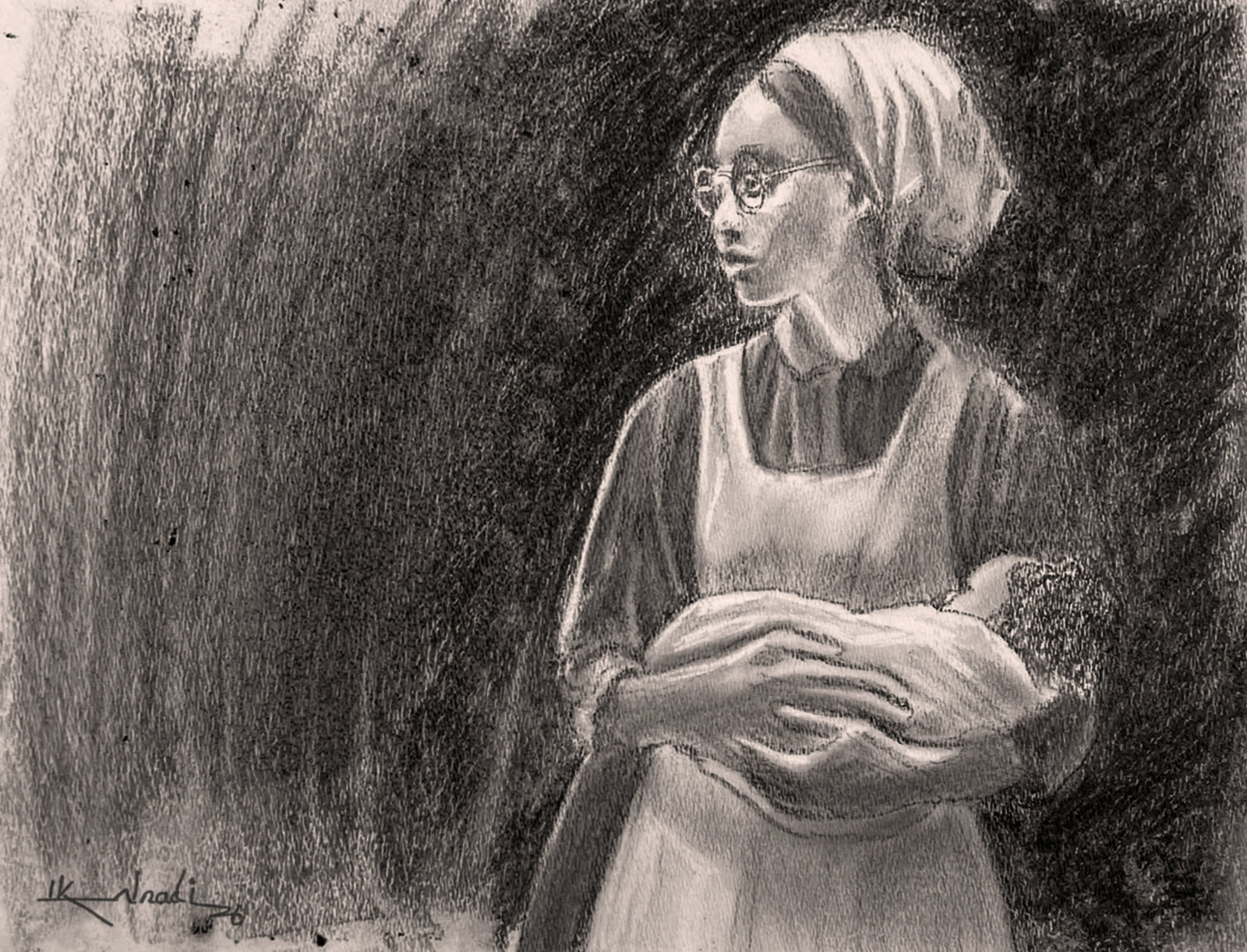
But neither should they be required always to embody elegance, maternal love, serenity or beauty. The most interesting future development in Nnadi’s practice may therefore lie in extending tenderness towards complexity. Motherhood contains affection. It also contains exhaustion.
- Impatience. Ambivalence. Fear. Humour. Boredom. Loss of self. Transformation. Desire. Work. Noise. Silence.
To represent the fullness of family life does not mean abandoning beauty. It means allowing beauty to coexist with contradiction. Nnadi’s most compelling conceptual path may therefore not be the representation of an ideal African woman. It may be something far more specific: the sustained observation of people he loves.
One tries to speak on behalf of a category. The other witnesses a relationship.
That distinction matters. One tries to speak on behalf of a category.
08 The wife inside the workA painting may have one painter. But artistic worlds rarely have only one author. +
There is another person whose role deserves closer attention. Nnadi’s wife is not merely a subject. She participates in the visual world from which the paintings emerge. Her presence affects styling, clothing, gesture and composition simply because these paintings originate inside their shared life.
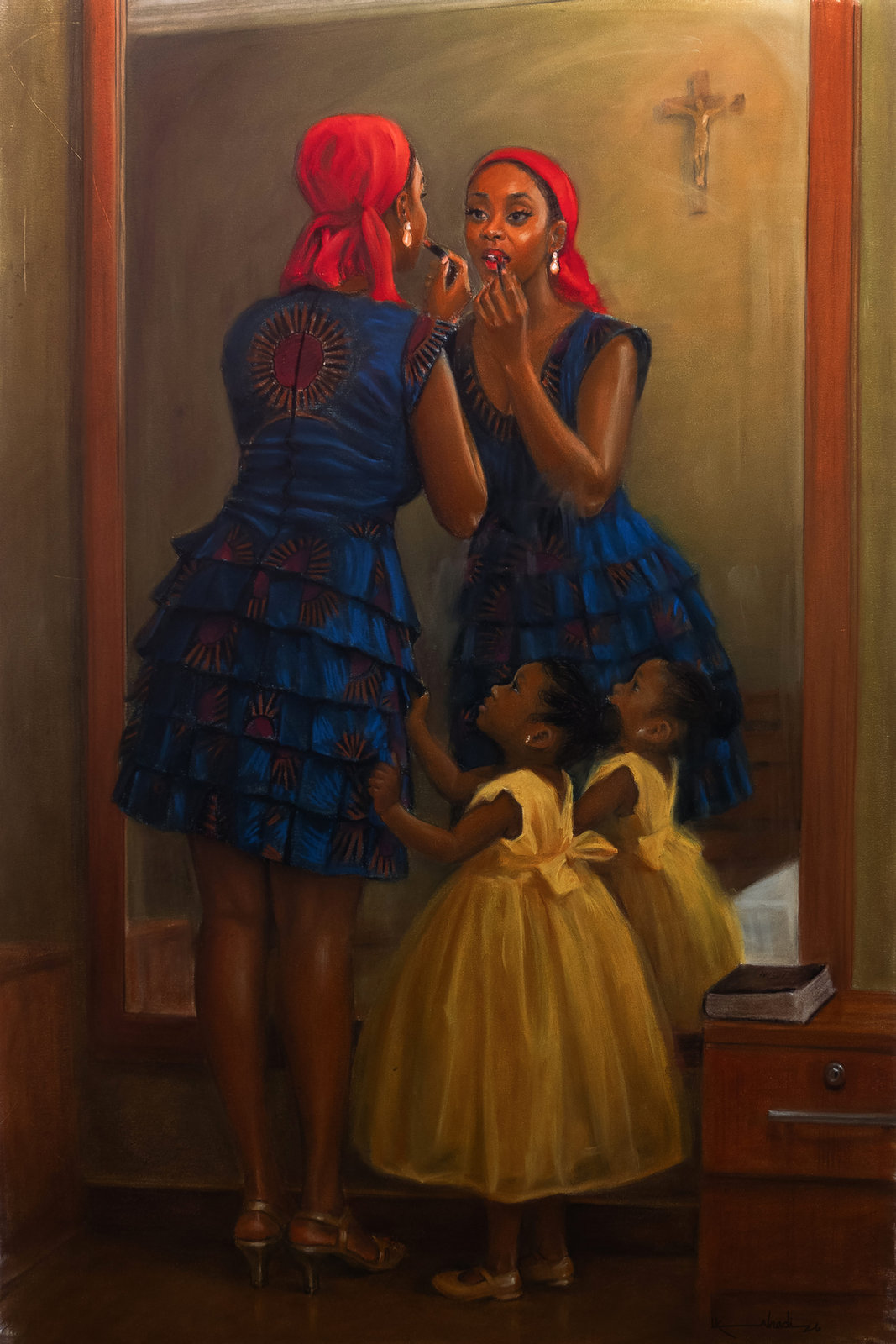
That opens a fascinating question about authorship. A painting may have one painter. But artistic worlds rarely have only one author.
I also draw from my wife’s creativity as a fashion designer to dress the mother and daughter subjects.
- Who chooses what is worn?
- Who creates the atmosphere of the home?
- Who agrees to be photographed?
- Who determines how she wishes to appear?
- Who shapes the aesthetic environment from which the painter later works?
Thinking about the paintings this way turns the family home into something resembling a creative ecosystem. The artist observes. His wife participates. Their daughter grows. The camera records. The canvas transforms.
09 The absent fatherAnd yet he is everywhere. +
One of the most interesting things about Nnadi’s mother-and-daughter works is that the father is often absent from the image. And yet he is everywhere.
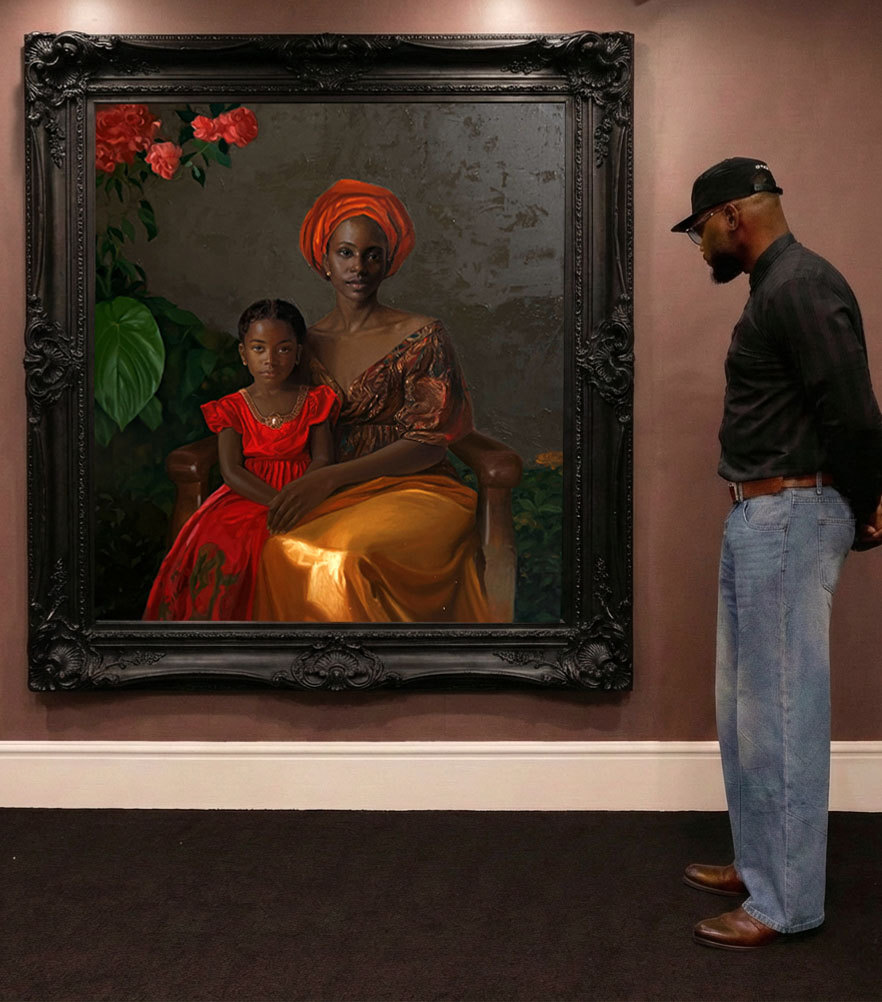
- He stands behind the camera.
- He selects the moment.
- He stretches the canvas.
- He paints the bodies.
- He looks.
This creates an unusually subtle depiction of fatherhood. The work does not require the father to place himself visibly at the centre of the family narrative. His presence is embedded in attention. That is significant. Masculinity is frequently represented through action, authority, possession or physical presence.
Here, fatherhood takes another form.
- Observation. Care. Attention. Witness.
The father is not necessarily the subject. He is the person who believes the relationship between two other people deserves to be remembered.
10 His daughter will grow up inside an archive of loveHe is constructing an inheritance. +
There is something particularly moving about considering these paintings from the perspective of the child. Nnadi’s daughter is two years old. She cannot yet fully understand the body of work being created around her childhood. But one day she may. She will be able to look at paintings documenting the way her father saw her mother. And the way he saw her. Not simply through photographs on a forgotten phone. Through objects into which hours, days and perhaps weeks of attention have been invested.
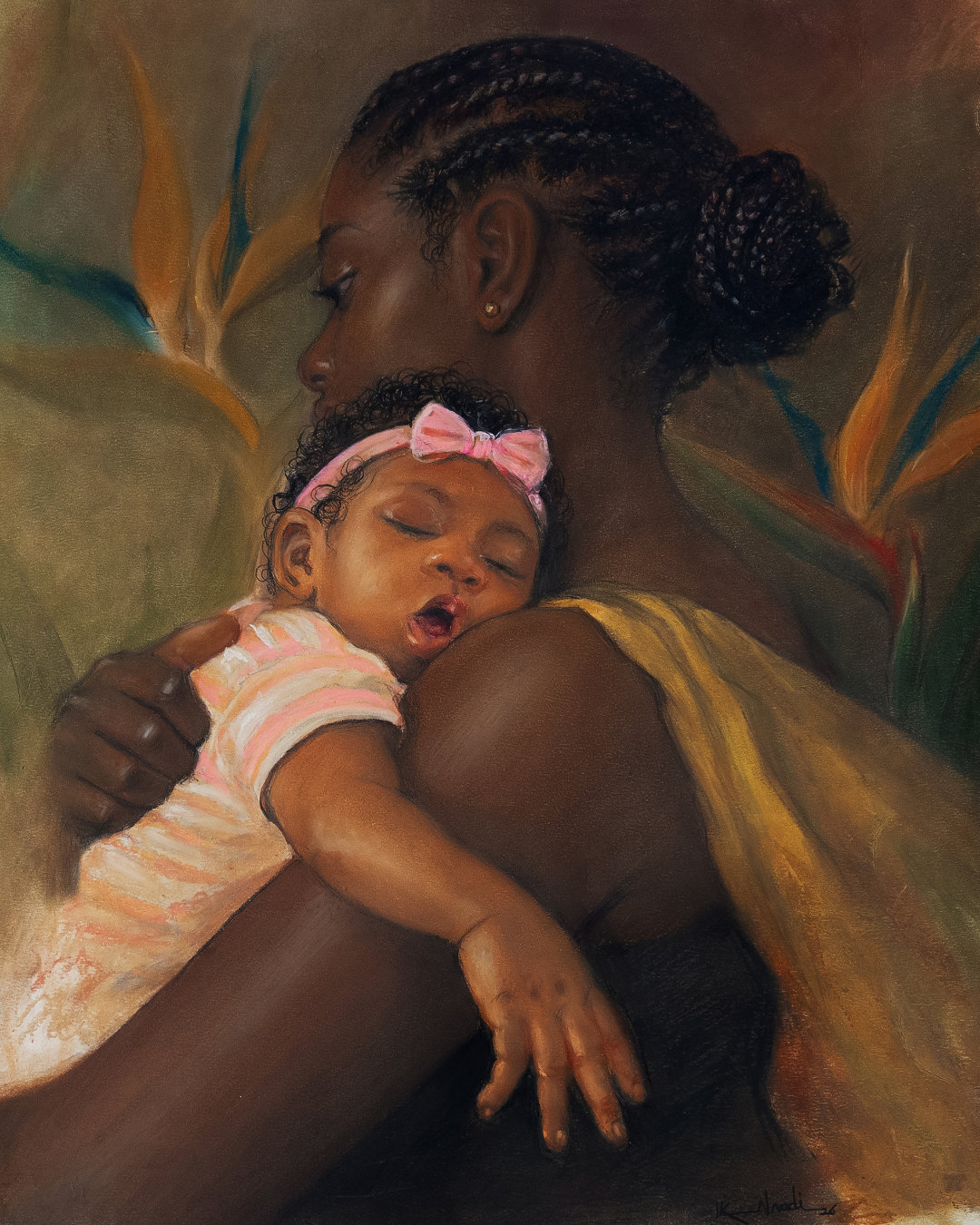
There is extraordinary emotional information contained in that. A child may grow up knowing that she was watched carefully. That her relationship with her mother was worthy of study. That her father considered the ordinary moments of her childhood significant enough to paint.
The series was inspired by the birth of my daughter, which became the main push behind it.
In that sense, Nnadi is creating something beyond an artistic series.
11 Art as a spiritual practiceSomething inside an image can meet something inside a stranger. +
Nnadi repeatedly describes art in spiritual terms. For him, an artwork must contain something genuine if it is going to affect another person. He does not appear interested simply in technical virtuosity. The question is whether a painting can move someone. He has received messages from viewers describing deep emotional responses to his work. Some have told him that the paintings reached them during periods of depression or emotional darkness. One person, he recalls, told him that seeing the work helped interrupt thoughts of suicide.
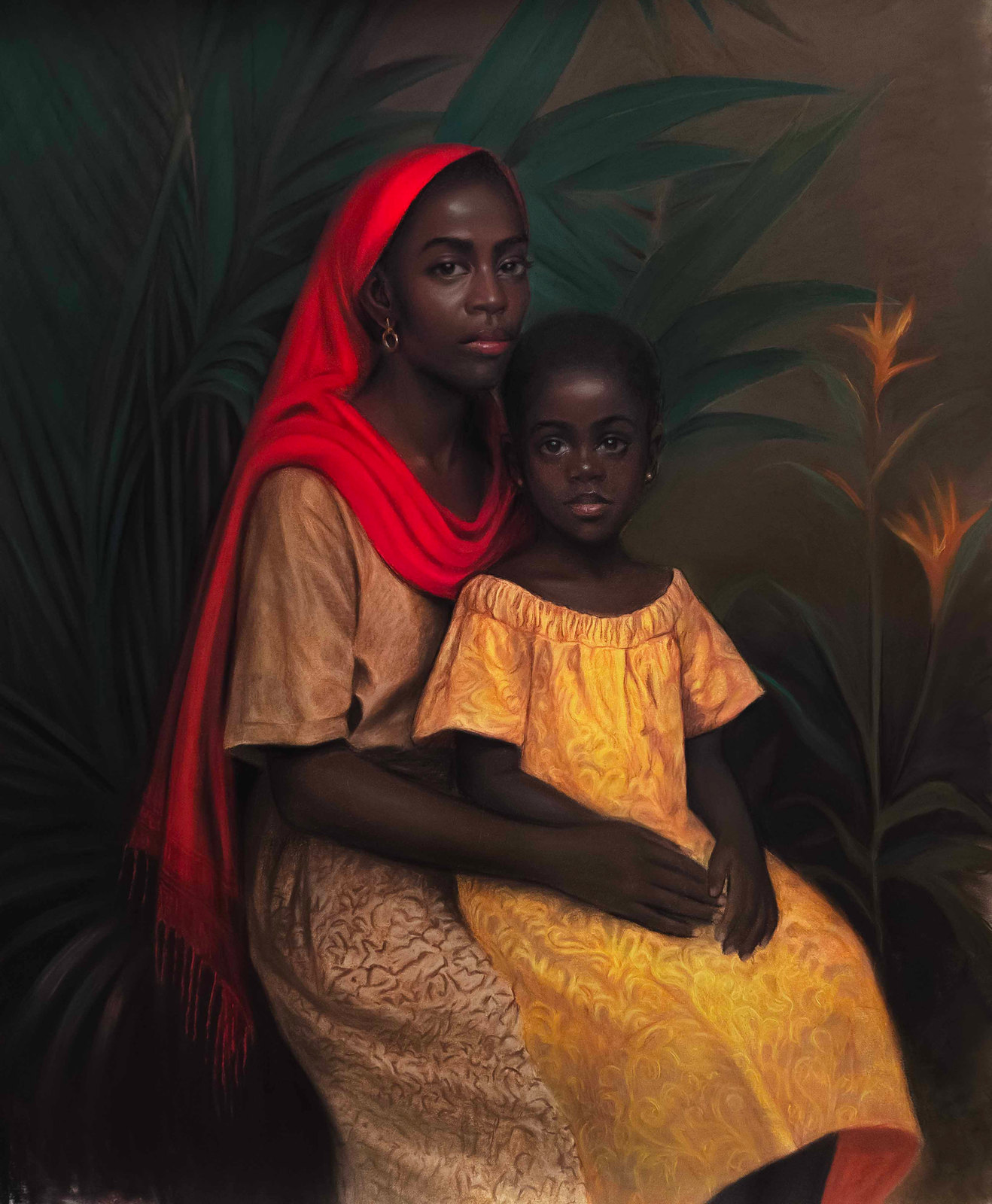
Nnadi does not speak about those messages lightly. For him, they affirm something fundamental about why he creates. A painting cannot solve another person's life. But art can sometimes create a pause. A recognition. A moment of connection. Something inside an image can meet something inside a stranger.
You have to be clean inward.
Nnadi believes that exchange requires sincerity from the person making the work. “You have to be clean inward,” he says. The language is spiritual rather than academic. But the artistic principle is clear. The emotional integrity of the work begins before the viewer encounters it.
12 He does not want to tell you what to feelMeaning happens somewhere between the two. +
Interestingly, Nnadi often prefers not to explain his paintings extensively when he presents them. He wants to know what happens before interpretation is supplied.
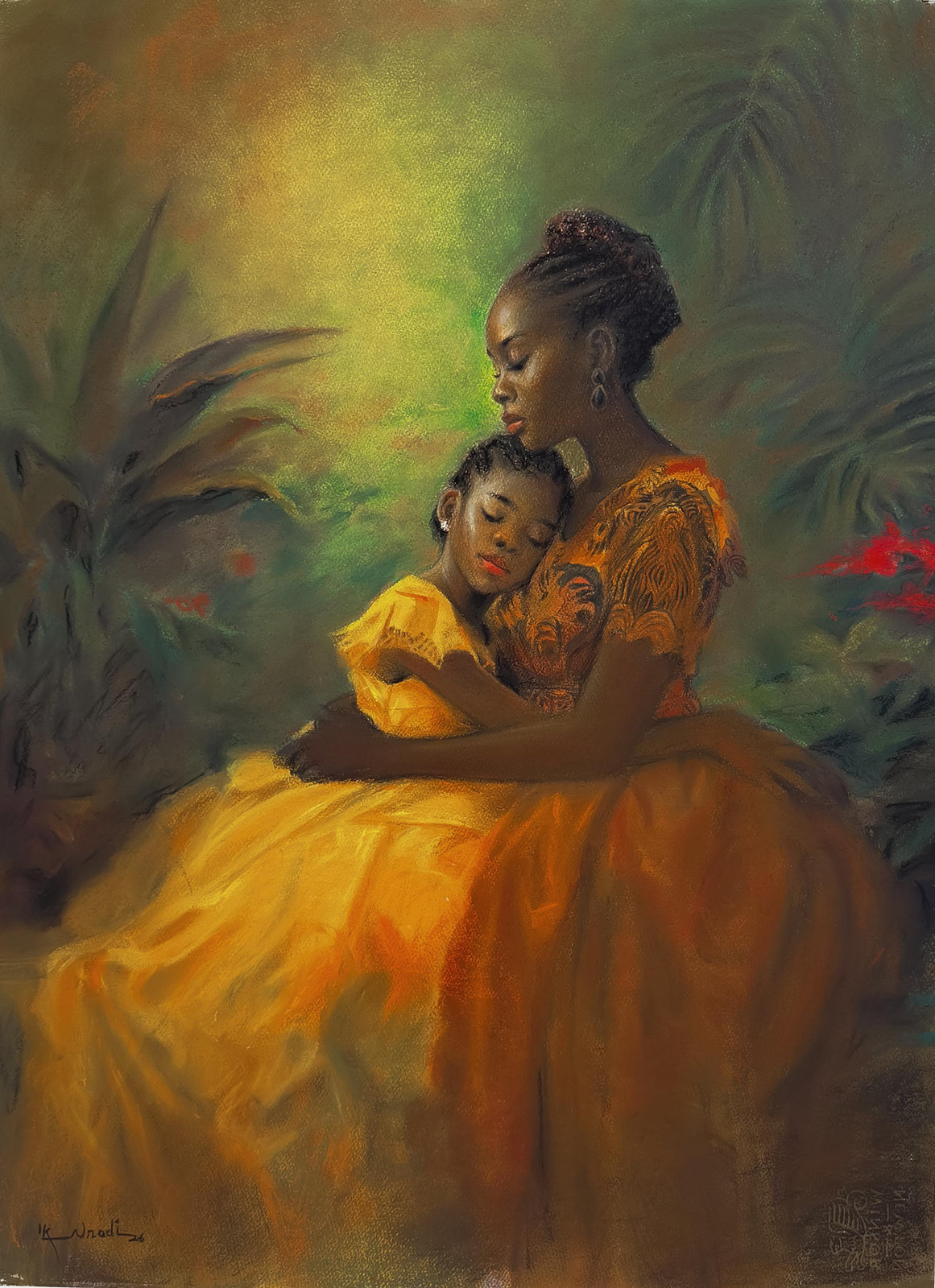
- What does the viewer see?
- What does the body recognise?
- Does the image trigger memory?
- Does it resemble something experienced?
- Does it create comfort?
- Discomfort?
- Longing?
- Recognition?
This is an important instinct. Artists frequently feel pressure to explain every symbolic element of their work. But some images become weaker when language closes them too quickly. Nnadi wants the encounter to remain open. He creates from his own experience.
13 Art and artificial intelligenceFor Nnadi, the answer is lived relationship. +
That emphasis on lived experience also shapes his response to artificial intelligence. Nnadi is not hostile to technology. But he questions whether a machine can reproduce the emotional origin of what he paints. His source material comes from people he lives with.
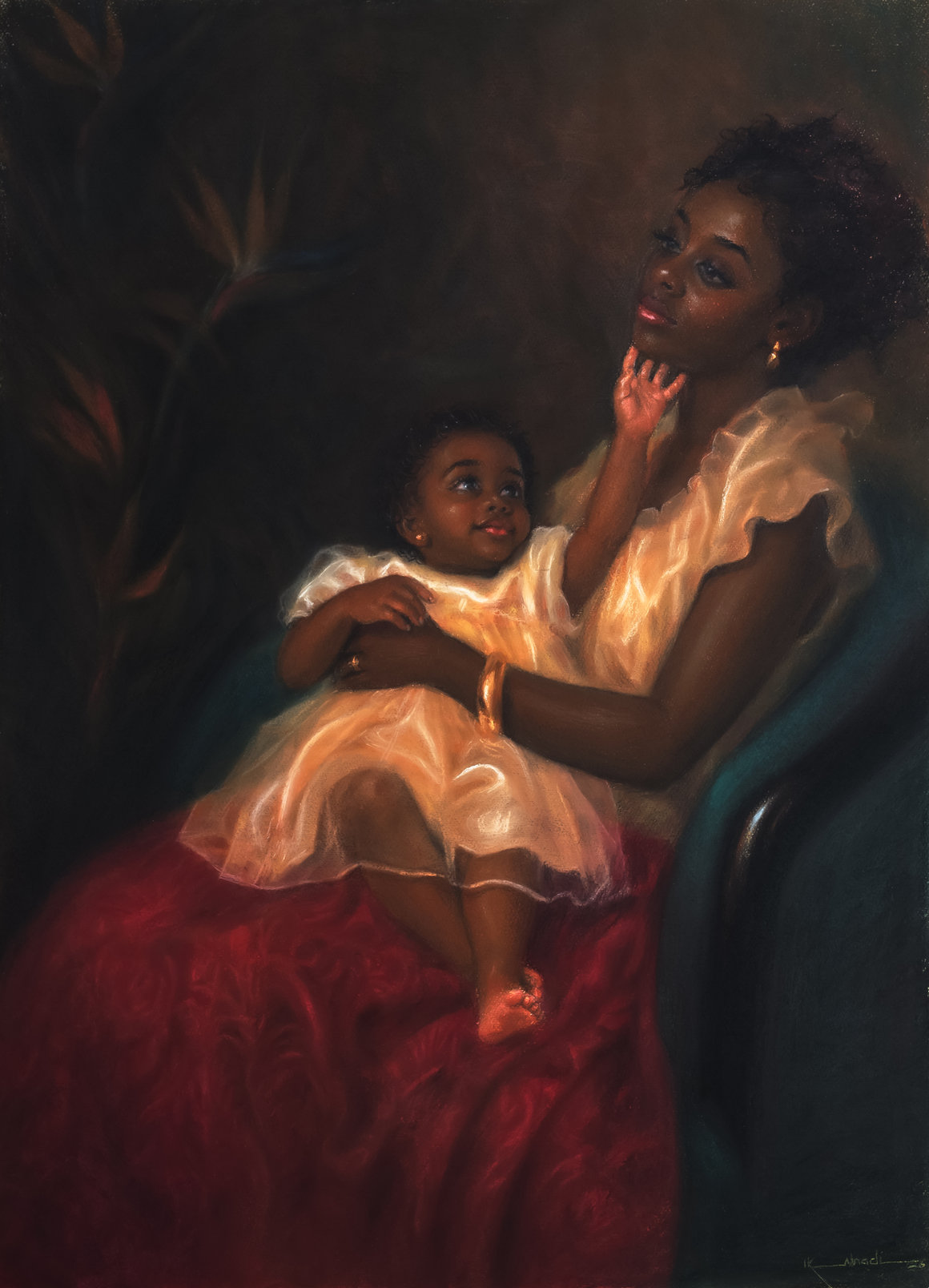
- He sees the moments.
- He knows what happened immediately before them.
- He understands the relationships inside the image.
An AI model might generate something visually resembling maternal tenderness. But resemblance is not memory.
- It did not know the mother.
- It did not witness the daughter grow.
- It did not stand inside the hospital when she was born.
- It did not experience the history surrounding the gesture.
This distinction may become increasingly important as generative images become more convincing. The central question may no longer be:
But resemblance is not memory.
Can a machine produce an image that looks emotionally convincing?
It increasingly can. The deeper question becomes:
What gives an image meaning beyond its appearance?
14 The camera as memoryCreative inheritance has found another route. +
His reliance on photography therefore deserves more attention. The camera is not simply a technical tool used to prepare paintings. It sits between life and canvas.
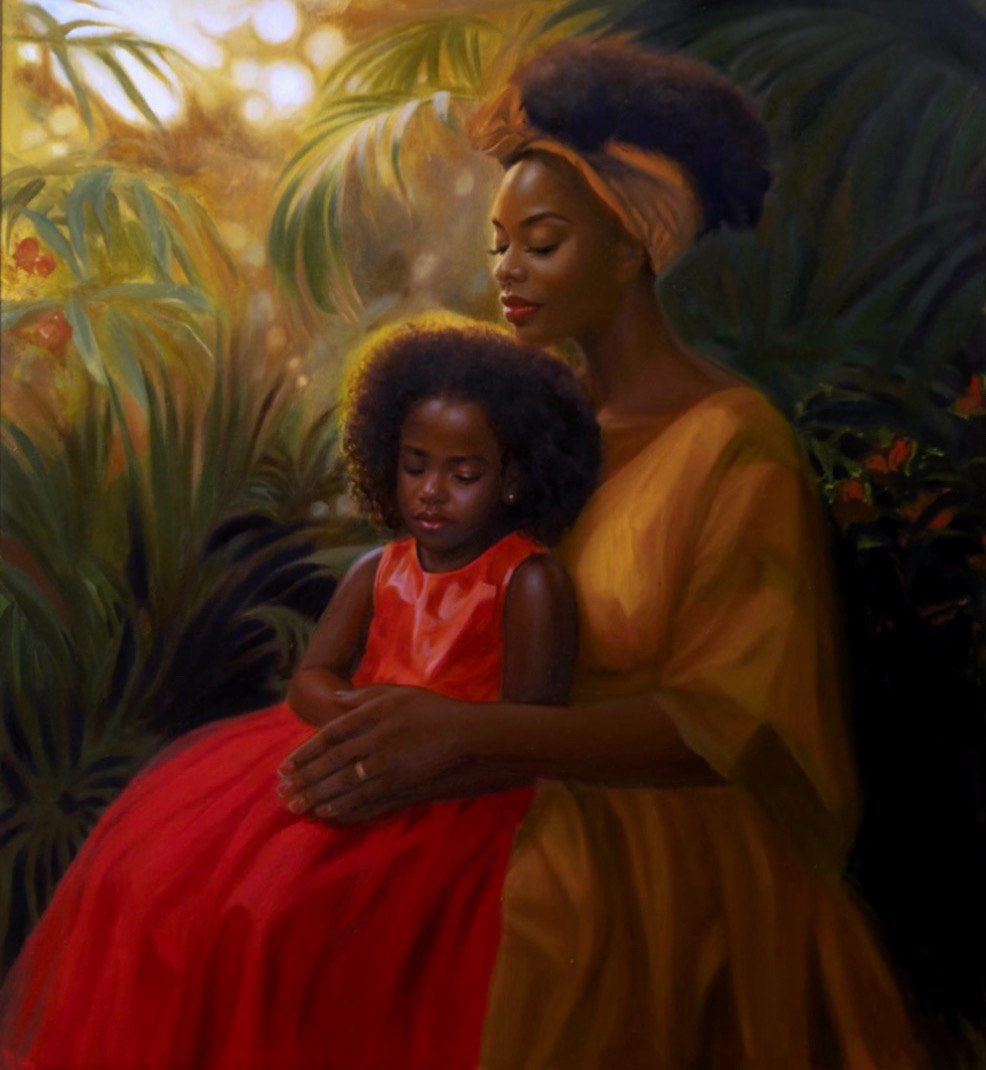
- A moment occurs.
- The camera interrupts its disappearance.
- The photograph becomes a memory object.
- The painter then returns to it.
- He selects. Recomposes. Translates. Slows it down.
A fraction of a second becomes an extended act of looking. There is also a fascinating intergenerational circle here. Nnadi’s father was a photographer. Nnadi becomes a painter who relies intensely on photography. The medium his father once practised therefore continues inside the son's work, even if indirectly.
I’m always with my camera. I’m always taking pictures of them.
15 Nigeria, talent and infrastructureNo artist develops in isolation. +
Nnadi is optimistic about Nigerian creativity. Less so about the systems surrounding it. He describes a country filled with ambition and talent but believes artists require substantially more structural support. The distinction is important. African cultural sectors are frequently discussed as though artists themselves need to become more innovative, entrepreneurial or globally competitive.
But often the artists already possess those qualities. The missing component is infrastructure.
- Studios. Residencies. Grants. Museums. Criticism. Archives. Collectors. Art schools. Public commissions. Mobility. Publishing. Curators. Conservation. Patronage. International networks. Professional representation.
No artist develops in isolation. What appears externally as individual success is usually supported by an ecosystem. Nnadi's observation therefore points beyond his own career. The question is not simply how one Nigerian painter becomes internationally successful. The more important question is what kind of cultural infrastructure allows thousands of Nigerian artists to build sustainable careers without needing exceptional luck.
16 Travel and the geography of opportunityTalent may be global. Mobility is not. +
Nnadi has not yet travelled extensively outside Nigeria. He has only recently prepared himself to begin doing so more actively. That matters because the contemporary art world remains intensely geographic. Being visible digitally is not equivalent to being physically present. A work can circulate internationally while the artist remains geographically restricted. A painting can cross a border more easily than the person who made it.
- This affects residencies. Speaking engagements. Institutional relationships. Gallery representation. Collectors. Curatorial conversations. Professional networks.
Even an invitation can become complicated when passports, visas and mobility enter the equation. Nnadi has already experienced how location can shape opportunity. He recounts being invited to speak about his work and then sensing that the possibility disappeared once organisers realised he was based in Nigeria. These moments reveal an uncomfortable truth about the supposedly global art world.
A painting can cross a border more easily than the person who made it.
17 What comes next?The question is how deep it can become. +
Nnadi is currently in an important stage of artistic development.
- He has found a subject that clearly matters to him.
- He has developed visual consistency.
- He has produced a substantial number of works around a coherent idea.
- He has experienced exhibition contexts and international interest.
But the project is still moving. That is important. The greatest danger for an artist who discovers a recognisable visual language is that recognition itself can become a trap. Collectors begin asking for what they already know. Galleries encourage consistency. Algorithms reward repetition. The market turns a body of inquiry into a signature product.
- Mother. Daughter. Elegant clothing. Warmth. Tenderness.
- Again.
- Again.
- Again.
But an artistic practice must remain larger than its most commercially recognisable motif. The question for Nnadi is therefore not whether Mother and Daughter should continue. It should.
18 Love is not a small subjectAn act of attention made permanent. +
Perhaps the most important thing about Nnadi's current work is that it takes intimacy seriously. Love is often treated as a private concern. Something belonging to relationships rather than politics. Homes rather than institutions. Families rather than societies. But love creates structures. It determines how children understand themselves.
- How adults survive difficulty.
- How memory passes between generations.
- How people experience safety.
- How identities form.
- How bodies learn whether they deserve tenderness.
Families are institutions too. They simply operate through gestures so ordinary that their architecture becomes difficult to see.
- A hand.
- A meal.
- A dress.
- A photograph.
- A parent watching a child sleep.
Nnadi paints inside that architecture. His work is therefore not only about mothers and daughters. It is about the invisible systems through which human beings tell one another:
you matter enough for me to pay attention.
And perhaps that is ultimately what portraiture has always been.
The works, as he lists them
Fifteen originals in pastel, charcoal and oil, and four more from his print editions. Titles, media and sizes as published by the artist, in inches, with centimetres added.
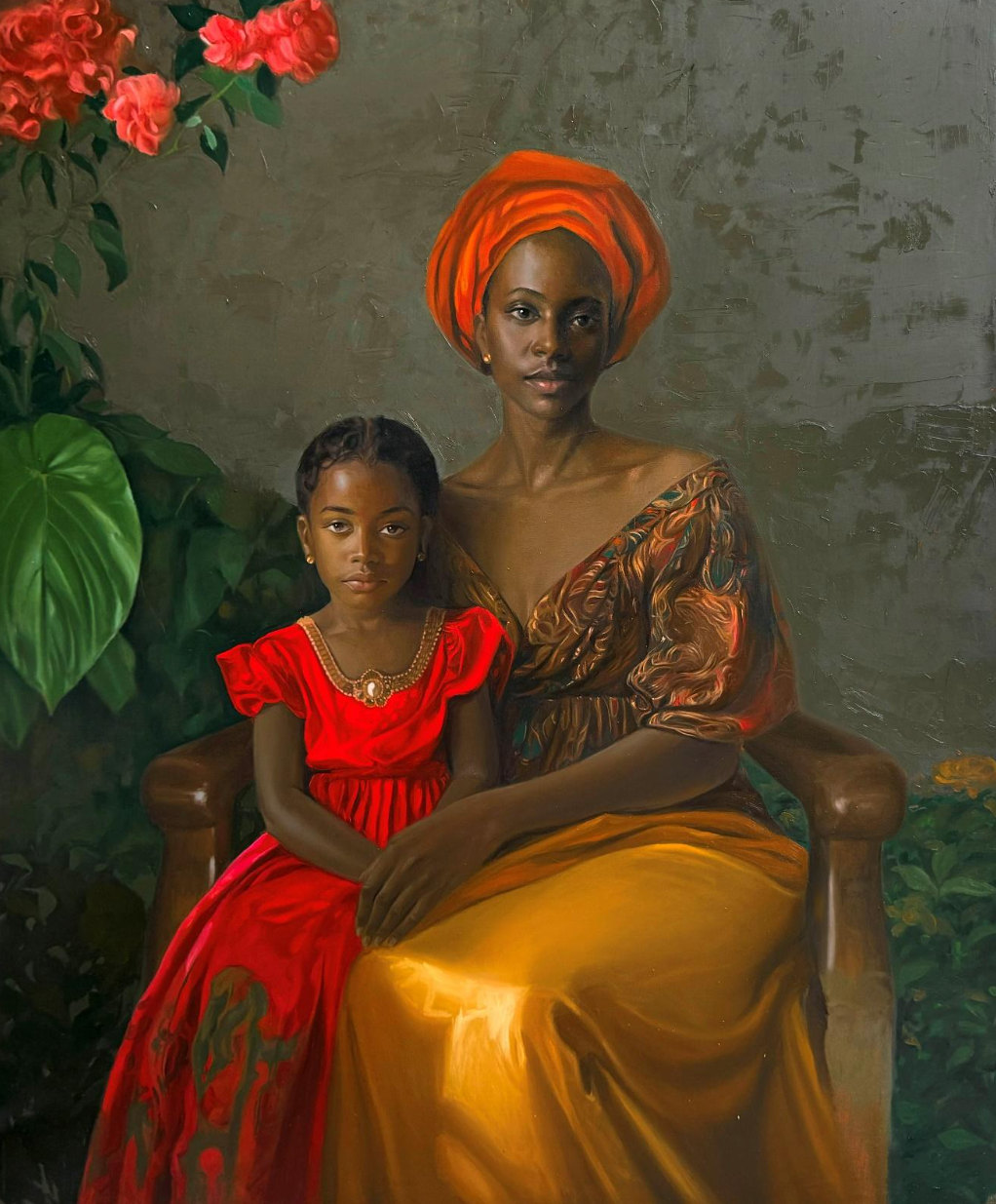
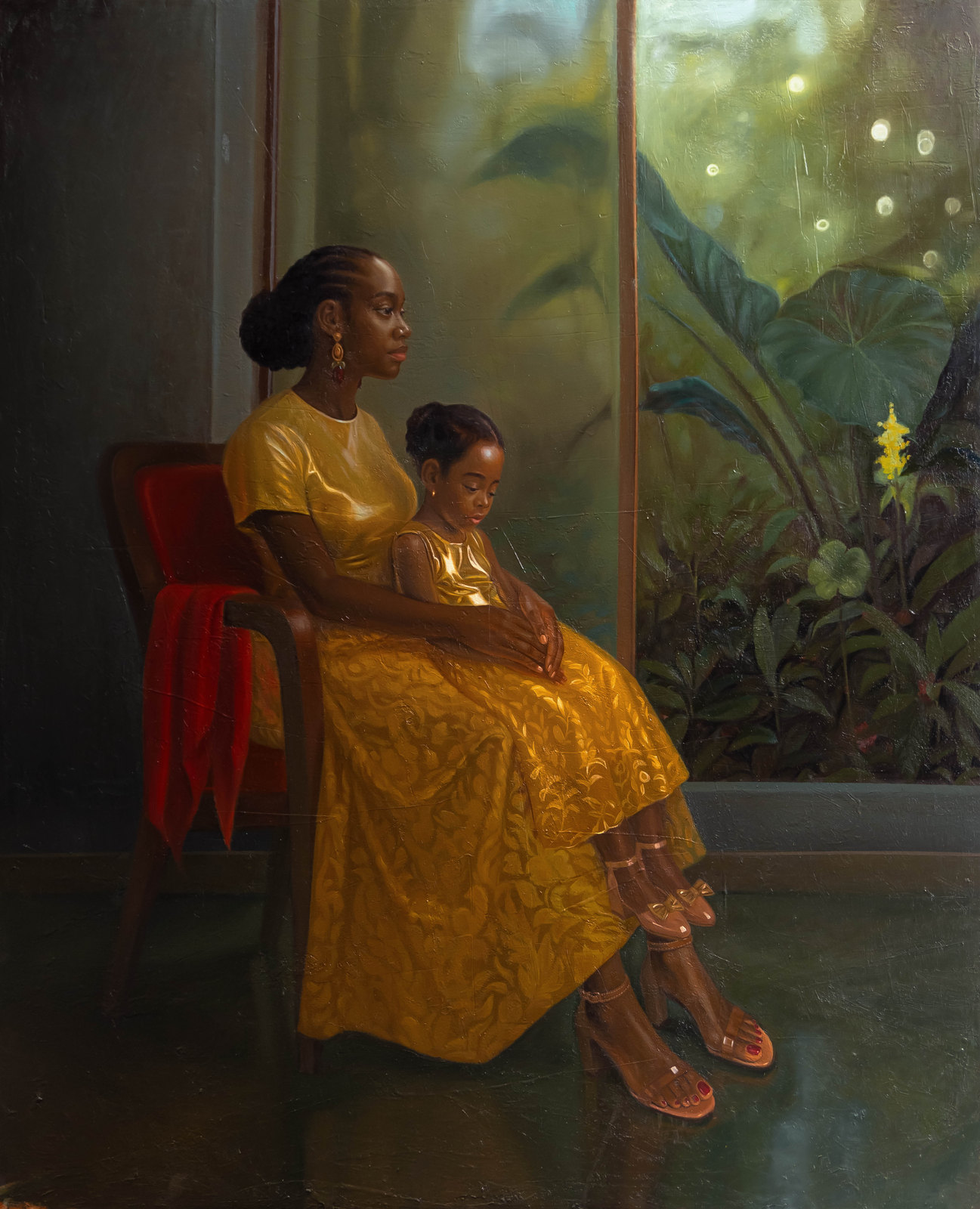
All works © Ikechukwu Nnadi. Images courtesy of the artist, from iknnadi.com, where originals and limited-edition prints can be enquired about.
01 Critical assessment of the practice +
1. The strongest element is not “African womanhood”
Nnadi's practice becomes most distinctive when it is understood through family observation, rather than broad statements about representing African women.
There are many contemporary artists working around Black beauty, African femininity, motherhood and tenderness.
His particular strength lies elsewhere.
He is a father painting a relationship developing in front of him.
That specificity makes the work credible.
The strongest conceptual proposition is therefore:
an artist constructing a visual archive of family intimacy through the evolving relationship between his wife and daughter.
This should remain the foundation.
2. The father-to-son artistic inheritance is extremely strong
The relationship with his own father provides important depth.
His father was a photographer.
His father later discouraged an artistic life.
Nnadi left partly to escape that psychological environment.
Nnadi later became a father himself.
He now uses photography to record his child.
That circle is extraordinary.
It introduces:
inheritance,
fear,
masculinity,
creative suppression,
fatherhood,
photography,
memory,
and intergenerational change.
This should be explored considerably further in future interviews.
3. The practice needs deeper language around masculinity
Nnadi's work creates an unusual entry point into male tenderness.
It should not be reduced to simplistic claims such as:
“challenging stereotypes about Black fathers.”
That centres the stereotype.
The richer question is:
What happens to an artist's gaze when he becomes a father?
His paintings suggest masculinity expressed through attention rather than dominance.
The father looks.
Preserves.
Honours.
Allows other people to occupy the centre of the image.
There is substantial intellectual territory here.
4. The wife needs greater agency in the narrative
Future documentation should include her perspective.
Not merely as muse.
Questions worth exploring include:
How does she experience being painted?
Does she choose which photographs may become works?
How does she understand the way her body is represented?
What does she think the series says about motherhood?
How does her own aesthetic sensibility shape the images?
How will their daughter eventually participate in decisions about her image?
These questions would make the project substantially richer.
5. Consent will become increasingly important
The daughter is currently very young.
As the series expands, an ethical question will eventually emerge.
A parent can legally consent to the representation of a young child in many contexts.
But an artistic archive can remain publicly visible for decades.
The child may eventually develop her own relationship with those images.
A sophisticated long-term practice should therefore include evolving consent.
As she becomes older, her agency should increase.
This is not a problem with the project.
It is a potentially important part of it.
6. Avoid turning tenderness into formula
The existing imagery is immediately attractive.
That creates commercial strength.
It also creates artistic risk.
Warm light + beautiful textiles + mother + daughter + affection can become a recognisable product language.
The work should continue becoming emotionally more complicated.
Potential future subjects could include:
generational difference;
motherhood and work;
absence;
fatigue;
play;
miscommunication;
the daughter's increasing independence;
ageing;
grandmothers;
family photographs;
the artist's father;
the artist himself;
domestic objects;
rooms after people leave them;
family histories that predate the child.
The underlying territory is enormous.
7. His technical ability should serve inquiry rather than dominate it
Realist technical skill attracts immediate admiration.
But technical precision alone has limited critical longevity.
The strongest development will occur when composition, light, paint, omission and distortion become ways of thinking.
Not everything needs to be perfectly described.
The artist should feel able to withhold.
Blur.
Crop.
Obscure.
Leave areas unresolved.
Allow memory rather than photography to determine parts of the image.
The question should gradually shift from:
How accurately can I paint what I saw?
towards:
What must this painting do that the photograph cannot?
That could mark an important next stage.
02 Cultural strategy for Ikechukwu Nnadi +
Positioning
The artist should not be positioned simply as:
a Nigerian realist painter celebrating African women.
That description is too broad and places him inside an already crowded category.
A stronger positioning would be:
Ikechukwu Nnadi is a Nigerian painter exploring intimacy, fatherhood, memory and the domestic archive through paintings drawn from the evolving relationship between his wife and daughter. Working between photography and painting, his practice considers how love, family and emotional inheritance become images.
That is considerably more distinctive.
03 Four core themes +
His practice can be organised around four interconnected territories.
1. The Domestic Archive
How does a family preserve itself?
What becomes worthy of memory?
What disappears?
What survives through photographs and paintings?
2. Fatherhood and the Gaze
What does it mean for a father to build images around the relationship between mother and daughter?
How does parenthood transform looking?
3. African Intimacy
How can African life be represented outside familiar visual economies of crisis, spectacle or exoticism?
4. Artistic Inheritance
What passes between generations even when artistic careers are discouraged?
The photographer father and painter son offer a particularly powerful entry point.
04 A stronger title for the body of work +
If Mother and Daughter remains the working title, it is clear but descriptive.
As the practice expands, an umbrella title could create greater conceptual space.
Possible directions include:
The Love Chapters
What We Hold
Inheritance of Tenderness
Held
The Family Archive
Ways of Holding
Before the Moment Leaves
Things Worth Remembering
Of these, The Love Chapters works particularly well because it permits multiple bodies of work rather than trapping the artist permanently inside one relationship.
A chapter can end.
Another can begin.
05 The Love Chapters as a long-term structure +
Instead of one endlessly extended series, the work could evolve through chapters.
For example:
Chapter I — Mother / Daughter
The existing body of work.
Chapter II — Father / Son
Potentially looking backwards towards his own upbringing, memory and his father.
Chapter III — Father / Daughter
His own relationship with his child.
Chapter IV — Her Own Image
The daughter becoming older and increasingly determining how she wishes to be represented.
Chapter V — The Family Album
Paintings created from older photographs, damaged photographs, inherited images and absent family members.
Chapter VI — Home
Rooms, fabrics, furniture and objects carrying family memory, sometimes without figures at all.
This would allow the practice to grow for years without becoming repetitive.
06 Public programming strategy +
Nnadi has the potential to speak beyond standard artist talks.
Strong conversation topics include:
Painting the People You Love
A conversation about intimacy, family and artistic responsibility.
The Father Behind the Image
Fatherhood, masculinity and the act of looking.
From Family Photograph to Painting
How photography becomes memory and eventually painting.
Who Gets to Be Seen at Rest?
African representation beyond suffering and spectacle.
Can AI Remember?
Human memory, generative imagery and emotional provenance.
When Your Family Becomes Your Archive
Consent, intimacy and the ethics of turning private life into public art.
These topics make him relevant to universities, art schools, museums, cultural festivals and interdisciplinary programmes without forcing him to become an academic speaker.
07 Residency strategy +
A residency could be particularly important at this stage.
Not simply because it would allow travel.
A good residency would remove him temporarily from his established visual habits.
The strongest residency would provide:
studio space;
curatorial dialogue;
access to archives;
photography collections;
museum collections;
family-history research;
critical writing support;
and encounters with artists working very differently from him.
A residency focused exclusively on producing more paintings for exhibition would be less valuable.
He needs intellectual expansion as much as production time.
08 Writing and publication +
Nnadi currently speaks about his work more richly in conversation than many standard artist statements allow.
That material should be preserved.
A publication could eventually combine:
paintings;
family photographs;
studio images;
short conversations;
reflections by his wife;
a text on his father;
notes about individual paintings;
and an essay on photography and family memory.
He does not need to become a conventional writer.
Oral history can form part of the archive.
His spoken language has warmth and directness that should not be polished away entirely.
09 Digital strategy +
The digital presentation should move beyond simply posting completed paintings.
The most interesting content already exists around the work.
Photograph.
Moment.
Sketch.
Canvas.
Detail.
Finished painting.
Reflection.
The viewer could understand how an ordinary domestic scene travels through several transformations before becoming art.
Importantly, not every source photograph needs to be publicly revealed.
Some should remain private.
Mystery protects the work.
The purpose is not to turn family life into permanent content.
It is to make the artistic process legible.
10 Technology strategy +
Nnadi's instinctive scepticism towards generative AI should not be treated as a weakness.
It could become a clear artistic position.
His work is ideally placed to ask:
What is the difference between an image of intimacy and an image made from intimacy?
That is a sophisticated question for the AI era.
He need not become an AI artist.
Technology could instead support:
digital archiving;
oral-history preservation;
multilingual interpretation;
virtual exhibitions;
cataloguing;
collection management;
high-quality documentation;
educational resources;
and interactive storytelling around the paintings.
The technology should preserve and circulate the archive.
It does not need to manufacture the emotional source.
11 Institutional strategy +
The work can legitimately enter several institutional conversations.
Not because it is simply visually pleasant.
Because it intersects with major themes.
Museums
Portraiture, African contemporary art, family archives, masculinity, photography and representation.
Universities
Visual culture, gender studies, African studies, family sociology, art history and digital humanities.
Health institutions
Maternal health, family formation, emotional wellbeing and visual cultures of care.
Schools
Family storytelling, portraiture, photography and how personal experience becomes art.
Fashion contexts
Textiles, styling, Nigerian dress and the construction of identity through clothing.
Photography institutions
The translation of photographic source material into painting and the inheritance from his photographer father.
That breadth should be cultivated carefully without allowing the work to become merely illustrative of other disciplines.
The paintings remain art first.
12 Market strategy +
The market should follow the development of the practice rather than determine it.
Three layers can coexist.
Original works
Maintain scarcity and coherent pricing.
Avoid erratic direct-market discounts that could undermine gallery relationships.
Editions
Selected works can become editions where appropriate, but edition size, paper quality, production and provenance should be consistent.
Institutional commissions
Potential commissions should emerge from the conceptual practice rather than asking the artist simply to reproduce an existing visual formula at a larger scale.
Long-term collector confidence depends partly upon discipline.
A clear archive should track:
title;
year;
dimensions;
medium;
source photograph;
exhibition history;
publication history;
ownership;
location;
high-resolution documentation;
and certificate information.
This becomes increasingly important as the market develops.
13 The next interview should go deeper +
The first interview established trust.
The next conversation should not repeat biography.
It should concentrate almost entirely on the work.
Questions worth asking include:
Tell me about one specific moment between your wife and daughter that became a painting. What happened before the photograph?
What does your wife think you see in her that she does not necessarily see herself?
Are there photographs she has asked you not to paint?
What does your daughter currently understand about your work?
Do you remember watching your father photograph people?
Do you still have his photographs?
What did he photograph?
Have you ever painted from one of his images?
What changed in your understanding of your father after you became a father yourself?
Do you think you are continuing something he started?
What does the painting know that the photograph does not?
What happens when a beautiful family moment is preceded by an argument or exhaustion? Does that context belong inside the painting?
Is there anything about motherhood you cannot access as a man?
What authority do you believe you have, and what authority do you not have, when depicting women?
How involved is your wife in determining how she is represented?
When your daughter becomes older, would you allow her to remove a painting from public circulation if she no longer wanted it shown?
Do you think tenderness can become political without becoming propaganda?
What does love look like when nobody is watching?
That second conversation could become considerably more profound than a conventional artist profile.
Final assessment
Ikechukwu Nnadi already possesses the element that cannot easily be manufactured through branding:
a genuine reason for making the work.
The next stage is not to invent a more impressive story around him. It is to excavate the story that is already there. A photographer father who abandoned one creative path. A son who chooses another. The need to leave home in order to believe in one's own artistic life. The construction of a new family in Lagos. The arrival of a daughter. A camera returning to the hands of the next generation. A wife and child becoming an archive.
A man learning to look differently because he became a father. And paintings attempting to preserve something human beings know will eventually disappear. That is already enough. The task now is to deepen it rather than decorate it. The most powerful version of Ikechukwu Nnadi's practice is not ultimately about producing idealised images of African women. It is about attention. Who receives it. Who gives it. How long it lasts.
What happens when a fleeting act of care is transformed into an object intended to survive for generations. That is the cultural proposition hidden inside the work. And it is considerably larger than beauty. It is the question of what, and whom, we choose to remember.
Sources and credits+
- Conversation with the artist: Tallulah Patricia Bär with Ikechukwu Nnadi, a recorded call between Zürich and Lagos, 2026, with his permission. Quotes are lightly edited for clarity.
- iknnadi.com: the artist’s website, the Love Chapters series, and the original works with their titles, media and dimensions.
- Adegbola Gallery, Lagos: artist page and year of birth.
- All works © Ikechukwu Nnadi. Images and portraits courtesy of the artist, from iknnadi.com.
More long-form exchanges with individual practitioners