Who Gets to Make Luxury?
Maison Amahle, Swiss trust, African taste and the infrastructure required to turn an object into a Maison.
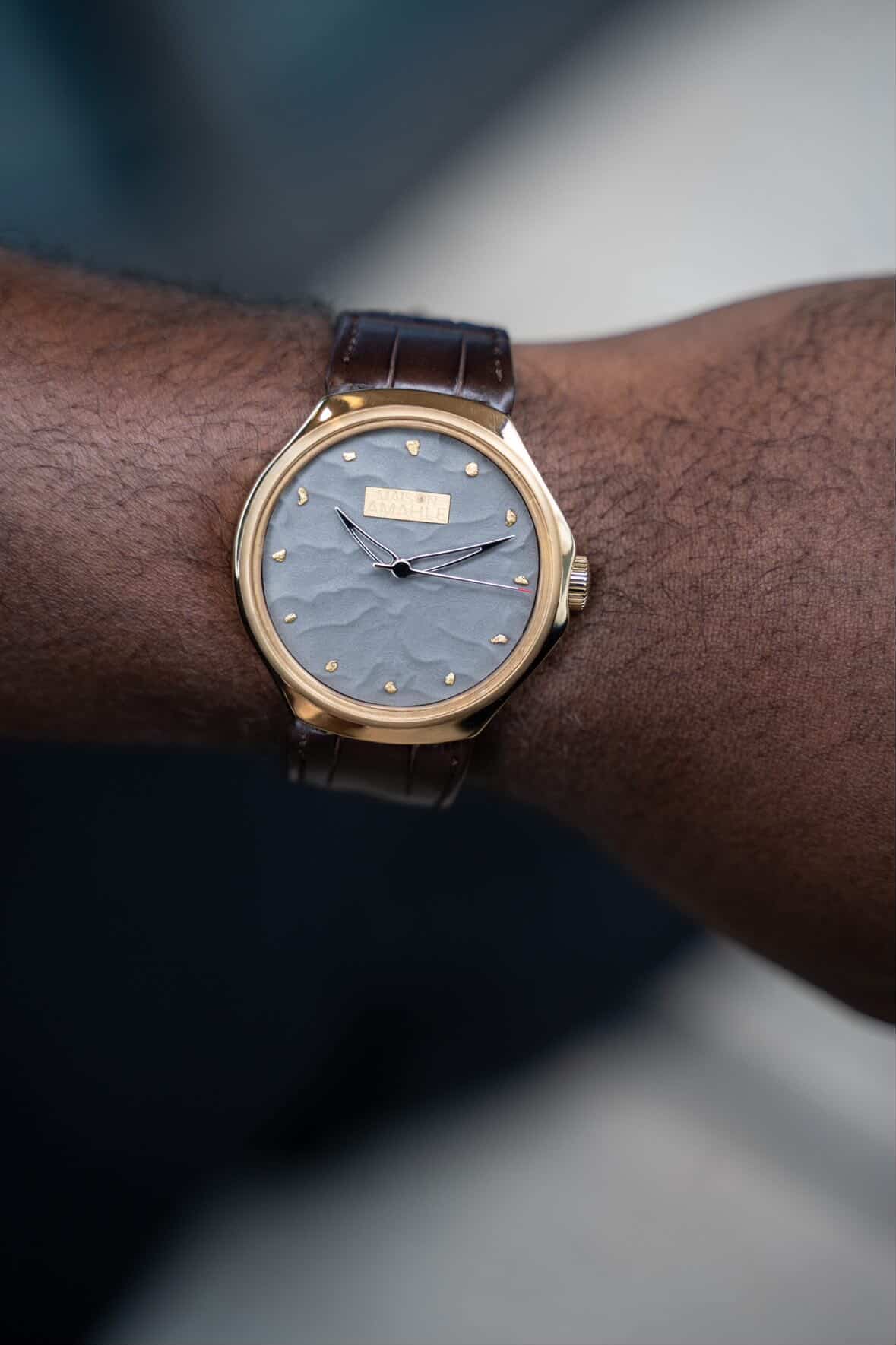
Zimbali 000 Midnight Desert · Maison Amahle
Maison Amahle, Swiss trust, African taste and the infrastructure required to turn an object into a Maison.
Zimbali 000 Midnight Desert · Maison Amahle
An artistic conversation
Written and moderated by Tallulah Patricia Bär
Zimbabwe ↔ Botswana ↔ Switzerland
In conversation with Nigel Ndlovu · 2026
Watchmaking · Luxury · Value chains
Swiss trust · African taste · Institutions
There is a watch on Nigel Ndlovu's desk that costs CHF 40,000, and this is where I think the conversation has to begin. Not with Africa rising, not with heritage, not with resilience, and not even with the rather beautiful story of a Zimbabwean who grew up in Botswana, came to Switzerland and decided to build a watch.
Forty thousand Swiss francs. At that price, sentiment disappears rather quickly. You can buy a serious watch from a serious name: a name your insurer recognises, a name your jeweller recognises, a name another collector recognises across a dinner table without anybody needing to explain the logo.
Maison Amahle does not yet possess that advantage, and perhaps this is what makes it interesting.
The Object
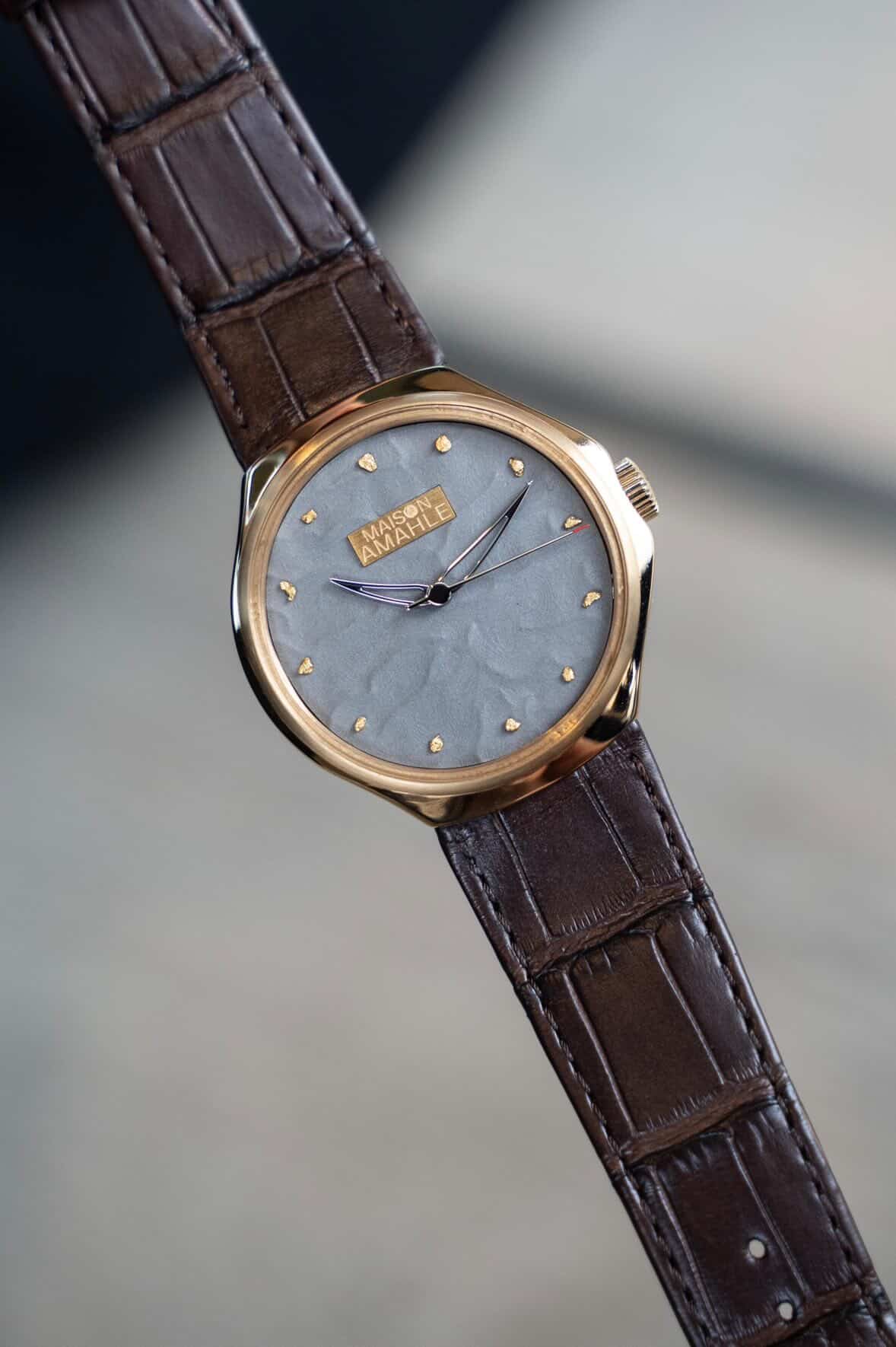
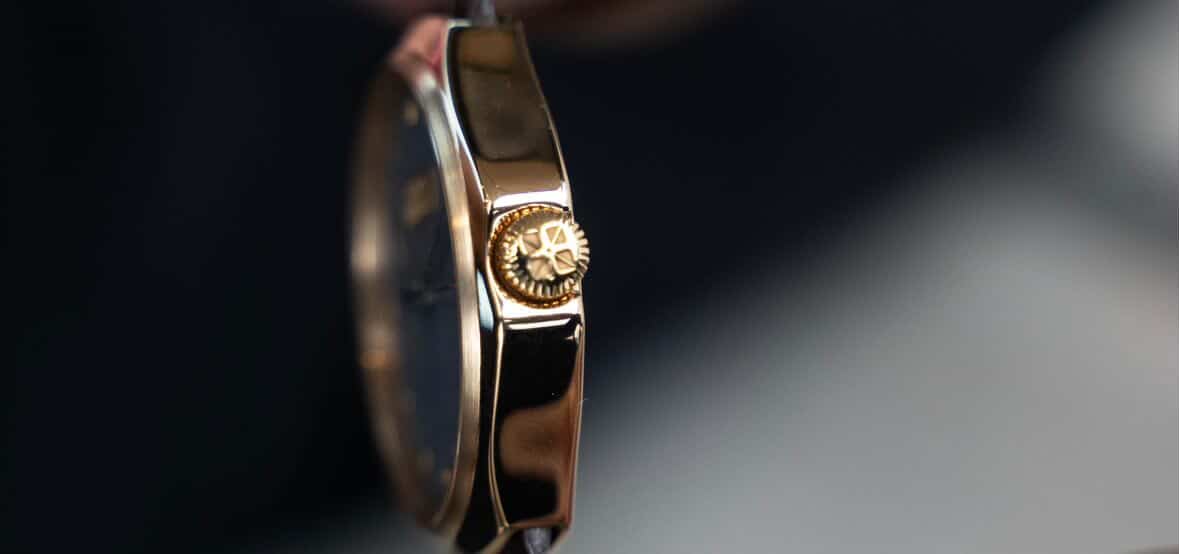
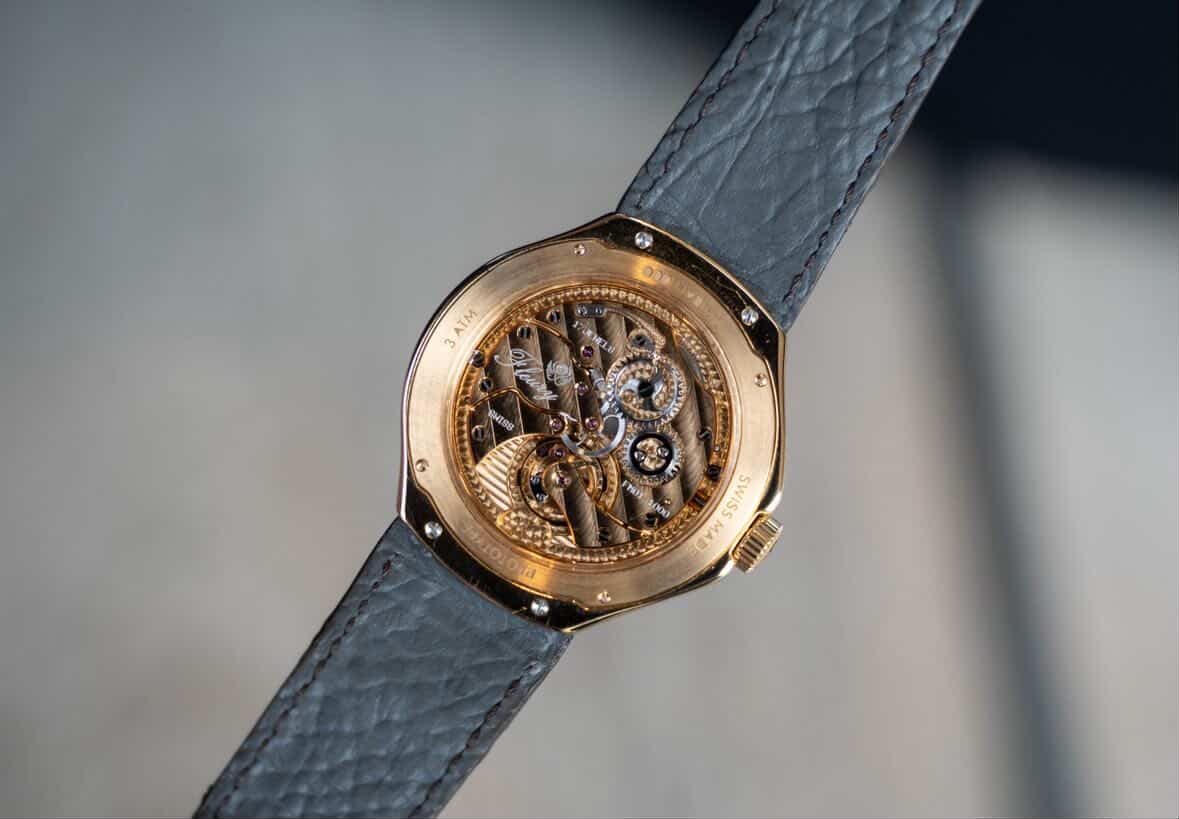
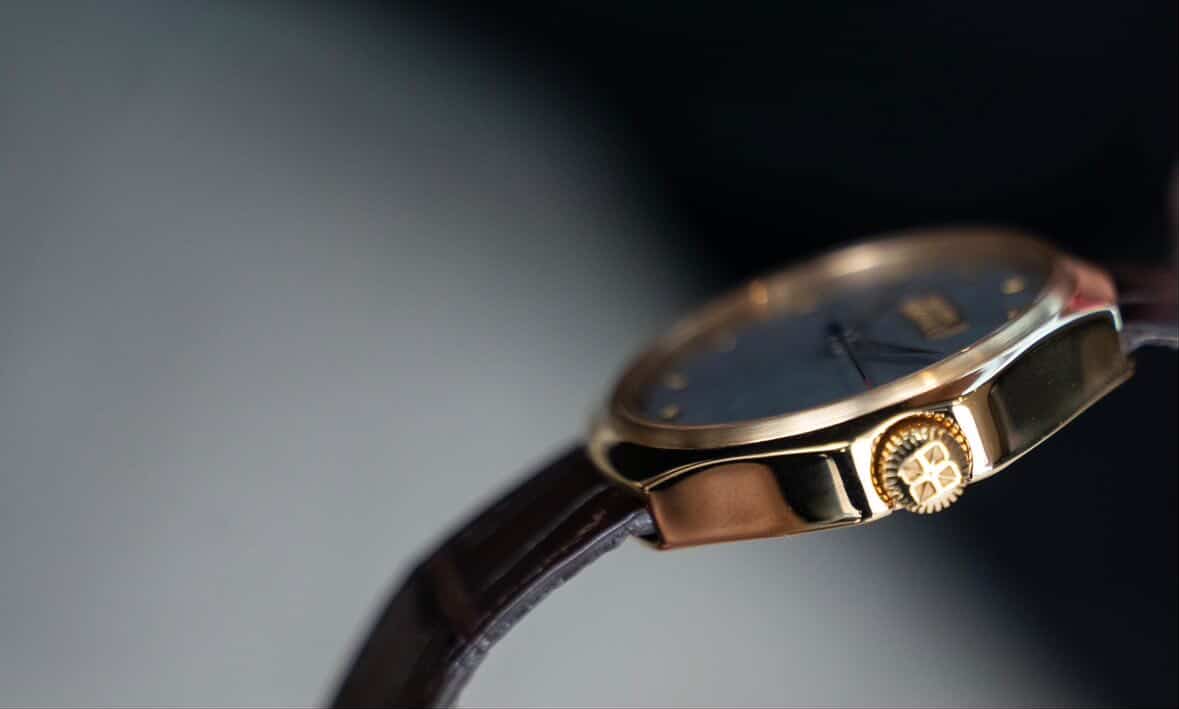
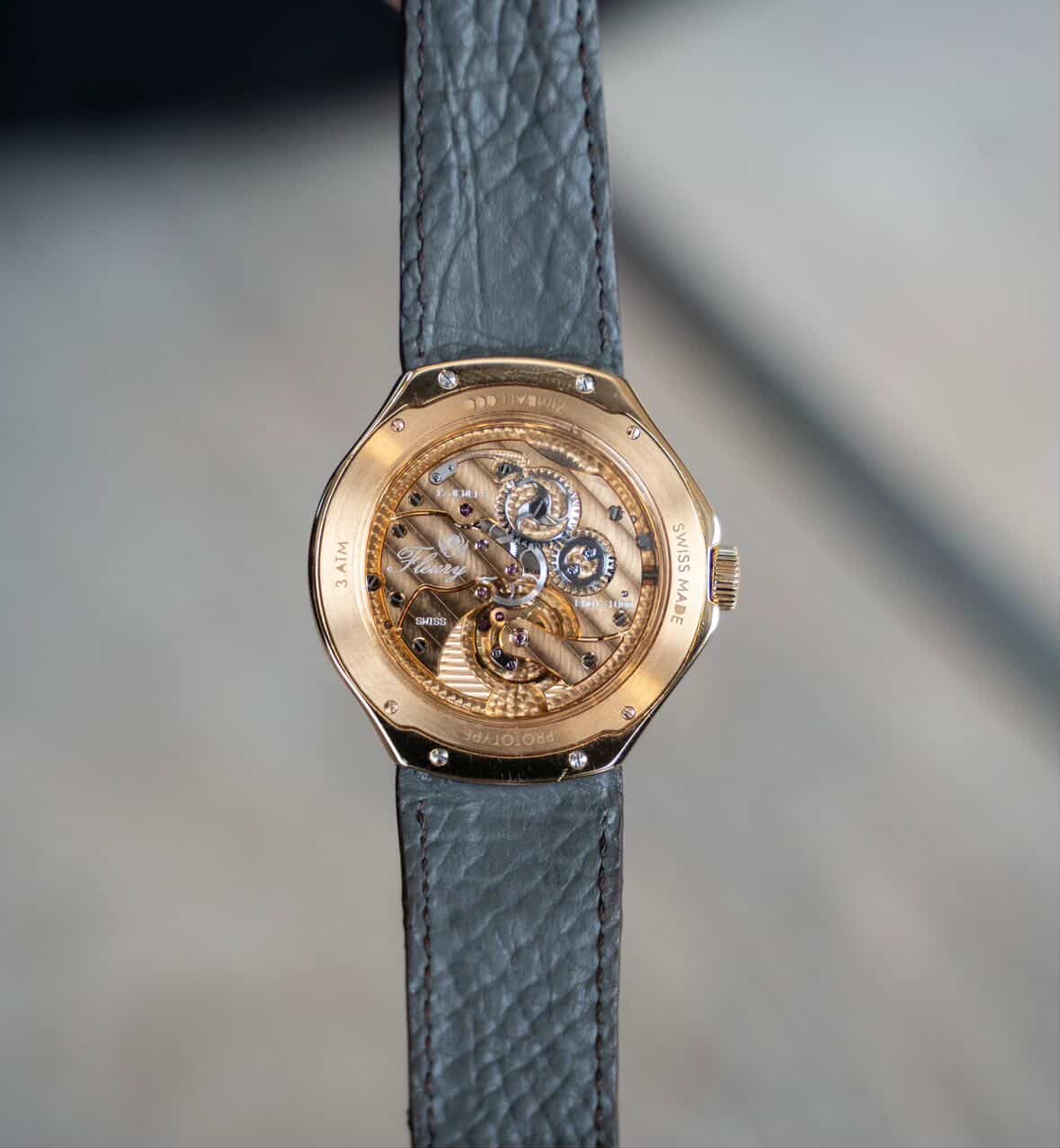
Nigel calls Maison Amahle the world's first Afro Swiss luxury watch house. His first public model is limited to twelve pieces and offered from approximately CHF 40,000 excluding VAT, with a 40 mm solid rose gold case, a hand wound Swiss movement developed with Manufacture Fleury, hand set 24 carat gold markers and an intentionally irregular sand textured dial. Maison Amahle says the watch is manufactured entirely in Switzerland.
These are facts about the object, and they are not small ones.
Twelvepieces worldwide, numbered 000.
From approx.CHF 40,000excluding VAT.
40 mmsolid rose gold, sand textured dial, hand set 24 carat markers.
Hand woundSwiss, developed with Manufacture Fleury. Made in Switzerland.
Those facts are harder to earn than they look. A hand wound movement developed with a named Swiss manufacture, a solid gold case, assembly in Switzerland: brands with far larger budgets have failed to get that far, and it is worth saying so before saying anything else.
Luxury, though, is not only the sum of the facts inside an object. Gold has a market price, craftsmanship has a labour cost and a movement has specifications. Luxury begins somewhere after all of that.
A Patek Philippe does not become Patek Philippe because somebody calculated the weight of its gold and added a margin. The name carries history, recognition and trust. People know where to service it, auction houses know where to place it, collectors know which references matter, dealers know what they can sell, and families know they can inherit it.
None of that describes a shortcoming in the Zimbali 000. It describes what every maison, Patek included, had to accumulate slowly, and the work that only begins once the object itself is finished. Nigel has finished the object. What sits in front of him is the second half.
Luxury is partly an object. It is also the network surrounding the object.
Nigel learnt this first through the object itself. His early case was approximately 37 mm; he has a smaller wrist and he liked it that way. Then he showed the design around, people told him it felt too small, and he moved towards 40.
Three millimetres is almost nothing, except that the dial changes with it, and then the geometry, the components, the CAD drawings, the material use and the placement of everything on it. The adjustment cost him months and thousands of francs, and he made it anyway.
That is the part of the trade nobody sees. A buyer meets the finished object; the iteration behind it is invisible by design, and in high watchmaking it is meant to be. The discipline is that the case should simply feel correct on the wrist, and that the work which made it feel that way should leave no trace at all.
At some point in our conversation Nigel said something almost casually. Swissness, he told me, gives you something you cannot simply buy: trust.
The remark stayed with me because it is true and also because it is uncomfortable. Why should geography produce trust, and why does "Swiss Made" communicate something before we have even touched the watch? Because behind those two words sit institutions and centuries of production, training and standards, companies and repair networks, collectors, failures, successions, workshops, regulation and a good deal of myth.
Switzerland did not become synonymous with watchmaking because somebody invented an excellent marketing campaign. An entire social and industrial ecosystem taught generations of customers what the words were supposed to mean. Maison Amahle is borrowing from that infrastructure, and for now it needs to.
It is worth being precise about how that ecosystem survived, because the story is usually told as though it grew by itself. It did not. When the Depression cut Swiss watch exports from 307 million francs in 1929 to 86 million in 1932, the Confederation intervened directly. It helped create the holding company ASUAG in 1931, put public money into the sector, and in 1934 passed a federal decree expressly intended to protect the Swiss watch industry, requiring permits to open or expand a company and to export movements and components. From 1936 the industry's own price tariffs were legally binding. The cartel had the force of law, dividing output and restricting entry, and it held for decades. Through those years dividends paid by Swiss watch companies averaged around 14 per cent, against 7.8 per cent for Swiss industry as a whole.
This matters, and not as an accusation. Swissness is not a natural endowment and it was not left to the market. It is an industrial policy that worked, assembled deliberately, with public money, in answer to a crisis. Institutions of that kind take a long time to build. They are not, however, mysterious, and there is nothing in them that could only have happened in Switzerland.
The opposite temptation is to describe Africa as the exciting new luxury frontier. There are enough consulting reports that do this already, and the actual picture is less convenient.
Swiss watch exports to Africa increased 9.4 per cent in value in 2025, which sounds significant until one looks at the other number: Africa still represented less than one per cent of Swiss watch exports by value, and in 2024 exports to the continent had fallen by 11 per cent.
Read alone, that number invites the wrong conclusion. It measures where Swiss watches are shipped, not who buys them, and it says almost nothing about African purchasing power. On that, the figures point the other way. The Africa Wealth Report 2025 counts roughly 122,500 dollar millionaires on the continent, alongside 348 centi millionaires and 25 billionaires, and projects the millionaire population to grow by 65 per cent over the coming decade. Sub Saharan African GDP was forecast to expand 3.7 per cent in 2025, against 0.7 per cent in Europe and 1.4 per cent in the United States, rising towards 4.1 per cent in 2026. The distribution is uneven and the report is candid about it: South Africa holds 41,100 of those millionaires while its own count fell 6 per cent over ten years, and Nigeria's high net worth population dropped sharply, even as Mauritius grew more than 63 per cent and Marrakech 67.
So the constraint is not appetite, and it is not capital. It is where the buying happens, and what stands between a collector and a purchase. There is not yet a dense continental retail and service infrastructure comparable with Europe, North America or parts of Asia. Nor should we imagine something called "the African luxury consumer" sitting patiently in Lagos or Johannesburg waiting for an African brand to arrive.
African wealth travels, and it has always travelled. The Lagos collector buys in London, the Ghanaian family shops in Paris, the Kenyan executive passes through Dubai, and the South African collector already knows the boutique manager in Geneva. The market is not merely African. It is transnational.
The other set of numbers
122,500alongside 348 centi millionaires and 25 billionaires.
65%increase in the millionaire population over the next decade.
3.7%in Sub Saharan Africa, against 0.7 in Europe and 1.4 in the United States.
USD 200bna year by 2030, on the Brookings estimate.
This may be one of the most important questions Maison Amahle will have to confront: why should an African collector buy an African watch?
There is no satisfactory answer that begins with obligation. People do not owe emerging African companies purchases out of racial solidarity, and at CHF 40,000 they certainly should not. That is not a criticism of African collectors. It is a compliment, because it treats them as buyers with alternatives rather than donors with a duty. Luxury relies on desire.
This distinction is often blurred when we talk about African creative industries. We ask consumers to support: support Black designers, support local, support African brands, support artisans. But support belongs partly to the language of charity, and luxury needs another verb.
The verb
Want.
I want this object. I prefer it. I choose it despite having other options. That is far harder, and far more valuable.
This is where retail becomes anthropological. A handful of spaces across the continent matter far beyond their turnover, because taste requires institutions: someone chooses what goes in the room, someone places one designer beside another, and someone decides that this lamp, this coat, this ceramic object and this photograph belong in the same cultural sentence. This is how an object acquires context.
Folawiyo trained as a lawyer in Nigeria before moving into fashion and hospitality. The name means wondrous performer in Yoruba, and she chose it for the number of things she intended the building to do. David Adjaye designed the 965 square metre structure, its lattice facade drawn from Yoruba adire textiles, rising three storeys to a glazed rooftop gallery and terrace that looks back over the city.
What matters commercially is the shelving logic. Alára places African designers such as Maki Oh and Lanre Da Silva Ajayi beside Valentino and Christian Louboutin, on equal terms rather than in a separate section, and it programmes fashion shows, exhibitions and pop ups alongside the retail floor. Folawiyo also runs the restaurant Nok on the same site. Before it opened, Nigerians who wanted luxury largely bought it abroad; her stated ambition was to change both how the city saw itself and how it was seen. Adjaye has described her as having built a contemporary visual language for African luxury.
The founder also heads the Women's Empowerment and Investment Group, which places seed and growth capital into women led businesses in Ghana. That combination is unusual and relevant here: the same person runs the shelf and controls a source of capital, which is precisely the pairing the missing middle usually lacks.
The store carries more than ninety African luxury labels and operates a store within a store model, giving houses including David Tlale, Christie Brown, Torlowei and Sukeina their own space inside it. Alongside retail it runs fashion shows, product launches and film screenings, and it will assemble commissioned gift boxes to a stated budget. It describes itself as a destination for curated fashion and lifestyle goods from the continent and its diaspora.
Magugu was born in Kimberley in 1993, studied in Johannesburg and showed his first collection in 2017. In 2019 he became the first African designer to win the LVMH Prize for Young Fashion Designers, taking 300,000 euros and a year of mentoring from the group, and he presented his debut Paris collection at the Palais de Tokyo. He has built the business from Johannesburg rather than relocating, which the jury remarked on at the time.
Magugu House began as that Johannesburg atelier, functioning as retail, archive, exhibition and cultural space rather than a shop. In February 2026, marking ten years of the house, he opened Magugu House Cape Town alongside a two storey suite he designed at Mount Nelson, his first work in hospitality. Created with StudioLandt, the Cape Town space shows limited editions, archival garments, photography, books and objects, rotates exhibitions quarterly with cultural partners, and runs monthly film screenings and salon conversations. The opening exhibition, By Our Own Hands, was made with the gallery Southern Guild and included Zanele Muholi and Zizipho Poswa.
Bousfiha is an architect and interior designer, Mohsine an entrepreneur trained in food industry engineering, and their families have been connected for generations. They started not with a shop but with a product: The Moroccans, an organic skincare line launched in 2015 and made on their farm on the Essaouira road from argan and prickly pear seed oil, rose water, black soap and local botanicals.
The flagship opened in December 2017 next to the Jardin Majorelle. Small Moroccan designers began asking for shelf space, so the founders started representing them, and in March 2020 opened MORO on the same street. It is now concept store, restaurant, boutique hotel and pool at once, behind a whitewashed mid century facade lettered in Helvetica. The point is the sequence: the skincare, the food, the rooms and the objects come from one sensibility that grew into a building, rather than a building later dressed with a brand.
Doumbia worked at the Paris concept store SO and SO Ethik and ran pop ups there for brands before returning home, where he found more new Ivorian labels than the city had places to show them. He began with a pop up boutique for designers, and after two years opened Dozo as something permanent.
It carries Ivorian and other African brands including Kente Gentlemen, Loza Maléombho, Olooh Concept, Missouwa and Vintage Nation, and functions as a gathering place where designers plan, compare notes on what is not working and organise events. Doumbia describes the model as functioning as a pack, which is a more accurate description of what a missing middle actually needs than any retail term.
Its founders refuse the term concept store and call it a mood store instead, on the grounds that a concept is limiting. The name comes from Marché Sandaga, a landmark Dakar market, and the reference is deliberate: the founders describe selling a perception and a feeling, closer to the unpredictability of an open market than to a curated rail.
The stock draws on the Dakar of the 1980s and 1990s and on a founder's grandfather's wardrobe, with kaftans, fine jewellery and leather goods displayed closer to a museum than a shop floor. A second Dakar address, L'Atelier Nomad, works in a related register.
Africa has extraordinary designers, and a far larger industry behind them than the word fashion suggests. UNESCO's first continental survey of the sector values it at around 31 billion dollars, with 15.5 billion in annual textile, clothing and footwear exports, more than 1.5 million jobs, thirty two fashion weeks a year across the continent, and ninety per cent of it composed of small and medium enterprises. Brookings has estimated that Africa's creative economy could reach 200 billion dollars a year by 2030. This is not a sector waiting to begin.
What is distributed unevenly is the machinery between making something excellent and building an enduring global house: specialist manufacturing and patient capital, luxury retail and distribution, repair, insurance and PR, fashion education and watchmaking education, collectors and critics, archives, museums, auctions and resale. The ecosystem, in other words, that allows an object to develop a biography longer than its founder.
That gap has a history, and it is not a history of African incapacity. Value chains that begin with African material and end with European margin were designed that way, over more than a century, and the institutions sitting at the profitable end were frequently protected by the states that housed them. European maisons appear self contained because we usually see the logo rather than the machinery surrounding it. They are not, and they never were.
No Maison is an island.
Interlude
Everything above rests on a set of assumptions most of us have never checked. Ten true or false statements, each with the reasoning underneath it. Open the answer without guessing if you would rather simply read.
A watch may only be marked Swiss Made if at least 60 per cent of its manufacturing costs are incurred in Switzerland.
The statement is true.
Since the ordinance was revised on 1 January 2017, a watch must meet four conditions to carry the words: at least 60 per cent of manufacturing costs incurred in Switzerland, technical development carried out in Switzerland, a Swiss movement, cased up in Switzerland, with final inspection by the manufacturer in Switzerland. Before 2017 the threshold applied mainly to the movement. Sixty per cent is a floor rather than a description, which means up to 40 per cent of the cost of a Swiss Made watch can originate anywhere on earth.
A fine mechanical watch keeps better time than an ordinary quartz watch.
The statement is false.
Quartz is roughly ten times more accurate. A mechanical movement certified as a chronometer is permitted a deviation of a few seconds per day; an unremarkable quartz watch drifts a few seconds per month. Mechanical watchmaking has not been sold on precision since the 1970s. It is sold on craft, on endurance, and on the fact that a mechanical movement can be dismantled and repaired more or less indefinitely.
Swiss watchmaking became the world standard without significant state protection.
The statement is false.
The Confederation intervened directly and decisively. After the Depression cut Swiss watch exports from 307 million francs in 1929 to 86 million in 1932, the state helped create the ASUAG holding company in 1931, put public money into the sector, and in 1934 passed a federal decree expressly intended to protect the Swiss watch industry, requiring permits to open or expand a firm and to export movements and components. From 1936 the industry's price tariffs were legally binding. The cartel had the force of law and held for decades, and through those years watch company dividends averaged around 14 per cent against 7.8 per cent for Swiss industry generally. Swissness is an industrial policy that worked rather than a natural endowment, which is also the reason it is not unrepeatable.
The quartz crisis of the 1970s and 1980s cost the Swiss watch industry roughly two thirds of its jobs.
The statement is true.
Employment fell from about 90,000 in 1970 to somewhere between 28,000 and 33,000 by the mid to late 1980s, and the number of firms dropped from roughly 1,600 to fewer than 600. Entire component towns in the Jura arc closed. The recovery came from repositioning the mechanical watch as a luxury object rather than an instrument for telling the time, which is the market any new maison enters today.
The tourbillon was invented to counter the effect of gravity on the escapement.
The statement is true.
Abraham-Louis Breguet patented it in 1801. A pocket watch spends most of its life in one vertical position, so gravity pulls on the balance consistently and introduces a repeating error; rotating the whole escapement averages that error out. In a wristwatch, which changes position all day, the practical gain is far smaller. The tourbillon survives mainly as a demonstration of skill, which is its own kind of value.
The Geneva Seal can be awarded to any Swiss watch, wherever in Switzerland it is made.
The statement is false.
The Poincon de Geneve is territorial. The watch must be assembled, cased and regulated within the Canton of Geneva, and it must satisfy finishing criteria besides. A watch made in the Jura, however fine, cannot carry it. What is worth noticing is that the seal was created by cantonal law in the nineteenth century. Certification of this kind is a policy instrument, and policy instruments can be written anywhere, by any jurisdiction that decides its makers deserve one.
Only a handful of Swiss brands make their own hairsprings.
The statement is true.
The hairspring is the hardest component in a mechanical watch to produce, and most of the Swiss industry buys it from a small number of specialist suppliers, with Nivarox the dominant name. Only a few houses make their own. It is the clearest illustration of how few brands are genuinely self contained: the logo on the dial is almost never the whole story of who made the watch.
A watch rated 3 ATM is suitable for swimming.
The statement is false.
Three atmospheres, or thirty metres, means resistant to splashes and rain. It is not a swimming rating and not a showering rating. The figure comes from a static pressure test, not a depth guarantee, and moving an arm through water raises local pressure well beyond the number on the case. The prototype caseback shown in this feature is engraved 3 ATM.
Rose gold differs from yellow gold mainly through a higher copper content.
The statement is true.
Pure gold is too soft for a watch case, so it is alloyed. Copper pushes the colour towards red and rose; silver and palladium pull it towards white and grey. Rose and red gold differ from one another only in the proportion of copper. Both are ordinarily 18 carat, which means 75 per cent pure gold by weight, the rest being the alloy that gives the case its hardness and its colour.
Many watches marked Swiss Made run on movements bought from outside suppliers rather than made in house.
The statement is true.
A large part of the Swiss market runs on movements from industrial suppliers, above all ETA, which belongs to the Swatch Group, and Sellita. A brand that produces its own movements is called a manufacture, and the distinction is commercial as much as technical: buying a movement is a purchase, developing one is the beginning of an institution.
This is why I think Nigel may have one advantage. He does not need Africa, not yet. He needs twelve people.
The Zimbali 000 is limited to twelve pieces worldwide, and that changes the mathematics entirely. The challenge is not how to capture the African luxury market. It is this:
Who are twelve people capable of spending CHF 40,000 who understand watches, care about this particular experiment and would genuinely prefer to own one?
Perhaps there are twelve and perhaps there are not; that is what the market will determine. But if they exist, who they are matters, because the first twelve customers are not merely customers. They become evidence.
Switzerland offers an instructive example in a completely different category. On did not build its global legitimacy through Roger Federer alone. The company already existed, the shoes already worked and customers were already running in them. Then Federer entered.
On itself describes the relationship unusually: not sponsorship but entrepreneurship. Federer had already been wearing the shoes, and after meeting the founders he became closely involved in the company, participated in product development and eventually helped create THE ROGER. What he gave On was more than visibility; he made the proposition culturally coherent. Swiss engineering, Swiss athlete, global excellence. The person and the product reinforced each other, which is rare.
Maison Amahle may need its own version of that moment, and not another influencer photographed wearing a free watch at an event. Trevor Noah is interesting because he is already part of watch culture, repeatedly documented wearing Patek Philippe, Audemars Piguet and unusual Rolex pieces. He is also South African, globally legible and culturally difficult to reduce to one place: African and diasporic and international at once, which resembles the market Maison Amahle itself needs to understand.
If he genuinely encountered a Maison Amahle and decided that it belonged beside the watches he already collects, the value would not primarily be his audience. It would be his judgement, and the difference between the two is enormous.
Maison Amahle does not need Trevor Noah to advertise the watch. It needs the kind of person he represents to believe the watch.
One phrase on Maison Amahle's website reads from mine to wrist, and the gold hour markers are indeed left intentionally irregular, small raw looking fragments set individually onto the dial. It is a good line, but it opens a bigger question than the brand perhaps intends.
What happens between mine and wrist? Africa has spent generations participating in luxury economies disproportionately near the beginning of the value chain: gold and diamonds, leather and metals, craft, labour and cultural imagery. Somewhere farther along that chain these become intellectual property, maisons, distribution networks and extraordinary margins.
Nigel eventually wants some of Maison Amahle's production capacity to exist in Botswana, the country where he grew up. That ambition is worth taking seriously rather than romanticising. Watchmaking ecosystems are not created by renting a factory and installing Swiss machines: skills sit inside people, people sit inside institutions, and institutions accumulate over time. Switzerland needed a century and a federal statute. But Botswana has been doing precisely this work in an adjacent industry for two decades, which is the more useful comparison.
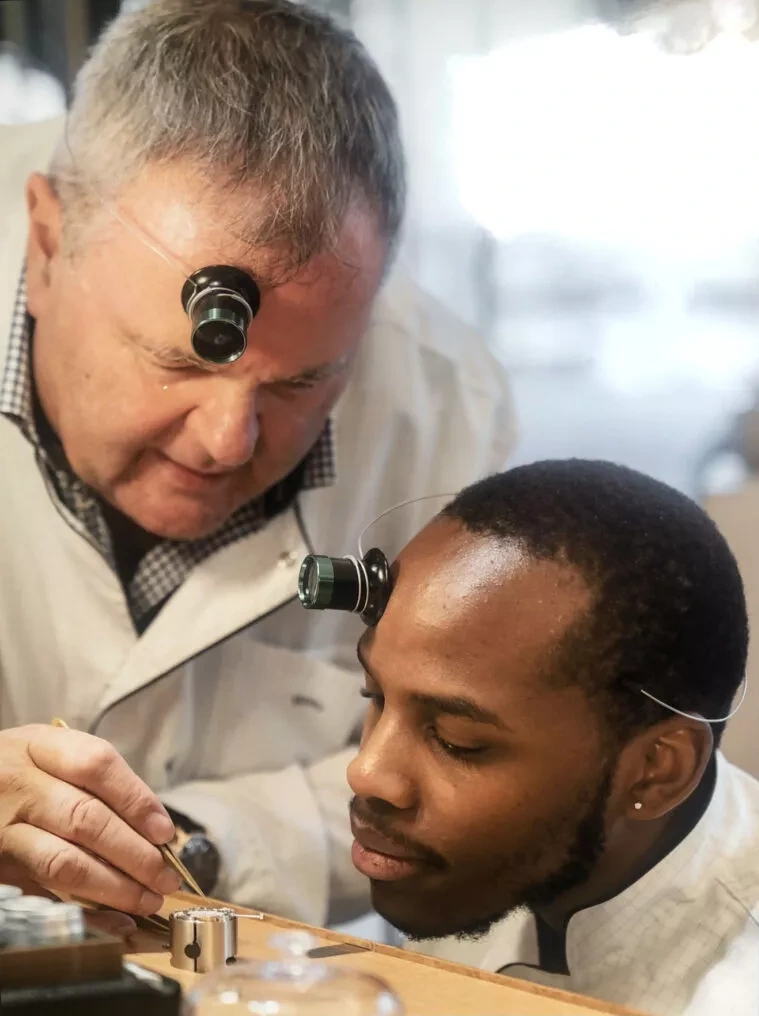
But this is precisely why the ambition is interesting. The question should not be whether Botswana can suddenly replace Geneva, because it cannot. The question is narrower and far more useful:
Which parts of the value chain could begin moving?
A strap. A component, a piece of finishing, jewellery work. Repair, training, assembly. Then perhaps something else.
Botswana makes this question unusually relevant, and it is further along than the phrase downstream value usually implies. Debswana, the 50:50 partnership between the government and De Beers, is the country's largest private sector employer, with more than 5,000 full time staff and around 6,000 contractors. Cutting and polishing has become the largest manufacturing sub-sector in the country. The state's own rough trading arm, Okavango Diamond Company, sells stones by tender inside Botswana and runs citizen tenders so that Batswana traders can enter the market rather than watch it pass. In 2023 the government took a stake in the Belgian house HB Antwerp and a cutting and polishing plant opened in Gaborone, with Okavango supplying rough for five years and the value addition contracted to take place in Botswana.
The objection about skills is answered there too, concretely. At one Gaborone precision cutting operation the managing director, Rutang Moses, was the first Motswana to run a diamond manufacturing plant in the country, and the company replaced most of its foreign staff with local ones. She has described building that expertise almost entirely from nothing.
So luxury does not merely pass through Botswana. Some of it is now made there. Extracting an expensive material does not automatically create an expensive industry, but design does, and so do engineering, branding, distribution, reputation and time, and Botswana has been buying that time deliberately for twenty years.
There is another question Maison Amahle should handle carefully. The Zimbali 000 connects its twelve hour markers to a narrative about Sundiata Keita uniting twelve tribes in the creation of the Mali Empire, and its website currently describes Mansa Musa as Sundiata's nephew.
The broad history of Sundiata as founder of the Mali Empire is established, but much of his biography comes through epic oral traditions, and genealogical and numerical details vary between sources. Scholarly and educational accounts more cautiously describe him as uniting multiple peoples and kingdoms, while Mansa Musa is more commonly described as a later relative, often a great nephew.
This may appear pedantic. It is not. European maisons have invented lineages, borrowed crests and mythologised their founders for a century and been largely forgiven for it. The reason to be careful here is not a higher standard imposed from outside. It is that precision is the more valuable asset, and a heritage claim that survives a historian is worth considerably more than one that does not.
The story deserves the same precision as the movement.
I asked Nigel another unromantic question: what happens when this watch needs servicing in ten years?
My own reference point was my mother's Rolex. She owned it before I was born, eventually it became mine, and its value lies partly in the fact that an infrastructure exists around it decades after its manufacture. Maison Amahle currently provides a three year warranty and recommends servicing every five to ten years, either through the Maison in Switzerland or through a local watchmaker supplied with parts. That is good, but if the Maison wants to make heirlooms its true horizon is much longer. The most important customer may not be the person buying the watch. It may be their daughter.
There is something timely about Nigel attempting this now. According to Bain's latest global luxury analysis, watches are moving towards connoisseurship, craftsmanship and rarity, while consumers across luxury increasingly seek personal meaning rather than straightforward social validation.
Perhaps that creates room for small maisons, but it also raises the standard. A logo alone no longer guarantees affection, and neither does an African story, nor Swiss Made, nor celebrity. All of them can open doors. None of them can make the watch matter.
Near the end of our conversation, I found Nigel's original 2023 deck. He hated seeing it again. I didn't.
Early presentations contain a kind of honesty that polished brands eventually lose, because they reveal the period before history is rewritten as inevitability. Before a company has "heritage," there is usually just somebody with a PowerPoint. Before there is a Maison, there is somebody emailing strangers. Before there is provenance, there is a prototype that doesn't quite work. Before there is a collector, there is a founder wearing his own watch around Geneva asking people whether it looks too small.
That is where Maison Amahle still is: somewhere between proposition and institution.
Perhaps that is ultimately the question. Not whether Africans can afford luxury, because of course they can, and not whether Africans can design beautiful things, because obviously they can. The more consequential question is this:
Who gets to own the systems through which beauty becomes valuable?
Who manufactures, who finances, who curates, who stocks, who critiques, who collects, who repairs, who archives. Who decides that something is important.
ALARA matters because it curates. Magugu House matters because it creates an institutional world around a designer. The LOTTE matters because it gives African and diasporic design physical context. Moro matters because it turns retail into experience. Swiss watchmaking matters because generations of infrastructure sit behind two small words. And Maison Amahle will matter only if it eventually creates an infrastructure around itself strong enough that the watch no longer needs explaining.
Perhaps Trevor Noah wears one and perhaps he doesn't. Perhaps the first important collector is someone whose name none of us know, which may even be better. For now there are twelve watches, twelve potential acts of belief, and a much larger question sitting quietly beneath them.
The question beneath
Can Africa move from supplying, consuming and inspiring luxury to owning more of the institutions that define it?
Parts of the answer are already being written, in Gaborone, in Lagos, in Johannesburg. The rest will take longer than five months to manufacture, which, for a company building mechanical watches, feels appropriate.
Nigel Ndlovu was born in Zimbabwe, grew up in Botswana and is based in Switzerland. He is the founder of Maison Amahle, which he describes as the first Afro Swiss luxury watch house.
Maison Amahle presented its first public model, the Zimbali 000 Midnight Desert, in a series of twelve pieces from approximately CHF 40,000 excluding VAT. The Maison states that the watch is manufactured entirely in Switzerland, provides a three year warranty and recommends servicing every five to ten years, either in Switzerland or through a local watchmaker supplied with parts.
This feature is based on a conversation between Tallulah Patricia Bär and Nigel Ndlovu. It is written as an essay rather than a transcript. Where Nigel's words appear, they are drawn from that conversation and edited for clarity. Product specifications and service terms are as published by Maison Amahle. Market figures and historical accounts are drawn from the references above and are the responsibility of the author.