TheSwissPanAfrican Strategy & Culture Studio
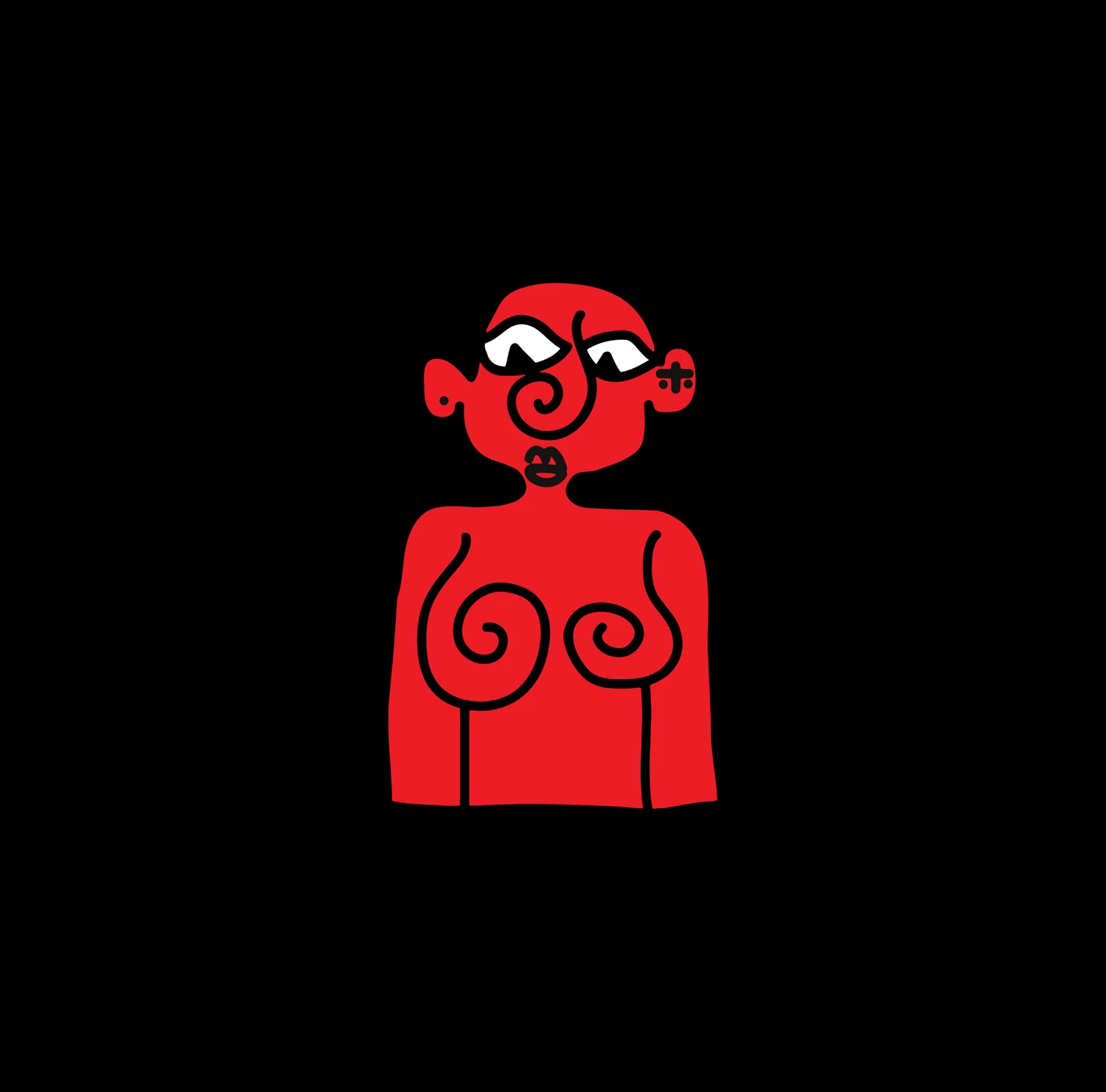
Red non-binary symbolic figure from Nana Danso's visual world on a black background

The Artistic Conversations · Accra

Nana Danso
The Witnesses

A conversation about the unseen worlds that shape everyday life, the characters who carry them, and the difficulty of building an artistic language before institutions know how to name it.

An Artistic Conversation

Moderated and interpreted by Tallulah Patricia Bär

Accra ↔ Zürich

Remote conversation · 2026

Spirituality · Mythology · Public art

World-building · Institutions · Publishing

01

The central question

How do you make the unseen visible without reducing it?

Nana Danso’s practice begins where ordinary description becomes insufficient: in the invisible worlds that continue to organise belief, space, memory and daily life.

Raised in Ghana and based in Accra, Nana works across painting, sculpture, installation, photography and film. His recurring figures, known as The Witnesses, are non-binary beings drawn from personal imagination, Ghanaian folklore, spiritual practice and the symbolic life of objects. They do not illustrate one fixed story. They inhabit a world in which multiple meanings can exist at once.

Our conversation moved between family memory, sacred spaces, public art, gallery systems, residencies, fashion, publishing and the challenge of locating a multidimensional practice within markets that often prefer recognisable trends.
“I have been developing a mythology around the unseen world, and how those experiences can be transformed into modern life.”

Nana Danso, edited from the conversation
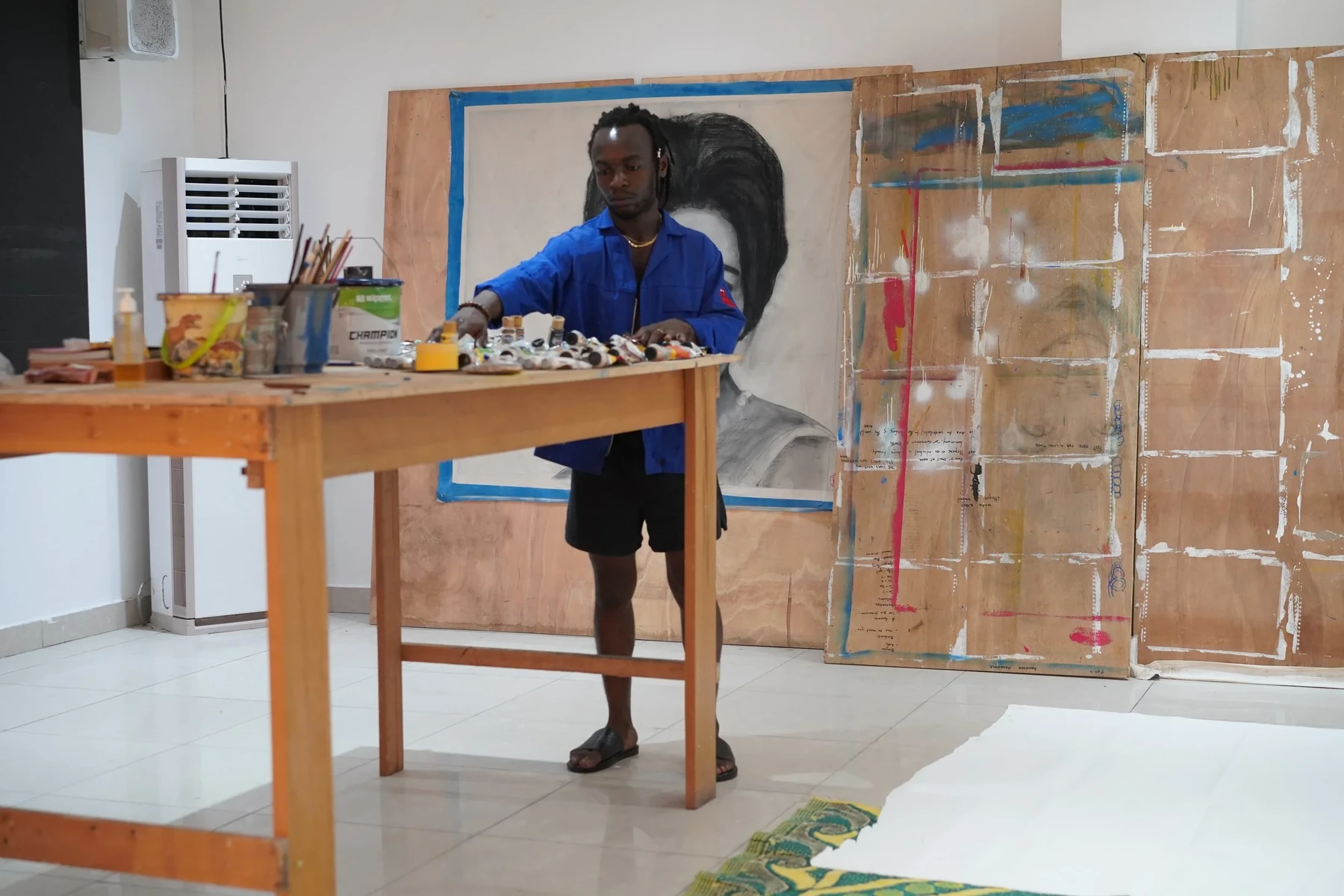
Nana Danso working in his studio in Accra

The beginning

A self-taught practice shaped by belief

Nana described leaving university after realising that his studies had little connection to the work that was already taking hold of him. He was still very young, but increasingly absorbed by the spiritual practices within his family and by the objects, shrines, symbols and rituals through which communities relate to forces that cannot be seen.

Rather than treating these traditions as remnants of the past, he began asking how they continue to shape contemporary visual language. The placement of objects in a home, the design of a shrine, a repeated sign, a protective form or a ritual gesture may survive even when its original sacred context is no longer consciously acknowledged.

His practice grows from that persistence.

The Witnesses

Characters who occupy the threshold

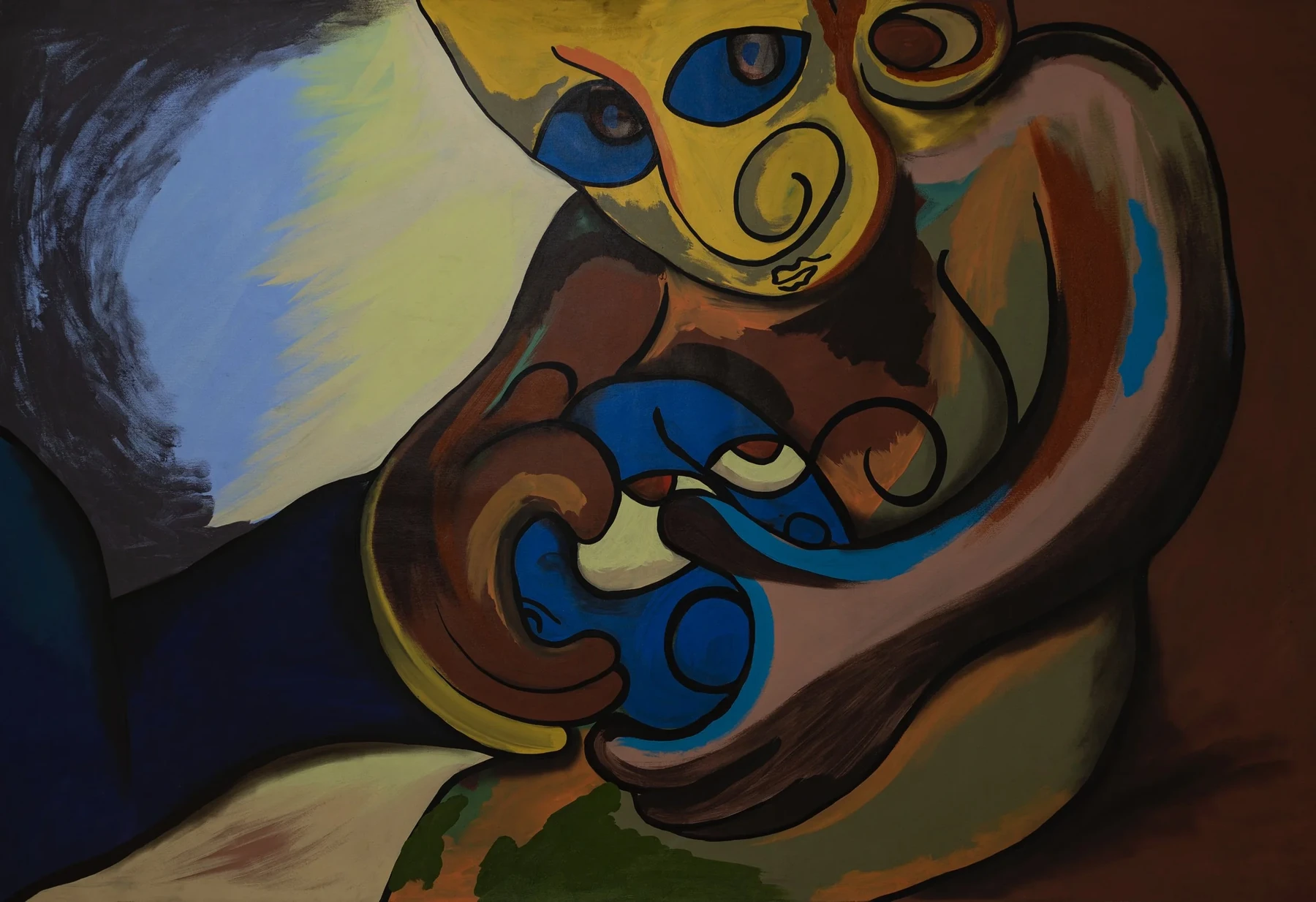
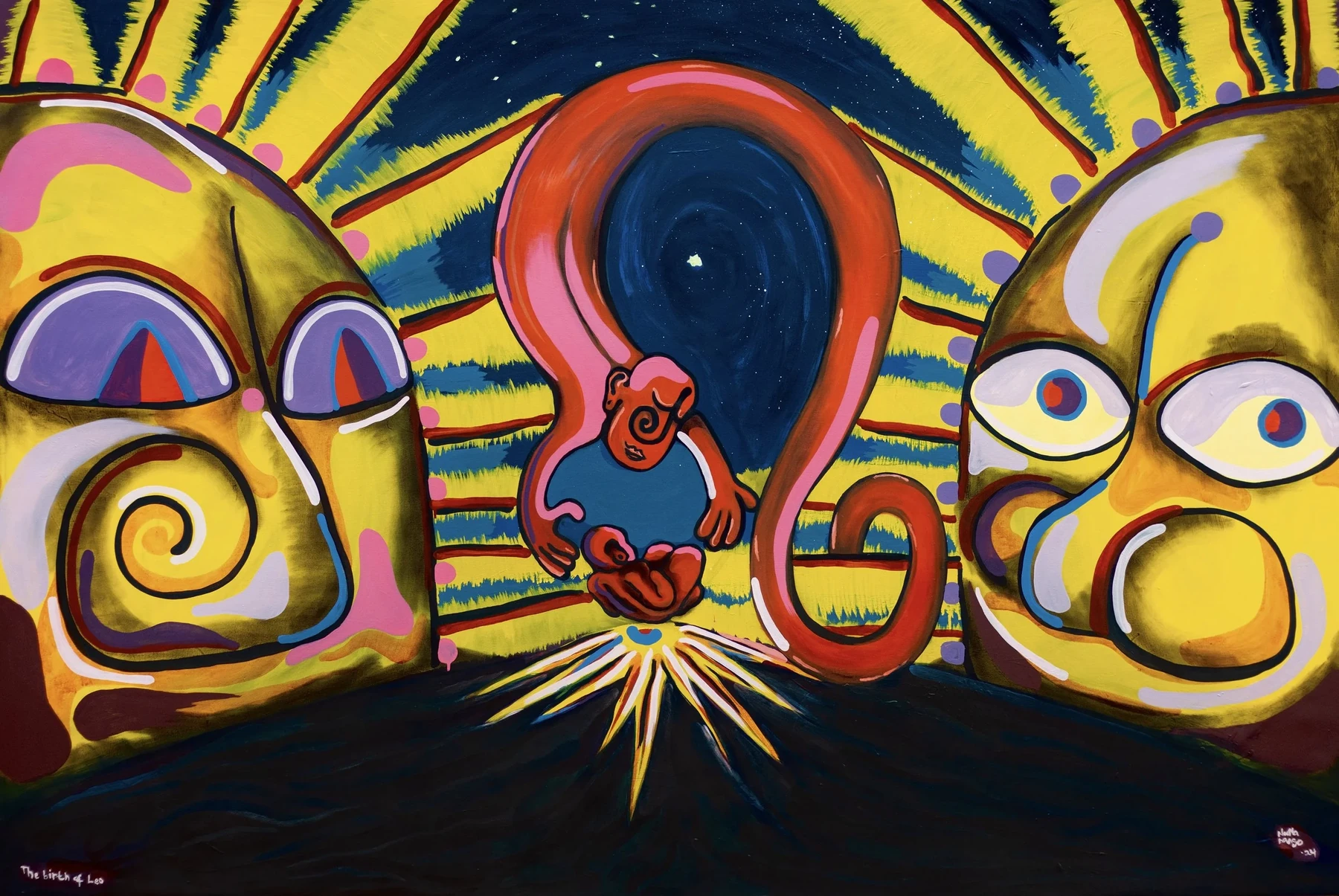
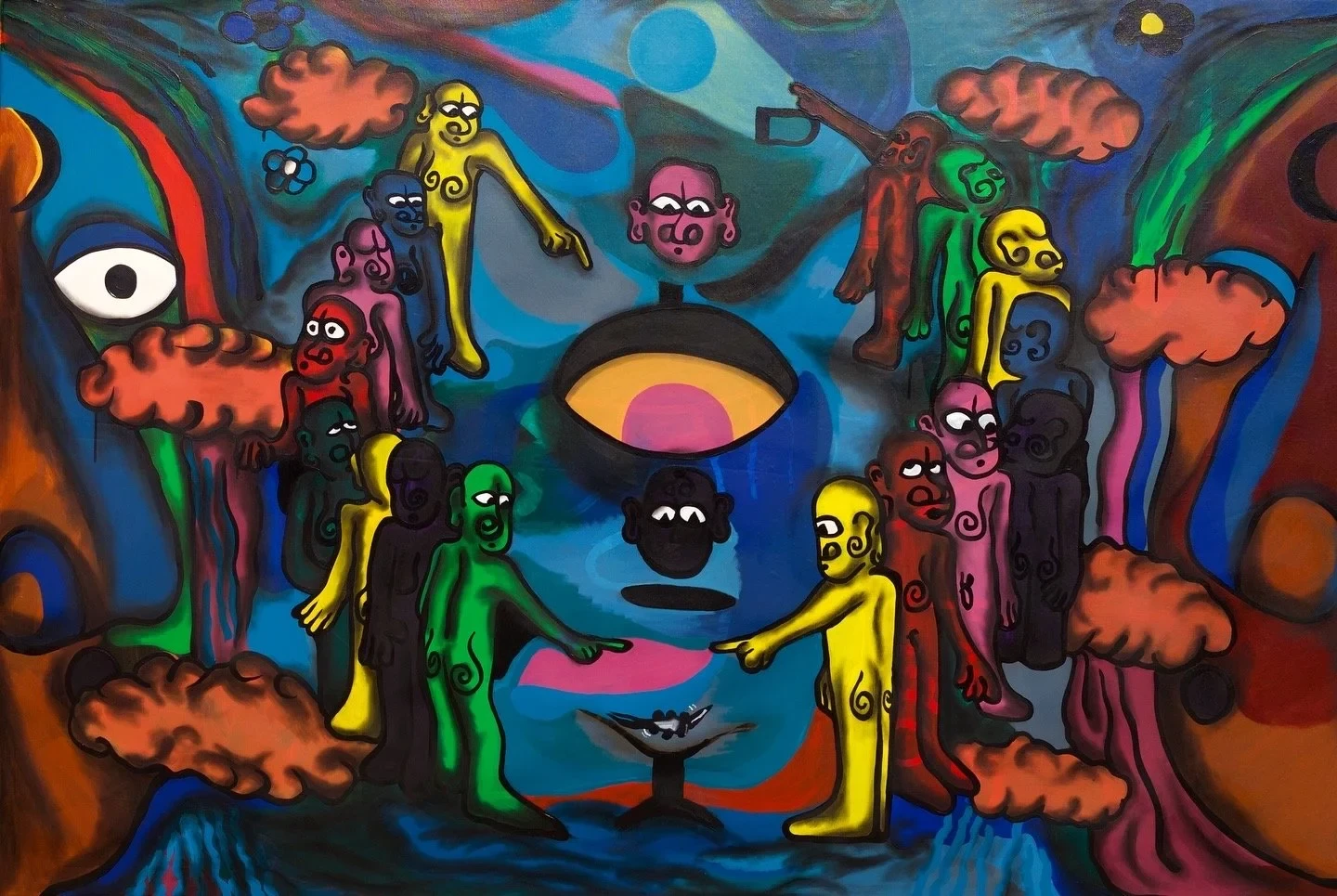
The Witnesses are neither portraits nor conventional deities. They are recurring non-binary beings through which Nana explores Ghanaian folklore, spiritual memory and contemporary life. Their bodies are marked by spirals, exaggerated eyes, symbolic gestures and forms that resist easy classification.

They operate between categories: visible and invisible, sacred and ordinary, familiar and strange, ancestral and imagined. In this sense, they are not simply figures inside paintings. They are the organising intelligence of a larger world.

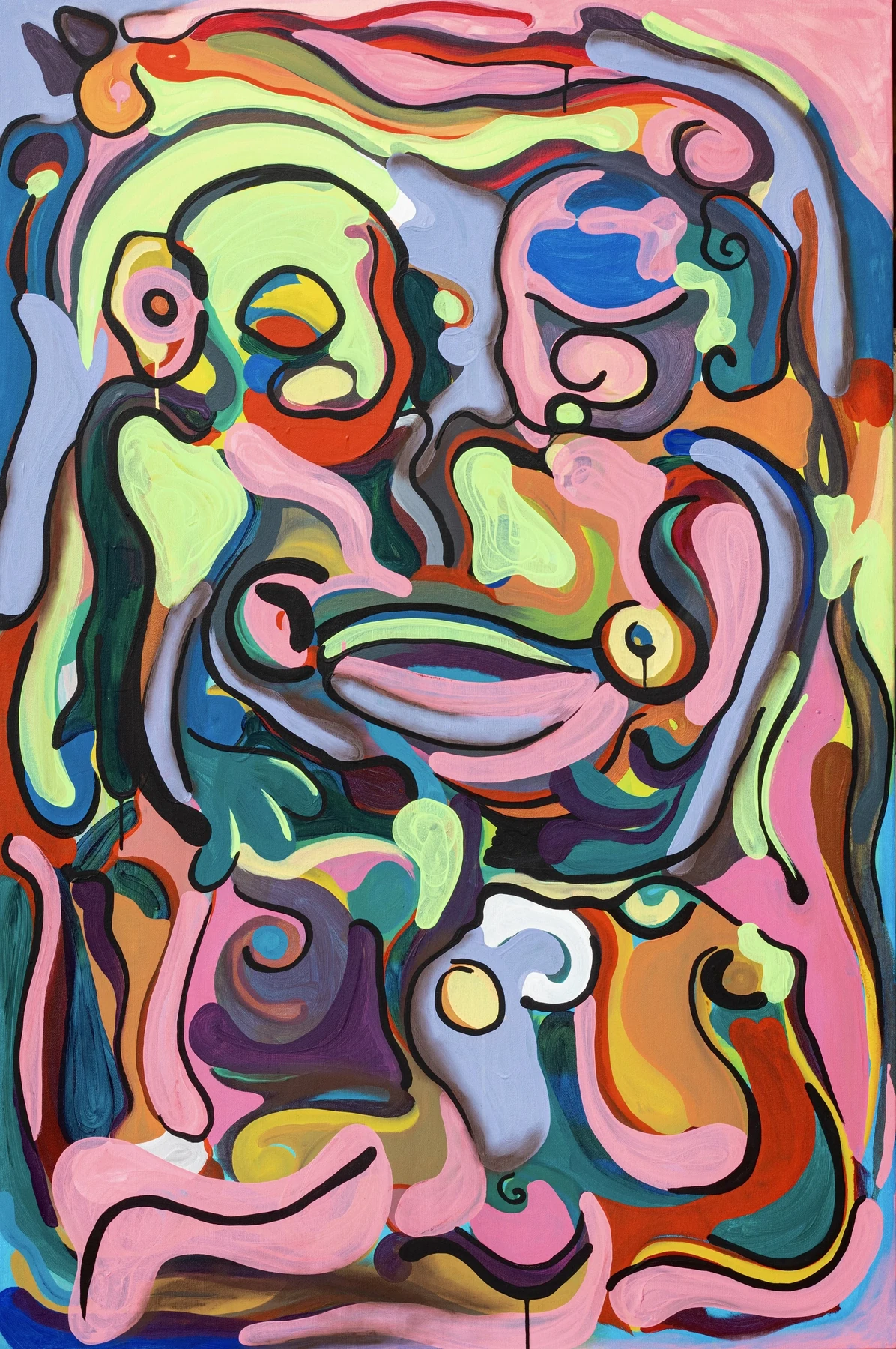
Fall, 2022 by Nana Danso, with brightly coloured figures and symbolic forms

Selected works

A visual language that refuses one reading

Artwork details follow Nana Danso’s official selected-works archive.

02

Public space

Why should art only appear inside a gallery?

Nana’s move into street art came from a practical absence: too few places in Accra where people could encounter art without already belonging to an art-world circle.

He described public art in Ghana as frequently tied to political figures, memorial monuments or sanctioned historical narratives. The Witnesses allowed him to insert another kind of presence into the city—ambiguous, spiritual, playful and unresolved.

A mural at Front/Back became one of the moments through which his language entered a public-facing cultural space. Later exhibitions and collaborations brought the practice into galleries and fashion, but the street remained important because it tested whether the work could live beyond the codes of the white cube.

03

The system around the work

When markets reward a trend, who gets to build a world?

The conversation became most revealing when Nana spoke not about making art, but about the structures that determine which art becomes legible.

Representation narrows quickly

Nana described a West African gallery environment in which attention can concentrate around a small number of successful artists and then reproduce similar aesthetics around them.

World-building needs time

A multidimensional practice cannot always be reduced to one saleable image. Residencies become important because they provide time and space to construct an environment rather than merely produce an object.

Visibility is not the same as infrastructure

Being noticed, shown once or collaborating with a major brand can expand reach, but a sustained career still needs curatorial context, writing, archiving, representation and institutional relationships.

Fashion as another surface

From imagined beings to Off-White

Nana’s collaboration with Off-White for the “Duty Free SS25” collection introduced his visual language into fashion. The importance of such a collaboration is not merely scale or prestige. It demonstrates that The Witnesses can migrate across surfaces and systems—canvas, wall, sculpture, clothing, moving image—without losing their underlying symbolic charge.

View Nana’s projects ↗

Residencies and movement

Travel should expand the language, not validate it

Nana has participated in residencies outside Ghana, including experiences in Pakistan and Benin discussed in the call. His website also documents a 2025 residency in Grand-Bassam focused on spirituality, everyday objects and the contemporary shrine.

Our conversation resisted the assumption that artistic development must always move toward Europe or the United States. Across the continent, residencies can create exchanges grounded in shared histories, different spiritual traditions and new forms of solidarity.

The question is not simply where an artist travels. It is what kind of thinking the journey makes possible, who can access it, and whether the network created continues after the residency ends.

The unwritten book

A mythology needs an archive of its own

During the conversation, the idea of a book shifted from a possible publication into a strategic necessity.

Nana writes, researches and builds a world whose meanings cannot be fully contained by a conventional exhibition caption. A book could bring together images, fragments of mythology, reflections on Ghanaian spiritual traditions, studio notes, photographs of relevant places, material experiments and the evolution of The Witnesses.

Such a publication would not merely document completed works. It could become the first coherent map of the world he is building—and a form through which future generations encounter knowledge that may otherwise become harder to access.

“My work may become relevant to generations who no longer have access to those traditions, but who could still meet that world through the art.”

Nana Danso, edited from the conversation

Tallulah’s reflection

Editorial interpretation

The right to remain difficult

What Nana is building is not difficult because it lacks clarity. It is difficult because the work refuses the simplified categories through which institutions often make artists legible.

The Witnesses are at once visual figures, spiritual propositions, narrative devices and inhabitants of a larger cosmology. They can become paintings, sculptures, murals, moving images or garments, but none of those formats contains the whole practice. The work asks for a different kind of attention: not “What does this image represent?” but “What kind of world makes this image possible?”

This distinction matters. Art markets often reward repetition because repetition is recognisable. Institutions may celebrate “African spirituality” while flattening the specific cultural systems, family histories and living practices from which the work emerges. Fashion may amplify a motif while detaching it from the mythology that gives it force.

Nana’s opportunity is therefore not to make the work easier. It is to build enough language, documentation and institutional context around it that the complexity can travel without being erased.

A book could help. So could carefully selected residencies, curatorial writing, museum commissions, public installations and cross-disciplinary collaborations. But the centre must remain the world itself: its beings, rules, symbols, tensions and relation to Ghanaian life.

The most valuable contribution may be precisely that Nana is not following the market’s current image of what contemporary West African art should look like. He is constructing a language that institutions may have to learn how to see.

Five ideas from the conversation

01

Spiritual knowledge survives through form.

Objects, spatial arrangements and symbols may continue to carry inherited meanings even when their sacred origins are no longer explicitly named.

02

World-building exceeds the gallery object.

Painting, sculpture, film, installation and public art become different entrances into one evolving mythology.

03

African art markets need wider visual languages.

Support should not concentrate only around styles that have already become commercially recognisable.

04

Residencies are research infrastructure.

Their value lies in time, space, cultural exchange and the ability to test a world at scale.

05

A book can become an intergenerational bridge.

It can hold images, language and cultural context together long enough to travel beyond one exhibition or one market cycle.

Possible pathways

Where this work could enter next

Editorial possibilities only—not claims of existing partnerships.

Curated museum environments

Installations that present The Witnesses as an interconnected world rather than isolated works.

Artist publication

A visual mythology combining artworks, writing, cultural research, process and archival material.

Public art commissions

Murals, sculptural figures and site-specific interventions in cities across Africa and the diaspora.

Interdisciplinary residencies

Programmes connecting art with anthropology, religion, sound, film, fashion, architecture and digital culture.

Fashion and material collaborations

Projects that preserve authorship and context while extending the language into new media.

Digital world-building

Animation, interactive archives and spatial storytelling that can reveal relationships between characters, objects and beliefs.

Curated transcript

The conversation in ten movements

Condensed from the supplied call transcript. Open each chapter to read the edited exchange.

01 Ghana, weather and a first point of connection

Tallulah: I am so excited to speak to someone in Ghana. How is everything there?

Nana: It has been raining heavily, and the flooding has affected people in ways that feel unpredictable. It reminds you how quickly everyday life can be disrupted.

02 Entering art outside university

Nana: I left university because the work I was already making felt more connected to my actual interests. I was around nineteen or twenty and increasingly drawn to art.

Tallulah: So the practice emerged before there was an institution around it.

03 Family spirituality and the unseen

Nana: I became interested in what my family practised culturally and spiritually—what they considered sacred and how they understood the invisible world.

Nana: Shrines, statues, symbols and monuments are all ways of relating to forces that are not physically present but still guide daily life.

04 The Witnesses

Nana: I developed characters called The Witnesses. They are non-binary beings from an imagined world, but they carry philosophies from Ghanaian folklore and sacred cultural practices.

Tallulah: They allow old spiritual languages to enter a contemporary visual world without becoming replicas of the past.

05 Public art in Accra

Nana: There are not enough places to encounter art publicly. Public art is often understood as a monument to a political or historical figure.

Nana: I began placing The Witnesses in the street and through murals, creating another kind of public presence.

06 Galleries and recognisable trends

Nana: The gallery system can become concentrated around a few successful artists and then pursue other artists who resemble them.

Nana: Artists who are building worlds or working across several forms may not fit easily into that structure.

07 Residencies as a place to build

Nana: Residencies allow me to create an environment and let people experience the world, rather than only seeing one object.

Tallulah: That suggests the work needs space, duration and context—not merely representation on a wall.

08 Off-White and movement across media

Nana: The collaboration with Off-White was one significant moment because the visual language entered another field.

Tallulah: It shows that the characters can move into fashion while remaining part of a larger mythology.

09 The possibility of a book

Tallulah: Have you considered bringing your writing, mythology, images and cultural context together in a book?

Nana: I write a lot, but I had not yet thought about it in such a cohesive way. It feels like a direction that makes sense.

10 What should travel?

Nana: I want to see where this language belongs in the art world and in institutions outside Ghana, without simply following whatever trend is moving.

Tallulah: The task is to build the network and context around the work without changing its centre.

Sources & credits

Primary material

All artworks and images remain the property of Nana Danso and their respective photographers. Confirm publication, crop, caption and promotional-use permissions before launch.

The Artistic Conversations

Conversations that become cultural knowledge.

Long-form encounters with artists, cultural practitioners and institution-builders—followed by editorial interpretation, visual context and practical pathways.

Explore TheSwissPanAfrican